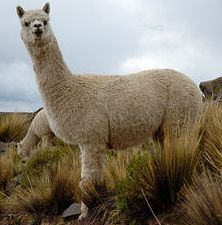
 Alpaca
fleece is the natural
fiber harvested from an
Alpaca
fleece is the natural
fiber harvested from an

The first European importations of alpaca fiber were into Spain. Spain transferred that fiber to Germany and France. Apparently alpaca yarn was spun in England for the first time about the year 1808 but the fiber was condemned as an unworkable material. In 1830 Benjamin Outram, of Greetland, near Halifax, appears to have reattempted spinning it, and again it was condemned. These two attempts failed due to the style of fabric into which the yarn was woven a type of camlet. It was not until the introduction of cotton warps into Bradford trade about 1836 that the true qualities of alpaca could be developed into fabric. It is not known where the cotton warp and mohair or alpaca weft plain-cloth came from, but it was this simple and ingenious structure which enabled Titus Salt, then a young Bradford manufacturer, to use alpaca successfully. Bradford is still the great spinning and manufacturing center for alpaca. Large quantities of yarns and cloths are exported annually to the European continent and the US, although the quantities vary with the fashions in vogue. The typical "alpaca-fabric" is a very characteristic "dress-fabric."
In recent years, interest in alpaca fiber clothing has surged, perhaps partly because alpaca ranching has a reasonably low impact on the environment. Outdoor sports enthusiasts recognize that its lighter weight and better warmth provides them more comfort in colder weather, so outfitters such as R.E.I. and others are beginning to stock more alpaca products. Occasionally, alpaca fiber is woven together with merino wool to attain even more softness and durability.
| The above article is licensed under the GNU Free Documentation License. From Wikipedia, the free encyclopedia (https://en.wikipedia.org/wiki/alpaca_fiber). Modified by Apparel Search August 31, 2008 |