Digital Fabric Printing Services
Services that print fabric for you — sample, short run, and production digital printing, custom design studios in New York and Los Angeles, coated fabrics for your own printer, and print-your-own fabric for independent designers.
When a Service Beats Owning a Machine
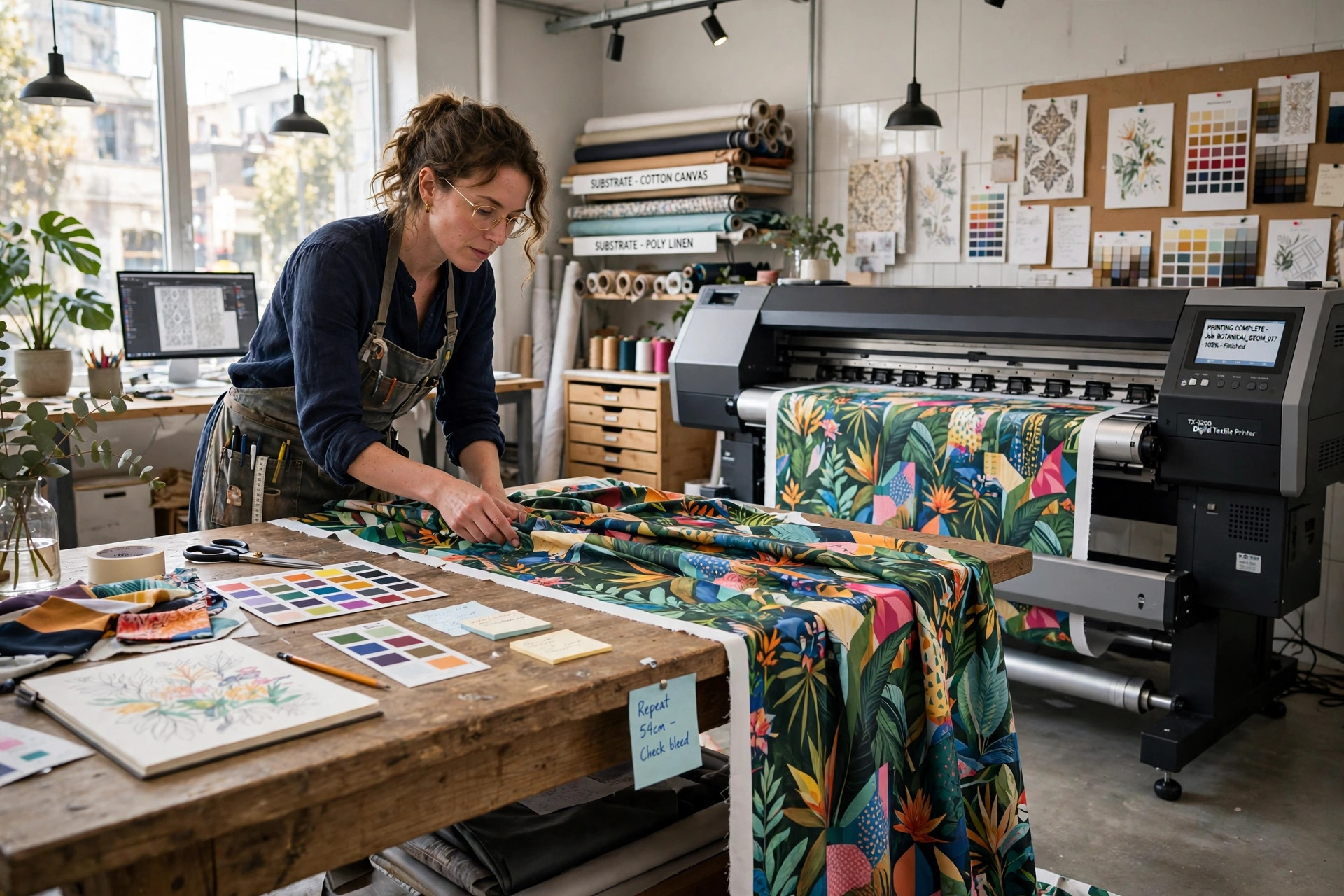
A printing service carries the machine, the inks, the fabric preparation, and the operator's learning curve, while you supply a design, a fabric choice, and a quantity. That division suits sampling, development, short runs, and any program whose volume does not yet justify equipment — and, as one listing here argues, it can suit production too when a commissioned mill has serious digital capacity. Digital suits short runs, development, and sample printing. Dream counts a short run as roughly 800 to 1,000 yards. Many domestic companies have also returned to production under their own control, without the expense and risk of much larger overseas runs. Whether your run is ten yards or a thousand, the questions are the same: files, fabrics, color, treatment, and honest expectations about variation.
The four services listed here serve four different customers. Dream is a commissioned printing mill for apparel and technical work. First2Print is a design-led studio for designers, merchandisers, artists, manufacturers, and consumers. Jacquard Inkjet Fabric Systems mainly equips and supplies people printing on their own wide-format machines, with treated fabrics and inks. Spoonflower lets individuals design, print, and sell their own fabric. Reading them as alternatives for the same job would miss the point; read them as a map of the service landscape, then approach the one whose customer you actually are, with the file and fabric preparation each one describes.
Dream and First2Print: Mill and Studio
Dream Fabric Printing Service provides sample, short run, and production fabric printing services, specializing in digital processes, unique technical applications, and product development services. Its facility housed two Reggiani Dream systems, among the most powerful digital printing systems in the world, making full production runs possible domestically. That positioning matters for brands weighing control against quantity: a commissioned mill prints your design on your program, under your direction, without requiring the minimums of a large overseas production run. Its technical applications and product development work also go beyond standard fashion yardage, where a service's engineering help is part of what you are buying.
First2Print is a large-format digital fabric printing studio supplying design and custom print services from offices in New York and Los Angeles, with New York as corporate headquarters handling order fulfillment for both locations. Its guidance on files is practical: designs can be created in almost any graphic software, with Photoshop and Illustrator most popular, and exported as TIFF files. File quality is integral to the result. Existing artwork or photographs can be scanned and manipulated into a textile design, usually as a seamless pattern repeated across the fabric for continuous yardage, or custom engineered to fit a product's cut-and-sewn pieces. It also warns that digital printing involves many variables — files and color management, printer and RIP technology, pre- and post-treatment, inks and dyes, and client expectations — so it is not an exact science and will show slight lot-to-lot variation. It calls its output digitally crafted custom fabric.
Jacquard and Spoonflower: Print Your Own, Your Way
Jacquard Inkjet Fabric Systems, sister company to Jacquard Products, was for over ten years a leading supplier of textiles treated for digital printing, inks, pigments, steamers, and related services. Its FabriSign and ProCoat premium custom coatings prepare textiles for wide-format digital printers without altering the feel of the fabrics, which remain soft, across bamboos, cottons, linens, nylons, polyesters, and silks. All of its fabrics were also available untreated for transfer printing on polyester with disperse dyes and for printing with Jacquard's pigmented textile inks for all fabrics — natural, blends, and synthetics — since pigmented textile colors do not require treated, coated fabric. For anyone running their own printer, that treated-versus-untreated choice, matched to ink type, is the central technical decision this listing teaches.
Spoonflower made the opposite offer: it runs large-format inkjet printers specially modified to run fabric, so you do not have to. Unlike conventional textile manufacturing, its description noted, digital printing entails very little waste of fabric, ink, water, or electricity, and Spoonflower printed using eco-friendly, water-based pigment inks on natural fiber textiles with no additional chemicals in printing or preparation, showing greater design detail than screen printing and allowing as many colors as a designer liked. All of its fabric was printed in Durham, North Carolina. Founded in May 2008 by two internet professionals after one founder's wife wanted to print her own fabric for curtains, it grew a community of over half a million individuals making curtains, quilts, clothes, bags, furniture, dolls, pillows, artwork, costumes, and banners, with a marketplace of independent fabric designers. It remains the clearest example here of digital printing creating a new kind of customer, not just a new kind of machine.
Digital Printing Services in This Directory
The listings below give each service's details in brief.
Dream Fabric Printing Service
Commissioned digital printing mill providing sample, short run (roughly 800-1,000 yards), and production fabric printing, specializing in digital processes, technical applications, and product development.
First2Print
Large-format digital fabric printing studio in New York and Los Angeles supplying design and custom print services to designers, merchandisers, artists, manufacturers, and consumers.
Jacquard Inkjet Fabric Systems
Supplier of textiles treated for digital printing, inks, pigments, and steamers, offering FabriSign and ProCoat coated fabrics in bamboo, cotton, linen, nylon, polyester, and silk, plus untreated fabrics.
Spoonflower
Print-your-own fabric service founded in May 2008 and printed in Durham, North Carolina, using water-based pigment inks on natural fiber textiles, with a marketplace of independent fabric designers.
Common Questions
What counts as a short run in digital fabric printing?
Dream Fabric Printing described a short run as more or less approximately 800 to 1,000 yards, with digital especially suited to short runs, development, and sample printing.
How should I prepare a design for a service like First2Print?
Create it in graphic software such as Photoshop or Illustrator and export a high-quality TIFF, usually as a seamless repeated pattern for yardage, or engineered to fit cut-and-sewn pieces. File quality is integral to the printed result.
Do fabrics for digital printing need to be coated?
It depends on the ink. Jacquard offered FabriSign and ProCoat coated fabrics for wide-format printing, while its pigmented textile inks could print on untreated fabric across natural fibers, blends, and synthetics.
More to Explore
References & Further Reading
Looking for Fabric Mills and Suppliers?
For machinery, supplies, and the wider fabric trade beyond these services, explore the main Fabric section on Apparel Search, and compare these services with the Fabric Search guide to digital fabric printers.