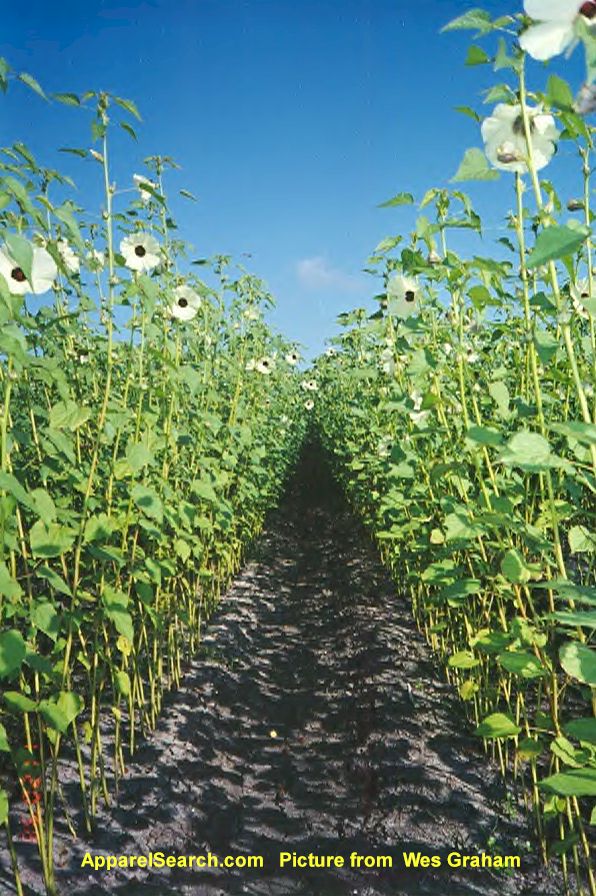
Click to enlarge
Harvesting Kenaf
Harvest is accomplished by utilizing a
forage harvester that cuts and "chops" the whole stalk, and then
blows the crop into a boll buggy that is positioned beside or the behind
the harvester. fiber length can be adjusted by adding or subtracting knives
from the cutting cylinder. The kenaf is then placed in a module. The
kenaf can be used as whole-stalk or transported to the separation facility,
where the bast and core are separated. Other harvesting techniques employ
cubing the kenaf. This is accomplished in the same manner, however the kenaf
is dumped into a hopper that feeds a field-side cuber. The cubes are then
transported to the processing facility.
Kenaf must be frost killed in Mississippi before harvest can occur.
This creates a problem because Mississippi does not receive a killing frost
until mid-December, normally. By this time the winter rains have set
in, making timely entry into the field nearly impossible. However,
research is being conducted at Miss. State to rectify this problem.
The Apparel Search Company wants to give special thanks to Wes Graham for providing wonderful information on Kenaf.