Silk Prices
Raw silk prices are tracked by government boards, statistical services and exchanges rather than posted on a single board. This page explains the pricing sources linked below and how to read them without mistaking historical data for a live quote.
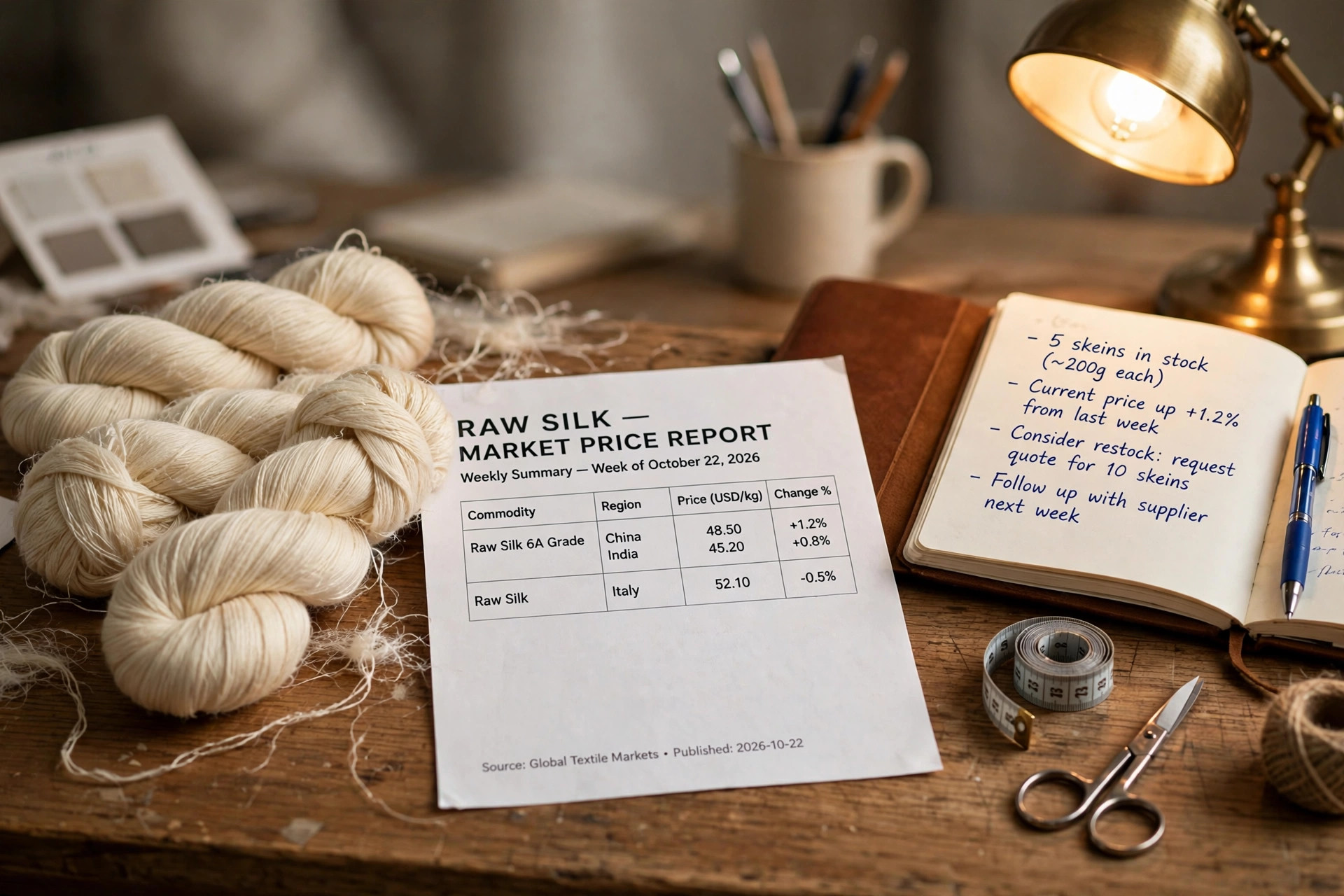
Where Silk Price Information Comes From
Unlike a metal or grain traded continuously on one world exchange, raw silk is priced through a patchwork of national markets, government statistics and specialist reporting, and this page brings those sources together. They include silk prices published by the Central Silk Board of India, part of the Indian Ministry of Textiles, Indian silk pricing statistics from Karnataka, the historic centre of Indian sericulture, marketplace price pages for raw silk and for silk from China, and exchange references from Tokyo and Shanghai. Each source answers a slightly different question, and using the right one matters.
Government and institutional statistics suit buyers who need a defensible reference price: what raw silk of a stated grade actually changed hands for in a major producing country, recorded by a body with no goods to sell. Marketplace price pages suit buyers who need to see what sellers are currently asking, with all the variation in grade, quantity and seriousness that open marketplaces contain. Exchange data, where it exists, serves a third purpose, showing how traders priced silk for future delivery at a point in time. A careful researcher notes which of the three they are reading before quoting any figure onward.
Exchange History and Why It Matters
Several of these sources are historical rather than current, and they are still worth using. The Tokyo Grain Exchange published silk prices and raw silk futures contracts, and its past data remains valuable for studying how silk prices behaved across seasons and economic cycles. A scholarly record of a national raw silk exchange likewise preserves how an earlier market organised silk trading. Historical series let a buyer or student see the range silk prices have occupied, how sharply they can move when a cocoon harvest fails or demand shifts, and why long-term silk contracts are usually written with adjustment mechanisms rather than fixed forever.
The caution that follows is simple: never present a historical exchange figure as a current price. Exchanges merge, contracts are delisted and statistical series are discontinued, and a page of past data can look deceptively like a live quotation. Check the date attached to any figure, check whether the publishing body still updates the series, and cross-reference at least two independent sources before using a number in a costing. The Shanghai Futures Exchange reference needs the same caution: an exchange shows how commodity pricing is organised, but its listing here is not a guarantee that a silk contract is trading today.
How Buyers Actually Use Silk Price Data
In practice, a garment manufacturer or fabric buyer uses silk price information as an early warning system rather than as a shopping list. Raw silk is the main cost inside silk yarn, and yarn is the main cost inside silk fabric, so a sustained rise in raw silk prices recorded by a producing country board will surface in fabric quotations within a season. Watching the trend, rather than any single figure, helps a buyer time bulk purchases, negotiate fabric contracts with an informed view of the mill position, and decide whether a quoted fabric increase is justified by the raw material market or is simply a margin exercise.
Students and researchers use the same sources differently, to document how a luxury natural fibre behaves as a commodity: seasonal, weather-dependent, concentrated in a few producing countries, and sensitive to fashion demand and to competition from synthetic substitutes. For either purpose, record your sources and dates. A silk price without a date, a grade and a place is not usable information, because silk grades differ widely in value and a price for one grade in one market cannot be transferred to another. Linking to the publishing bodies themselves, as the References below do, keeps the date, grade and market attached to each number.
Silk Prices in the Wider Textile Market
Silk does not price itself in isolation. It competes at one end with fine cotton, wool and linen for natural-fibre garment budgets, and at the other with polyester and lyocell imitations that copy its lustre at a fraction of its cost, so its price ceiling is set partly by substitutes and its floor by the labour-intensive reality of sericulture, where cocoons are reared, harvested and reeled largely by hand. When silk prices rise far above substitutes, demand leaks away; when they fall too far, low raw silk prices can threaten the survival of the producers themselves.
If you are researching beyond silk, the textile price links page in this section connects to pricing guides for cotton, wool, polyester, nylon and yarn generally, which makes comparison across fibres possible in one sitting. Use this page for the raw silk level, the silk yarn prices page for the intermediate product, and the silk fabric prices page for finished cloth. Reading the three levels together gives a far truer picture of the silk market than any single price could, and it is the picture professional buyers, who live with all three levels at once, actually work from.
Common Questions
Where can I find a reliable raw silk price?
Start with official statistics from a producing country, such as the Central Silk Board of India price pages linked in this section, and note the grade, market and date. Cross-check against a second source, because no single board or marketplace covers the whole world silk trade.
Are exchange silk prices current?
Not necessarily. Some exchange silk data linked from directories is historical, preserved after contracts stopped trading. Always check the date of the data and whether the series is still updated before treating a figure as current.
Why do silk prices change so much?
Silk supply depends on silkworm rearing and cocoon harvests in a small number of producing countries, so weather and harvest quality move supply, while fashion demand and the price of synthetic substitutes move demand. The combination produces larger swings than in more industrialised fibres.
More to Explore
References & Further Reading
Looking for Fabric Mills and Suppliers?
Compare silk with other fibres through the Apparel Search fabric directory or start from the Fabric Search hub.