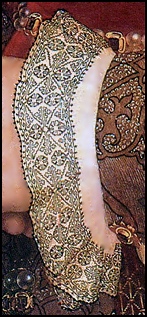
Although superficially similar to Back Stitch the Holbein stitch produces a smoother line and a pattern that is identical on both sides of the fabric. It can be worked in straight lines, diagonally, or in a stepped fashion to make a zigzag line and is well suited to creating outlines or intricate filling patterns.
Holbein stitch is also known as double running stitch, line stitch, Spanish stitch, Chiara stitch and two-sided line stitch.
Description of the technique
Holbein stitch is usually worked on on an even-weave fabric where the threads can be counted to ensure perfect regularity and is worked in two stages. Firstly, a row of evenly spaced running stitches is worked along the line to be covered. Then the return journey is completed, filling in the spaces between stitches made on the first journey and sharing the same holes:
Modern Holbein techniques
In recent years Holbein stitch has become fashionable again, along with modern blackwork and modern Assisi embroidery. Formality has given way to a more light-hearted approach, and motifs include cute cats and other cartoon-style animals. Classic map samplers and chessboard designs have also been updated, and the use of colors is much more imaginative and daring.
See also
References
- Eaton, Jan. Mary Thomas's Dictionary of Embroidery Stitches, Revised by Jan Eaton. London: Hodder&Stoughton, 1989. ISBN 0-340-51075-7