Head coverings during the 16th century ranged from the simple to the complex.
The simplest, which was worn throughout the 16th century and well into the
17th, was the "coif". The coif is, quite simply, a close-fitting
cap
made of a light
fabric, usually white or naturally-colored
linen (or
silk, for the nobility). It was worn for
reasons headwear has been worn for centuries--warmth, protection from the
elements, and to keep hair out of the face--but it's most important functions
during Elizabethan times were conferring respectability upon a woman, and,
for more skilled and affluent people, for decoration.
Womens' Coifs,
1500 to 1550
The coif, in one permutation or another, was one of the most common pieces
of headwear worn by women (and sometimes by men, as well) throughout the
16th century; it appears in many paintings of both nobility and the common
folk.
Actual examples of Tudor coifs, however, are hard to find. It is likely
that a coif or close-fitting cap of some sort was worn underneath the heavy
and concealing veils and english gable hoods of the 1520s and 30s and the
lighter french hoods that followed them, but all that would show of a coif
worn underneath a hood or veil would be the front edge. It is very difficult
and sometimes impossible to tell whether or not the ruffled border of a
gable or french hood is attached to the hood or is the edging of a coif
worn underneath. As almost all female portraits of the time show the woman
wearing a hood of some kind, there is far less iconographical evidence to
go on then exists during the latter half of the century.
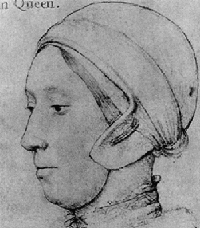
The only clear depictions of a Tudor coif appear in some sketches by
Hans Holbein drawn in the 1530s, one of Anne Boleyn herself. The front edge
is far back on the crown, with tabs on either side coming forward past the
jawline. The front edge is also wired with a heavy wire, presumably to keep
its shape and to help keep it on the head.
The line of the coif follows quite closely the line of the gable and
transitional hoods worn at the time, a good indication that this coif was
worn underneath a hood as well as by itself.
The coif seems to conform quite smoothly to the head, with no bump at
the crown to signify a bun; Anne's hair was either braided and crossed over
her head somehow, or was fastened at the base of her neck. There are no
gathers at the crown like those which appear in coifs of the late 1590s
and early 1600s. This coif appears to have been shaped with a vertical seam
running down the back center, rather than by gathers at the nape of the
neck.
A strip is wrapped around the coif and knotted at the base of the neck.
Its purpose is unknown; it could be helping to keep the coif more securely
on the head, or help support whatever hood was worn over the coif so that
it didn't slip back. Perhaps it was worn for warmth, or was simply a fashionable
decoration.
There is also another head covering worn under the coif, visible along
the front ed, which looks to be a band of fabric holding back hair. In addition,
two (metal?) clips are seen on either side of the coif. It looks like the
edge of the band wrapped around the coif has been slipped underneath one
these clips, perhaps to hold it in place. Aside from this, their purpose
is a mystery. One possible use for the clips could be to aid in keeping
an English hood on the head; straps sewn onto the underside of the cheekpieces
of the hood, when slipped underneath these clips, would keep the hood on
quite firmly (and invisibly.)
Another of Holbein's sketches portrays a woman wearing a more loosely-fitting
and enveloping coif. It has an wired front identical in shape to Anne Boleyn's,
but comes down farther along the brow and covers more of the cheek.
Coifs, 1570
As the century progressed, English and French
hoods became smaller and more dainty until
they hardly covered a woman's hair at all.
A young gentlewoman in the late 1560s, would
often wear a french hood-type headdress
placed daintily back on her head, allowing
her to show off the bouffant rolls at her
brow which were becoming more popular at
this time. She could choose to wear many
other items of headwear as well, among them
flat hats, tall hats, pillbox shaped hats,
veils, and a variety of other decorative "billiments"
perched atop a lady's coiffure. Although
respectable women still had their hair "covered",
albeit by nothing more than a small caul
and transparent veil, a woman's hair began
to be considered an asset to be displayed
rather than something to be hidden away
beneath a bulky hood. Queen Elizabeth's
pride in her red hair had something to do
with this; many women would frizz, bleach
and dye their hair to approximate the Queen's
curly red locks. As headwear became more
revealing, coifs became more and more visible--and
more and more popular as a fashionable item
of headwear, especially among the middle
classes and working women for whom the tall
hats, decorated caps and wired, transparent
veils worn by the gentry were not practical.
Unfortunately, few pictures were drawn or
painted of the English bourgeoisie or servants,
and so it is not until 1570 that we find
a portrait which shows a coif of this time
in detail.
A sketch of London Gentlewomen,
drawn in 1570 by Flemish artist Lucas de
Heere, is one of the best examples we have
of coifs worn during this decade. This picture
also illustrates the variety in coif styles
and headcoverings to be found in one place
and one moment in time.
Although forty years later than the coifs
sketched by Holbein, these do have some
similarities to the coif worn by Boleyn.
The front top rests far back on the crown,
while the sides curve far forward along
the jawbone. The fronts are obviously wired,
which must help them to stay on a lady's
head. The profile is much rounder than the
square shape of the Tudor
coifs shown
above, however; and there is another coif
or headpiece worn underneath the outer coif,
which comes quite far foward along the crown
of the head and then curves back in a sillhouette
quite similar to that of the late Elizabethan
coif. The backs of these coifs are not seen,
but one can postulate that it is shaped
by a seam running down the back of the head
and/or gathered at the base of the neck.
A sketch of London washerwomen created
at this time reveals coifs very similar
to that worn by the women in the back of
Heere's painting. These are close fitting
around the sides of the head with the top
far back towards the crown where it meets
a gathered circle sewn on the back. A band
of fabric, or under-cap of some kind, is
worn underneath this coif, similar to that
worn by the Englishwomen in de Heere's sketch.
Whether it is worn as protection for the
hair or to give the coif something to be
fastened too.
The coifs worn by these washerwomen are
somewhat similar to that worn by a vegetable
seller in a Flemish painting by Beuckelaer
dated to 1573. The woman in the picture
also wears a coif consisting of a gathered
circle at the back of her head, but it is
fastened to a narrow band rather than to
two sidepieces coming forward to the jaw,
like the London washerwomen were wearing,
or to a wired close-fitting coif two side
points, like the Englishwoman in de Heere's
sketch is wearing. This flemish coif is
seated far back on the woman's head; in
fact, I don't know how she kept the coif
on at all, unless the painter is indulging
in a bit of artistic license. You can use
a stretchy comb sewn to the inside of the
band to keep this kind of coif, which is
sometimes referred to as an "Italian
coif", secure and in place.
The two details from additional Flemish
paintings, to the right, show women wearing
something vaguely similar to the italian
coif above: a dark brown, slightly puffed
circle of fabric is on the back of the woman's
head, with a length of hair, wrapped with
a ribbon, wound around the base of the "coif"
to keep it in place. The second woman is
wearing something which, though hard to
make out, could also be a small, round coif
attached to a band. The bottom of the coif
looks rather flat, which suggests that it
is cut differently then the white one shown
in Beucklayer's painting.
Coifs, 1600
Today, there are far more extant samples
of early 17th century coifs than there are
16th century. Therefore, we have a greater
knowledge of the material, construction
and decoration used for these head-dresses
than we have for the coifs worn during King
Henry's time and Queen Elizabeth's earlier
reign. All of the coifs we have which date
from 1590-1620 are strikingly similar, almost
identical, in their makeup. They were rectangular,
with the fold of the fabric going around
the back of the head and the seam running
along the top of the head. The bottom of
the coif was gathered and tied at the back
of the neck, and the front edge came to
a point at the center forehead, curved back
coming down the side of the head, and curved
forward again near the jawline to a blunt,
rounded point. The excess material at the
crown of the head was gathered tightly together
and stitched down. The front edge was often
decorated with bobbin lace, fancy braid,
or other decorative elements. All of the
surviving coifs of this time are elaborately
decorated. This item of headwear was used
an excuse to show off a needleworker's talent;
many surviving coifs are completely embroidered,
often with
Blackwork Embroidery.The
front edge was often trimmed with bobbin
lace, braid, or some other decorative element;
if worn under another headdress, this front
edge was often the only part of the coif
that showed. This beautiful decoration may
have been one of the reasons that so many
beautiful specimiens of these coifs still
survive.
Discussion boards are a great place to
meet other members of the
fashion industry,
get advice, and share information. This forum was created
to discuss the topic of this page. If you have questions,
or information to improve this page, please join in the community
discussion below. Please keep the communication on topic and
for the purpose of education.