Overalls - Definition of an Overall from the Clothing Definitions Directory by Apparel Search
About Overalls Men's Overalls Women's Overalls Definition List Clothing Industry Glossary
An overall is a type of garment which is usually used as protective clothing when working. Some people call an overall a "pair of overalls" by analogy with "pair of trousers".
 History
The 1989 issue of the Oxford English Dictionary lists:
The word "overall" (as garment):
First in 1792 as "overalls" or "overall trousers" = "trousers worn outside the normal trousers to protect them" (from which the "bib-and-brace" use).
First in 1815 as "overall" = "any outermost coat or cloak", with a long list of examples, which do not show when "overall" began to mean "boilersuit".
The word "boilersuit" first on 28 October 1928 in the Sunday Express newspaper.
The first mention of boilersuits known here is in a special rule for manufacturing explosives, laid down in 1891: "Overall suits and head covering shall be supplied to all workers"
The one-piece work overall arrived in 1891-1916, in tough cotton or in linen, to fit over a shirt or vest and trousers. (The cloth cap began to spread through the working class, and some women wore them too.)
In the beginning of the 20th century, coveralls came in as protective garments for mechanics in the USA.
- Learn about the difference between overalls and coveralls.
Women wore overalls in factories in England during the First World War in 1916.
Rules were implemented in match factories: "Suitable overalls are required for all workers employed in the phosphorus process, except for people who only put the matches in boxes".
During the Spanish Civil War, the Communist soldiers used boilersuits as their uniform. Early aeronauts also wore specially designed one-piece suits.
In the 1930s, overalls were used as comfortable children's clothes.
After W.W.II, many athletes also utilised the advantages of overalls.
Overalls have sometimes been items of fashion, in the 1960s and 1970s. By analogy with protective clothing, technical students started wearing overalls to specific events in Sweden and later in Finland, and later the practice spread to all students.
Consequently the fashion world began to sell one-piece overalls as high-quality leisure wear. Ski-overalls were and still are especially popular.
Several years ago there was a time when boiler suits were very fashionable, especially jeans-type coveralls.
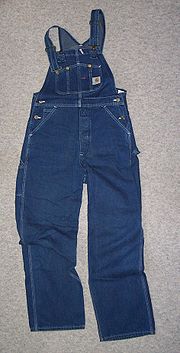
These are trousers with an attached front patch covering the chest and with attached galluses or suspenders (also called braces in England) which go over the shoulders. Often people use the word "overall" for the bib type garment only and not for a boilersuit. In the U.S, boilersuits are also called "coveralls" to distinguish them from the bib-type overall.
Bib overalls are usually made of blue denim and often have riveted pockets, similar to those on blue jeans. Bib overalls have long been associated with rural men and boys in the U.S. South and Midwest, especially farmers and railroad workers. They are often worn with plaid flannel shirts, long johns or a red union suit underneath, or with a T-shirt or no shirt at all in warmer weather. These workers seldom wear neckties because of the inherent safety risk it would bring. All over America in modern times, painters, farmers, certain factory workers, some train locomotive engineers, carpenters and other tradesmen or workmen often wear overalls as protective overgarments. Cowboys (beef ranchers) are not typically known to wear such garments in their customary garb. Since the 1960s, different colors and patterns of bib overalls have been increasingly worn by young people of both sexes, often with one of the straps worn loose or unfastened along the side and under the arm. The bib overalls fashion trend among American youth culture peaked in the latter half of the 1970's.
Overalls became clearly work clothes and were reserved for this purpose for a long time.
Etymology of "dungaree"
The term "dungaree" was associated with a coarse undyed calico fabric that was produced and sold in a region near Dongari Killa (also called Fort George) in Bombay (now Mumbai) in India. The cloth was cheap and often poorly woven. As such, it was used by the poorer classes for clothing and by various navies as a sail cloth. Sailors often re-used old sails to make clothes. In time, the name of the cloth came to also mean an item of clothing made out of it.
In British English such a bib type overalls are usually called a pair of dungarees.
In the U.S., carpenter jeans are often referred to as dungarees.
Military overall
In the British Army, male Officers' mess dress in most regiments includes a pair of very tight wool trousers which extend above the waist and are worn with braces. The first use of overalls as part of a military uniform was by the Americans. In fact, the earliest written reference to "overalls" in the English language dates to 1776 in the uniform regulations of various American militia units organized to fight in the American Revolution. Overalls were also used by loyalist units, as well as by patriots. As with the gaiters they replaced, military overalls of the Revolutionary War were very tight in the leg, and while some styles retained the full buttoned sides, most relegated the buttons to the distance from mid-calf to the hem. The gaiter style foot covering was retained, as the first military overalls were intended for infantry soldiers. Early regulations and military records show that overalls were strictly a protective layer of clothing for the breeches and stockings for the first couple of years of war. However, the 1778 uniform regulations for the Continental regulars specifically state that overalls, made of linen for summer and wool for winter, will be issued as a replacement for breeches. This is the first purposely non-protective use of overalls in place of breeches as a regular piece of clothing. Specialist battledress was developed primarily during the Second World War, including the Denison smock - originally for parachutists but also adopted by snipers. Specialized jump clothing was perpetuated by the Canadian Airborne Regiment who wore distinctive disruptive-pattern jump smocks from 1975 until disbandment in 1995.
Special patterns of AFV uniform were also worn beginning in the Second World War, initially black coveralls, later khaki coveralls as well as the padded "Pixie suit". Olive drab tanker's uniforms were adopted with the Combat uniform in the 1960s, including a distinctive padded jacket with angled front zip.
The Canadian Army has made extensive use of plain coveralls as a field uniform, commonly using khaki coveralls in the Second World War to save wear and tear on wool Battledress. In the 1950s and 1960, the cash-poor Canadian military adopted black coveralls which were often worn as combat dress, replacing them in the 1970s with rifle green coveralls. These were worn in the field in Canada by units in training but are also evident in photos of men deployed to West Germany during the Cold War, as armoured and mechanized units sometimes preferred to wear coveralls when carrying out maintenance.
Shortalls
Shortalls are a type of overalls in which the legs of the garment resemble those of shorts. The word is a contraction of these two words. They are often worn during the summer and had their latest popularity peak in the mid 1990s. Today popularity is increasing again for shortalls. Also seen now are skirtalls which are like shortalls except that the bottom of the garment resembles a skirt.
Shortalls designed for toddlers often have crotch and leg snaps to facilitate diaper changes.
Sometimes it could be capri overalls which are a type of overalls whose legs are like the legs of capri pants.
Boilersuit
This is sometimes called a coverall. In American English, it is nearly always referred to as "coveralls". It is a one-piece garment with full-length sleeves and legs like a jumpsuit, but usually less tight-fitting. Its main feature is that it has no gap between jacket and trousers or between lapels, and no loose jacket tails. It often has a long thin pocket down the outside of the right thigh to hold long tools. It usually has a front fastening extending the whole length of the front of the body up to the throat, with no lapels. It may be fastened with buttons, a zipper, velcro, or snap fasteners. Boilersuits with an attached hood are available. The word "boilersuit" may also refer to disposable garments such as Dupont's Tyvek suits.
Boilersuits are so called because they were first worn by men maintaining coal-fired boilers. To check for steam leaks or to clean accumulated soot from inside the firebox of a steam locomotive, someone had to climb inside, through the firehole (where the coal is shovelled in). A one-piece suit avoids the potential problem of loosened soot entering the lower half of his clothing through the gap in the middle. As the firehole opening is only just large enough for a fit individual to negotiate, a one-piece suit also avoids the problem of the waistband snagging on the firehole as he bends to wriggle through, or of jacket tails snagging if he has to come out backwards.
Uses of boilersuits
Coveralls are most often worn as protective clothing over "street" clothes at work. They are sometimes also worn directly over underclothes (shirt and boxers/briefs).
Coveralls called student overalls are used by university students in some Nordic countries as a sort of party-uniform, with insignia on the back and color varying with program and university. It is also practice to customize the coverall in a variety of ways, including adding a large number of patches, and exchanging parts of the suit with other students.
The French police unit called CRS use boilersuits as uniforms.
A dark blue coverall is the current working uniform of the U.S. Navy, with the owner's name and "U.S. Navy" on the chest, and rank insignia on the collar points. In the US Navy submarine force, these are called "poopie suits".
Similar coveralls in olive drab (and more recently, desert tan) are also used by the crews of armored fighting vehicles in the US Army and Marine Corps, where the men and also their overalls are sometimes called "CVCs", an abbreviation of "Combat Vehicle Crewman".
Dr. Thomas Blasingame (a petroleum engineering professor at Texas A&M University) is notorious for wearing an overall on every occasion from daily wear to official events.
In car racing and drag racing, boilersuits normally made of a fireproof material such as Nomex or wool are used.
Chad Smith, drummer for the Red Hot Chili Peppers, commonly wears boilersuits during concerts.
All members of the heavy metal band Slipknot wear numbered boiler suits along with unique masks.
Fictional serial killer Michael Myers of the Halloween series of movies is almost always depicted wearing a boilersuit.
References
-
Diana de Marly, Working Dress', London, 1986, p. 144.
-
Diana de Marly, Working Dress, London, 1986, p. 162.
-
Naval Customs, Traditions, and Etiquette
-
18th Century History of Mumbai: Mumbai/bombay pages
|
Discussion boards are a great place to meet other members of the fashion industry, get advice, and share information. This forum was created to discuss the topic of this page. If you have questions, or information to improve this page, please join in the community discussion below. Please keep the communication on topic and for the purpose of education. |
|
|
|
|
