The word
crochet is derived from
the Middle French word
croc or
croche,
meaning
hook. It describes the process of creating
fabric from a length of cord, yarn, or thread with a hooked
tool. The origin of the crochet technique is a subject of
considerable controversy. The word is not to be confused
with "crotchet", otherwise known as a
quarter note.
Definition
Crocheted fabric in the modern sense is begun by placing
a loop on the hook, pulling another loop through the first
loop, and so on to create a chain. The chain is either turned
and worked in rows, or joined end-to-end and worked in rounds.
Stitches are made by pulling one or more loops through each
loop of the chain. This method distinguishes crochet from
other methods of fabric-making as it is composed entirely
of loops and is only secured when the free end of the strand
is pulled through the final loop
Origins
Some theorize that crochet evolved from traditional practices
in Arabia, South America, or China, but there is no decisive
evidence of the craft being performed before its popularity
in Europe during the 1800s. Many find it likely that crochet
was in fact used by early cultures but that a bent forefinger
was used in place of a fashioned hook; therefore, there
were no artifacts left behind to attest to the practice.
These writers point to the "simplicity" of the
technique and claim that it "must" have been early.
Other writers point out that woven, knit and knotted
textiles survive from very early periods, but that there
are no surviving samples of crocheted fabric in any ethnologic
collection, or archeological source prior to 1800. These
writers point to the tambour hooks used in tambour embroidery
in France in the seventeenth century, and contend that the
hooking of loops through fine fabric in tambour work evolved
into "crochet in the air." Most samples of early
work claimed to be crochet turn out to actually be samples
of
naalebinding.
Beginning in the 1800s in Europe, crochet
began to be used as a less costly substitute
for lace. It required minimal equipment
and supplies, all easily accessible to all
classes. At this time, thread spun from
natural fibers was used without dyeing,
and worked with handmade hooks of ivory,
brass, or hardwood. Those that survive to
this day are often ornately carved or inlaid
with mother-of-pearl.
Early history
Around the world, crochet became a thriving
cottage industry, supporting communities
whose traditional livelihoods had been displaced
by imperialism. The finished items were
purchased mainly by the emerging middle
class. The introduction of crochet as an
imitation of a status symbol, rather than
a unique craft in its own right, had stigmatized
the practice as common. Those who could
afford true lace disdained crochet as a
cheap copy. This impression was partially
mitigated by Queen Victoria, who conspicuously
purchased Irish-made crochet lace and even
learned to crochet herself. Irish crochet
lace was boosted by Mlle. Riego de la Branchardiere
around 1845 who published patterns and instructions
for reproducing bobbin and needle lace via
crochet.
From 1800 to 1950, crochet was done almost
exclusively in thread. Crochet in the round
or filet crochet, worked in rows of 'open'
or 'closed' mesh to create patterns, were
most common. Mass-produced steel hooks were
used to work the thread beginning in about
1900.

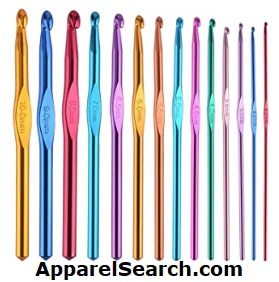 The following types of crochet are derived
from the basic method:
The following types of crochet are derived
from the basic method: