Smiley Face Jewelry
The happiest motif in jewelry, in enamel and metal
Smiley face jewelry is built on the classic smiley: the round yellow face with two dot eyes and an upturned smile, a pop culture symbol of happiness that has been reproduced on jewelry since the 1970s. Smiley faces appear as enamel pendants and charms, earrings, bracelets, rings and pins, in novelty plastic and plated versions, in sterling silver and gold, and in modern fine versions with diamond or colored stone details. This guide covers the smiley as a design and cultural symbol, the main jewelry styles and variations, including winking and colored smileys, and wearing smiley jewelry for fun, gifts and retro fashion.
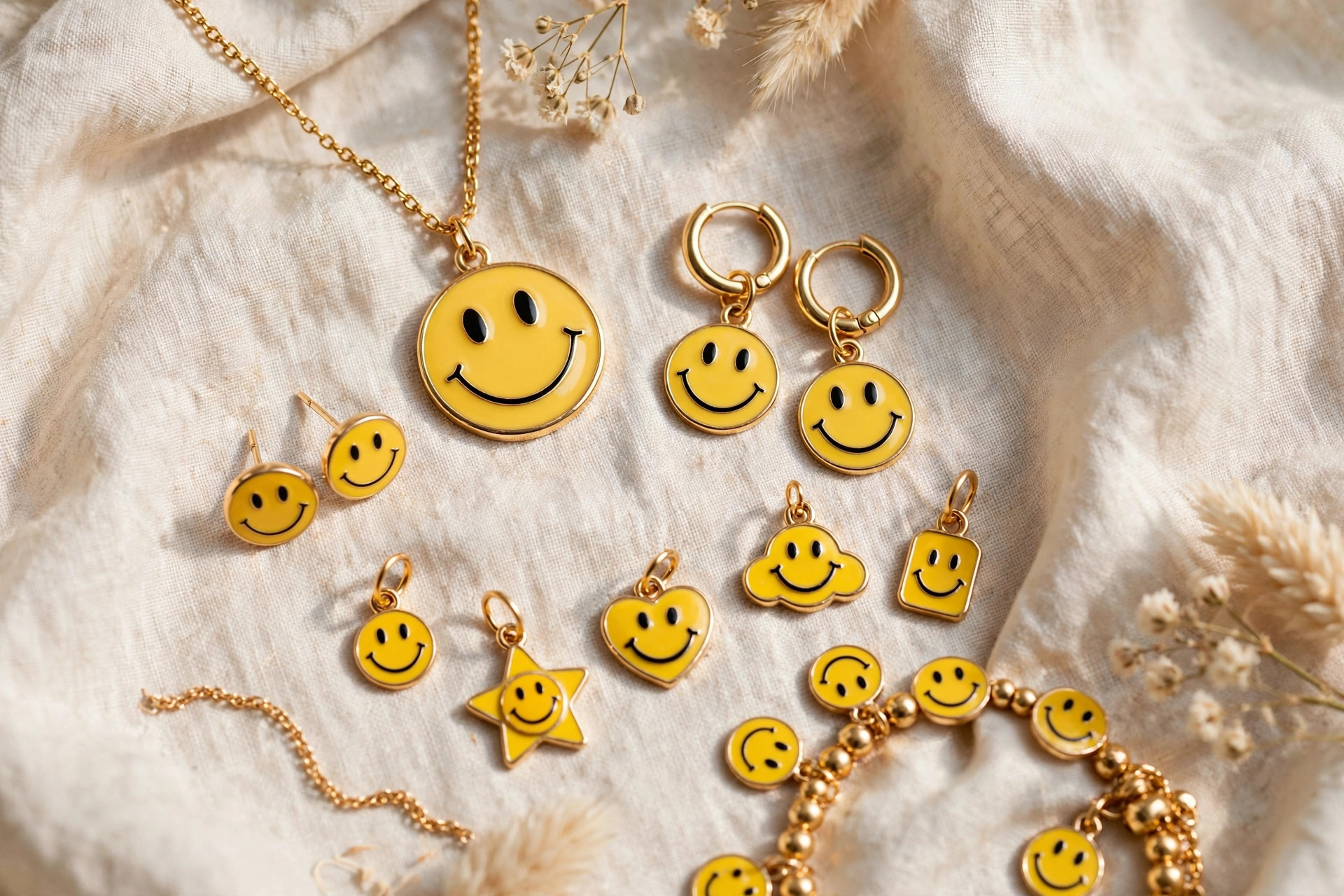
A smiley face is a simple and universally recognized symbol that represents happiness, joy, positivity, and a friendly disposition. It typically consists of a round yellow face with two black dots for eyes and a curved black line forming a smile. The smiley face has become an iconic and easily identifiable symbol in popular culture, often used to convey feelings of contentment and friendliness.
In the context of jewelry, the smiley face can carry various meanings and relevance:
Expression of Positivity: Smileys in jewelry can be worn to express a positive outlook on life. They serve as a reminder to smile, be happy, and spread joy to those around you.
Youthful and Playful Aesthetics: The smiley face is often associated with a youthful and playful vibe. Jewelry featuring smiley faces can be trendy and appeal to a younger audience, adding a lighthearted touch to their style.
Nostalgia: For some, smiley face jewelry may evoke feelings of nostalgia, harkening back to the 1960s and 1970s when the smiley face became an iconic symbol of the counterculture and peace movements.
Communication of Emotion: Smileys in jewelry can serve as a non-verbal way to communicate emotions. For example, giving a smiley face necklace or charm as a gift can convey feelings of happiness and affection.
Unity and Friendship: The universal recognition of the smiley face makes it a symbol of unity and friendship. It can be a shared symbol among friends or within a community to signify a bond based on positivity and joy.
Customization and Personalization: Some jewelry pieces allow for the customization of smiley face designs, enabling wearers to choose colors or add embellishments that reflect their unique style and personality.
Fashion and Pop Culture Trends: The smiley face has made periodic comebacks in fashion and pop culture, making it a relevant choice for those who want to stay current with trends.
Mood Jewelry: Some jewelry incorporates smiley faces that change expressions based on temperature or mood, adding an interactive and fun element to the jewelry.
In recent years, smiley face jewelry has seen a resurgence in popularity, especially in the fashion world, where it is embraced for its cheerful and optimistic symbolism. Whether worn as a pendant, earrings, ring, or bracelet, smiley face jewelry allows individuals to carry a piece of positivity with them and share their joy with others through their personal style choices.
Wearing smiley face jewelry can have a positive psychological effect on the wearer, potentially contributing to feelings of happiness and positivity. However, the extent of this effect varies from person to person and depends on several factors:
Personal Association: If the wearer has a personal association with smiley face symbols as a source of happiness or positivity, wearing such jewelry may serve as a reminder of those positive feelings. For example, someone who associates smiley faces with childhood memories of joy and playfulness may experience a boost in mood when wearing smiley face jewelry.
Psychological Priming: The concept of psychological priming suggests that external cues, like smiley faces, can influence a person's mood and behavior. Seeing smiley faces regularly can potentially prime the mind for positive thoughts and emotions, which can indirectly contribute to a happier mood.
Individual Differences: People have different emotional responses to symbols and imagery. While some individuals may find smiley face jewelry uplifting and mood-enhancing, others might not experience the same emotional impact.
Intent and Belief: The wearer's intent and belief also play a role. If the wearer consciously chooses smiley face jewelry with the belief that it will bring positivity and happiness, the placebo effect might contribute to an actual improvement in mood.
As for whether seeing smiley face jewelry makes people happy, it can certainly have a positive effect in certain situations:
Social Interaction: When others see someone wearing smiley face jewelry, it can convey a friendly and approachable demeanor, potentially leading to more positive social interactions. Smiley face jewelry may encourage smiles and conversations, which can create a more positive atmosphere.
Positive Associations: For some individuals, the sight of smiley face jewelry may trigger positive associations and memories, leading to a brief uplift in mood.
Subtle Reminder: Seeing smiley faces in jewelry can serve as a subtle reminder to maintain a positive and cheerful attitude, which can influence one's mood, even if only momentarily.
Ultimately, the impact of smiley face jewelry on the wearer and those who see it is subjective and context-dependent. While it may not guarantee lasting happiness, it can contribute to a more positive and friendly atmosphere, which, in turn, may lead to happier interactions and experiences.
Check out more trendy jewelry designs.
A Motif That Is Pure Mood
Most motifs in this design section carry layers of history or faith; the smiley carries one simple message and delivers it instantly, which is its design genius and its limit. It cannot be made solemn, and it does not try. Jewelry versions succeed by leaning into that simplicity: the face must be drawn exactly, since a few millimeters of smile curvature separate the classic smiley from a generic happy face, and the yellow must be the right saturated yellow in enamel.
The smiley also marks fashion's cycles more honestly than most motifs: each revival, seventies novelty, eighties rave, modern retro, brings the same face back in the materials of the moment. Pieces from the better end of each wave, solid silver and gold smileys especially, become small period collectibles, a reminder that even the lightest design in this section is still jewelry, and benefits from being made like it.
Common Questions
Where does the smiley face design come from?
The classic smiley, a yellow circle with two oval eyes and a smiling arc, was created in 1963 by graphic artist Harvey Ball for an insurance company's morale campaign, and became a mass pop symbol in the 1970s. It has since cycled through fashion repeatedly, including acid house culture in the 1980s and modern retro revivals, carrying jewelry with it each time.
What forms does smiley jewelry take?
Enamel pendants and charms are the classic form, with the face in its trademark yellow. Earrings pair two smileys or use a single statement face, bracelets string small smiley beads and charms, and fine versions render the face in polished gold with the features engraved, enameled or set with tiny stones. Color variants, winking faces and heart-eyed faces extend the family.
Who wears smiley face jewelry?
Smiley jewelry is bought for its mood: cheerful novelty pieces for children and parties, retro pieces for wearers who remember its earlier waves, and understated gold smileys as a small daily optimism symbol. As a gift it is a straightforward good-cheer and get-well gesture.