Paris, France Fashion Shopping Streets
Department store grandeur on Boulevard Haussmann, flagship luxury on Saint-Honore, boutiques in the Marais
Paris is the fashion capital the other capitals measure themselves against, and its shopping is organized by street and by quarter, each with a distinct personality. The Faubourg Saint-Honore is the pulse of Paris design; Boulevard Haussmann holds the great department stores; Avenue Montaigne gathers the couture houses; Les Halles and the rue de Rivoli serve the chains and the young designers; Saint-Germain-des-Pres mixes chic boutiques with literary cafe history; and the Marais is the quarter of independent labels, vintage and jewelry.
The good news for visitors is that the districts cluster. Saint-Honore, Haussmann and Montaigne form a rough triangle in the 8th and 9th arrondissements that a determined walker can cover in a day, with Les Halles and the Marais just to the east and Saint-Germain a bridge crossing away. This guide walks each district in turn, with the landmarks and house numbers that make Paris shopping feel like a treasure hunt with very good signage.
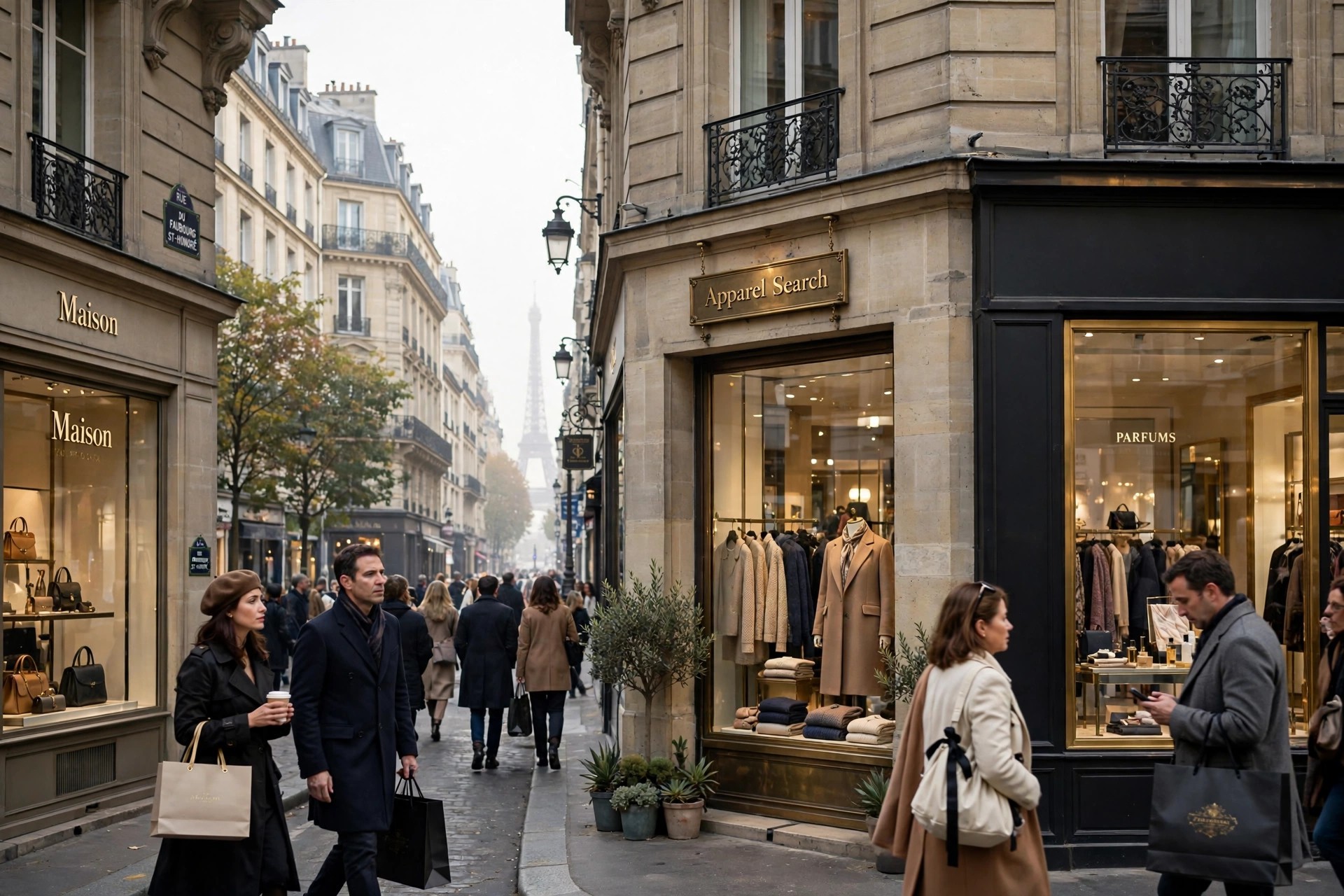
Boulevard Haussmann and the Department Stores
Boulevard Haussmann is one of the wide, tree-lined boulevards created in Paris during the Second Empire by Baron Haussmann, with the enthusiastic support of Napoleon III. It is mostly lined with apartment blocks whose regulated cornice height gives the boulevard its pleasing eye line, and at number 158 stands the Musee Jacquemart-Andre. The stretch between the Chaussee d'Antin and Havre-Caumartin metro stations, behind the Opera Garnier in the 9th arrondissement, is where the famous department stores stand: Printemps and Galeries Lafayette.
Paris department stores are famous for being worlds unto themselves. Galeries Lafayette and Printemps dominate Boulevard Haussmann with real Belle Epoque grandeur, concentrating top designer collections for men and women, gourmet food shopping, home design, jewelry and even hardware into a labyrinth of consumer delights - each floor has a theme, from cosmetics to fashion to home accessories. Around them you will also find plenty of other shops, such as C&A, H&M, Zara, Benetton and Uniqlo. Marks & Spencer, the British department store chain, opened a store on Boulevard Haussmann in 1975 with its first overseas stores.
Rue du Faubourg Saint-Honore and Avenue Montaigne
The rue du Faubourg Saint-Honore, the extension of the rue Saint-Honore westward from the northern edge of the Louvre, is cited as one of the most fashionable streets in the world: relatively narrow and nondescript next to the nearby Champs-Elysees, yet dedicated throughout its length to high-fashion stores and exclusive establishments, with virtually every major global fashion house present. The district is occupied by classic designers such as Versace, Hermes and Yves Saint Laurent alongside resolutely trendy concept shops. Addresses tell the story: number 14, the atelier and boutique of couturier Dominique Sirop, established in 1996 and at this location from 2000; number 19, where perfumier Jean-Francois Houbigant established his shop in 1775; number 22, the flagship of Lanvin, founded by Jeanne Lanvin in 1889; number 24, the flagship of Hermes, founded in 1837 and at this address since 1880; and number 29, the institute and headquarters of Lancome, established in 1935.
Avenue Montaigne and the Avenue des Champs-Elysees form one of the city's hottest fashion junctures. Many would say Montaigne is fast outstripping Saint-Honore in notoriety, with legendary designers such as Chanel and Dior lining the street, while the Champs-Elysees features luxury names including Louis Vuitton alongside a major run of trendy global chains such as Zara. Pair the two districts in a single walk: flagship gravity on Montaigne, spectacle on the Champs-Elysees.
Les Halles, Saint-Germain and the Marais
Les Halles and the rue de Rivoli are where Paris shops its chains and trendy boutiques: the main streets include the rue de Rivoli, rue Pierre-Lescot, rue Etienne Marcel and rue de Turbigo. Once the locus of 'the guts of Paris', an enormous outdoor food market, the area around Chatelet-Les Halles was transformed into a major shopping area in the 20th century, with the underground Forum des Halles mall where global chain stores reign - while in the rue Montorgueil area, quirky contemporary boutiques abound, including Barbara Bui and several young, cutting-edge designers.
Across the Seine, Saint-Germain-des-Pres - its main streets the Boulevard Saint-Germain, rue Saint Andre-des-Arts and rue de Sevres - was once synonymous with the intellectuals of its cafes and has since acquired several levels of chic; BCBG, Sonia Rykiel and Paco Rabanne keep boutiques here, along with the famous department store Le Bon Marche. Le Marais, the historic aristocratic district across the river to the east, has remade itself many times and is now prime territory for unique and finely crafted items: antiques and fine art around the Place des Vosges, jewelry at boutiques on the rue des Francs-Bourgeois, and up-and-coming designers on the rue des Rosiers.
Common Questions
What is the most fashionable street in Paris?
The rue du Faubourg Saint-Honore is cited as one of the most fashionable streets in the world, home to virtually every major fashion house - including the Hermes flagship at number 24, there since 1880, and the Lanvin flagship at number 22. Avenue Montaigne, lined with houses such as Chanel and Dior, rivals it.
Which Paris department stores should I visit?
Galeries Lafayette and Printemps, side by side on Boulevard Haussmann behind the Opera Garnier, are the famous pair - Belle Epoque buildings holding designer collections, gourmet food halls and home design. Le Bon Marche, in Saint-Germain-des-Pres on the Left Bank, is the elegant third name.
Where are the independent boutiques in Paris?
Le Marais is the quarter for independent and up-and-coming designers, vintage and jewelry, around the rue des Francs-Bourgeois and rue des Rosiers. The streets around Les Halles and rue Montorgueil hold quirky contemporary boutiques and young designers, and Saint-Germain-des-Pres mixes chic boutiques with its cafe heritage.
Photos


