Nonwoven Fabric Mills
Nonwoven producers run lines, not looms: they extrude, lay, punch and bond fiber webs into engineered fabrics for hygiene, medical, industrial and technical markets. This page profiles how those mills work and what buyers should verify.
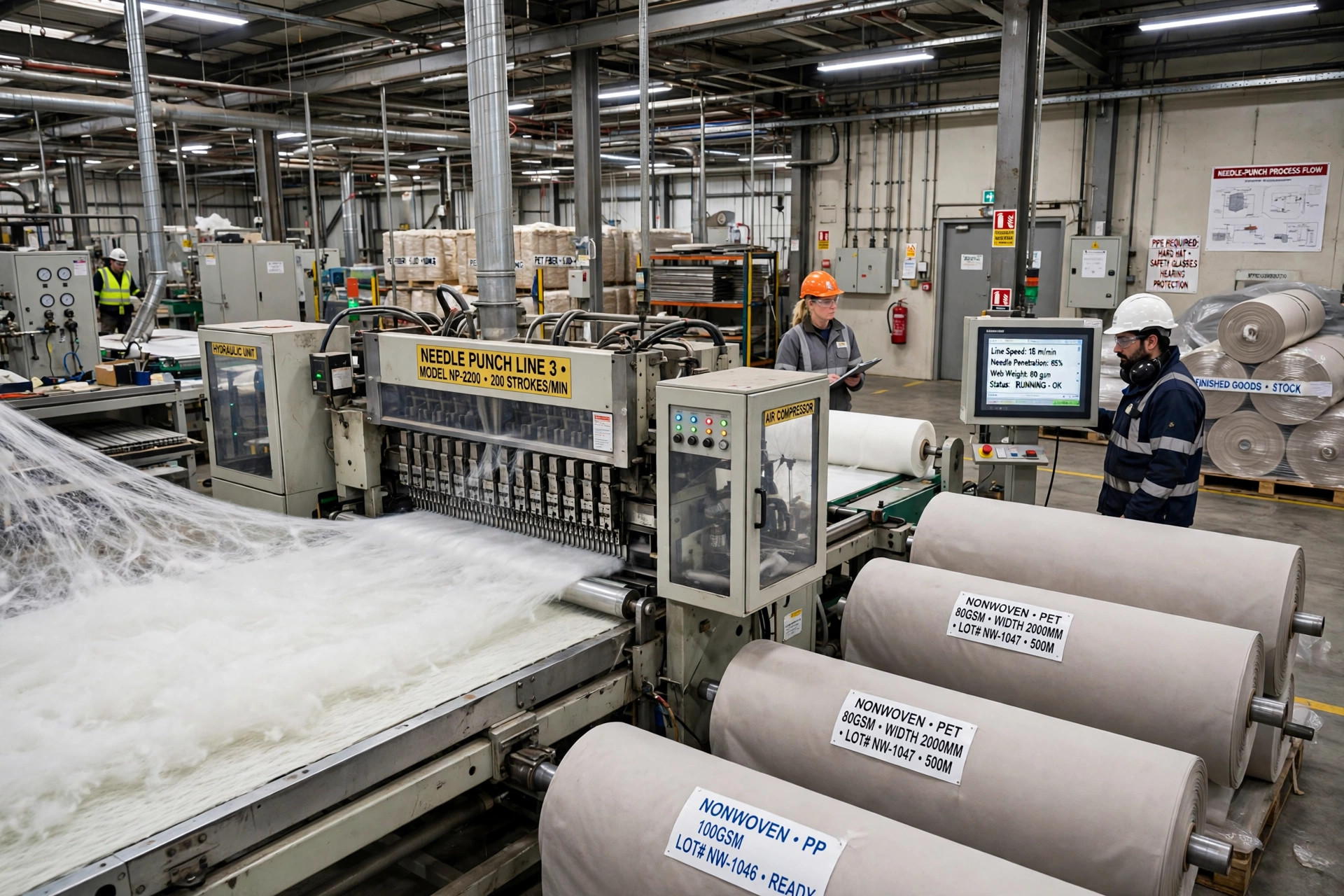
What a Nonwoven Mill Actually Runs
Calling a nonwoven producer a mill is convenient shorthand, but its plant looks nothing like a weaving mill. A spunbond line extrudes molten polypropylene through spinnerets, draws the filaments, lays them as a continuous web on a moving belt and bonds them, converting thermoplastic raw material into finished fabric in one continuous process. A needle-punch plant instead opens bales of staple synthetic fiber, cards them into a web, and drives barbed needles through it repeatedly until the fibers entangle into a dense, felt-like fabric.
Most sizeable producers are vertically integrated across several of these steps and often across several technologies. One company in the listings below describes itself as a vertically integrated producer of engineered nonwoven fabrics and specialty synthetic fibers and a large needle-punch-based manufacturer, while another specializes in thermal-bonded and mechanically entangled webs. That breadth matters to buyers, because the same end use — an automotive carpet, a wipe, a medical wrap — can often be served by more than one technology at different price and performance points.
The Markets Producers Serve
Large global producers concentrate on hygiene, wipes, medical and industrial markets, where volumes are high and specifications are exacting. Engineered-materials companies in this sector employ thousands of people worldwide supplying nonwovens that must handle fluids predictably, stay soft against skin, or act as sterile barriers. Their product development is application engineering: adjusting fiber blends, web density, thickness and bonding until permeability, absorption or insulation hits the customer's target.
Specialist producers serve narrower technical niches. Metallized and plated textiles, for example, turn nonwoven and woven substrates into electrically conductive fabrics used in EMI gaskets, conductive tapes, shielding cable wrap, RF-shielded tents and pouches, grounding planes, resistance heating, antimicrobial wound care and scent-control garments — products sold in dozens of countries and, in the listed company's case, through government supply listings. Other specialists focus on a single process, such as high-quality spunbond, and compete on consistency of the web rather than breadth of range.
How Buyers Should Qualify a Producer
Qualify a nonwoven producer against your specification, not its brochure. Ask which web-forming and bonding technologies the plant runs in-house, what basis-weight range each line holds comfortably, and what measurement controls govern web density, thickness accuracy, blending and polymer consistency — the quality aspects producers themselves emphasize. Request production samples from the actual line that would run your order, and test them for the properties your application depends on, from tensile strength and elongation to permeability and absorption.
Commercial diligence matters equally. Confirm minimum run quantities per specification, how changeovers between weights or fiber blends are scheduled, whether the producer will hold safety stock, and what happens when a lot misses specification. Because nonwoven lines are capital-intensive and run continuously, producers plan capacity carefully; a buyer who forecasts honestly and consolidates specifications will usually get better pricing and priority than one who orders many small, dissimilar lots.
The Producers Listed Below
The company listings below span the sector's range: needle-punch and specialty fiber production, a global hygiene and medical nonwovens group, conductive plated textiles, spunbond manufacture, and a thermal-bonding specialist within a large international group operating across many countries and sites. Use them as starting points, and verify current capabilities on each company's own site before issuing a specification, because product lines and plant footprints change.
Marketplace directories that aggregate hundreds of nonwoven suppliers appear in the References below rather than as company listings, since they are portals rather than producers. If you know of additional nonwoven producers that should be listed here, please let us know. When researching mills that produce fabric of any kind, you may also want to visit the fabric mills directory on Apparel Search.
Nonwoven Fabric Mills Listed Here
Five producers are listed below, each with a short description of what it makes. Portal directories appear in References, not as listings.
Foss Manufacturing Company
Vertically integrated producer of engineered nonwoven fabrics and specialty synthetic fibers, one of the largest needle-punch based manufacturers and a pioneer in using synthetic fibers in new applications.
Polymer Group Inc
Global engineered materials company focused primarily on nonwovens for the hygiene, wipes, medical and industrial markets, which has employed more than 3,000 people worldwide.
Shieldex-U.S.
Manufacturer and developer of plated, electrically conductive textiles and yarns based in Palmyra, NY, selling Statex products across the Americas since 1997 into shielding, EMI, heating and antimicrobial applications.
Surya Textech
Manufacturer of spunbond nonwoven fabric, converting polypropylene through a continuous process into a web of continuous filament for a diverse range of products.
Vita Nonwovens
Part of the Vita Group, producing engineered nonwovens using thermal bonded and mechanically entangled technologies, with detailed controls over web density, thickness, permeability, absorption and insulation.
Common Questions
Do nonwoven mills use looms?
No. Nonwoven producers form a web directly from fibers or extruded filaments and bond it thermally, chemically or mechanically — for example by needlepunching — without weaving yarns on a loom.
Which nonwoven markets do large producers serve?
Primarily hygiene, wipes, medical and industrial markets, where high volumes and exact specifications for fluid handling, barrier performance and softness are required.
What should I ask a nonwoven producer before ordering?
Which forming and bonding technologies it runs in-house, its comfortable basis-weight range, its controls on density and thickness, minimum run quantities, and how off-specification lots are handled.
More to Explore
Looking for Fabric Mills and Suppliers?
Compare nonwoven producers with conventional mills in the Apparel Search fabric directory, or start again from the Fabric Search hub.