Chipboard Grain Direction - Fashion Terms of Interest to the Fashion Industry
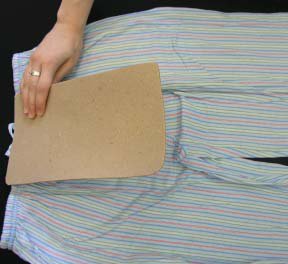
The apparel industry uses chipboard for folding and packaging purposes. Garments are occasionally folded over a chipboard to provide stability for the folded garment. The chipboard can also help maintain the measurement required of the folded garments.
|
|
Chip Board, Kraft Paper and Cardboard is often used as part of the packaging for clothing. Chipboard is often used in the folding process for shirts and other articles of clothing.
When discussing chipboard, grain direction is important because the direction of the grain provides strength or weakness in a particular direction. Chipboard grain direction can be discussed in terms of short-grain or long-grain. Paper (including chipboard) that is short-grain has its grain running in the shortest direction of the board, and that which is long-grain has its grain running in the long dimension.
Paper, like wood, has a grain. And yes, chipboard is a type of paper product.
Several methods are available to determine Kraft paper grain. Three primary methods (depending on the thickness) are folding, tearing or wetting. For heavy Kraft papers and cardboard, simply folding and creasing the material first in one direction parallel to an edge and then making a fold perpendicular to the first fold works well. The fold on the grain of the Kraft paper (which will be parallel to the direction of the fibers) will be easier to make and will have a sharper appearance. Tearing is another quick method that works on either thin or thick Kraft papers. Tearing a line down the length of the fibers produces a straighter separation and is somewhat easier to do than tearing across the fibers. The best method however is by taking a small square of the Kraft paper and quickly wetting one side only. As the water starts to expand the fibers on that side, the Kraft paper will begin to curl and hump up.
Bending Test : Thicker papers are best tested by bending them in both directions. One direction offers considerably more resistance than the other. Parallel to the grain direction the resistance is far less than against the grain.
Tearing Test : A sheet is torn in longitudinal and transverse directions. The tear pattern will be straight when parallel to the grain and jagged across the grain.
Learn about shirt packaging materials and other types of apparel packaging.
Learn more about Chipboard on Apparel Search.
Learn more about Chipboard on Wikipedia.
You may have
interest in viewing the
apparel manufacturers components
section or the
fashion
trimming area.
It may also help you to view other trimming terms.
ML101210
Fashion Terms: A B C D E F G H I J K L M N O P Q R S T U V W X Y Z
 |
|
|
| What is a passion for fashion? |

Check out the clothes section ...
Learn about fashion celebrities?
Catch up on the latest fashion news ...
Jump start your fashion career.
Apparel Search
Add Your Company
Contact
Us About Us
Advertise
News Letter
Legal
Help
Copyright © 1999-2026 Apparel Search Company.
All Rights Reserved.