Chipboard
Fashion Terms — the Apparel Search fashion terminology directory
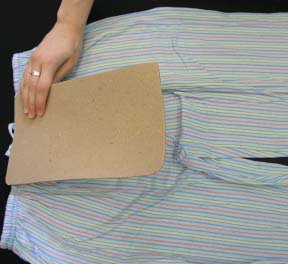
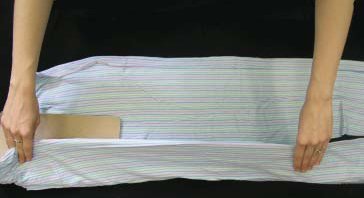
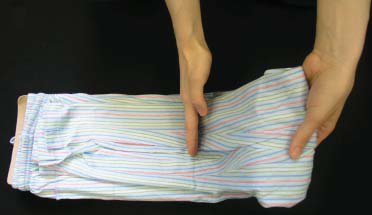
The apparel industry uses chipboard for folding and packaging purposes. Garments are occasionally folded over a chipboard to provide stability for the folded garment; the chipboard can also help maintain the measurement required of the folded garments. Chipboard is a type of paperboard — cardboard — generally made from reclaimed paper stock, produced in various thicknesses or paper stocks, of one or several plies. This page explains chipboard, how it is specified by weight and thickness, and shows pictures of chipboard being used to fold sleep pants and package shirts.
Chipboards - Terms of Interest to the Fashion Industry
Fashion Terms Fashion Terms Directory Fashion Terms by Category Fashion Fashion Trimming Terms Trims & Notions Shirt Packaging
Pictures of chipboard being used to fold sleep pants.
 The
apparel industry uses
chipboard for folding and
packaging purposes. Garments are
occasionally folded over a chipboard
to provide stability for the folded
garment. The chipboard can also
help maintain the measurement
required of the folded garments.
Within the industry, paperboard is referred to by weight (grams per square meter, pounds per 1000 square feet) or by thickness (mm or thousandths of an inch, or 'points' - for example, 0.007" thick paperboard is also known as 7-point. The chipboard can come in various colors, coating, shapes and weights.
Learn about chipboard grain direction.
ML33009 - chipboard
Fashion Terms: A B C D E F G H I J K L M N O P Q R S T U V W X Y Z
What is a passion for fashion?
Check out the clothes section ...
Learn about fashion celebrities?
Catch up on the latest fashion news ...
Jump start your fashion career.
Fashion Industry Network
Chipboard in the Packing Process
Chipboard earns its place at the end of the production line, in the folding and packing department where a garment's presentation is decided. The workflow is repetitive and exact: the garment is laid over the board, folded to the board's edges — which is what makes every unit in a carton the same size — sometimes secured with clips or pins where the packaging style calls for them, and slid into its polybag or box. Dress shirts are the classic example, folded around board (often with tissue and a collar support) so the shirt arrives with its retail shape intact, but the same technique serves knitwear, sleepwear and any folded garment that must look deliberate on a shelf.
Choosing board is a small specification with visible consequences. Too light a board buckles and the package looks tired; too heavy wastes material cost across tens of thousands of units and adds shipping weight. Grain direction, the subject of the companion term page linked from here, decides whether the board flexes along the fold or fights it. And because chipboard is generally made from reclaimed paper stock, it is one of the more easily recycled components of apparel packaging — a point in its favor as brands audit the footprint of everything that surrounds the garment, not just the garment itself.
Common Questions
What is chipboard in the apparel industry?
A stiff paperboard, generally made from reclaimed paper stock, used as a folding and packaging support: garments are folded over a chipboard sheet so the folded package keeps its shape and its required dimensions through packing, shipping and display.
Why fold a garment over chipboard?
Stability and uniformity. The board stops the garment flopping or unfolding, holds the fold at the specified measurement, and gives a shelf or polybag package a neat, consistent rectangle — the page's photographs show the board inside folded sleep pants and shirt packaging.
How is chipboard measured?
By weight — grams per square meter, or pounds per 1,000 square feet — or by thickness, in millimeters or thousandths of an inch, called points: 0.007 inch paperboard is 7-point board, as this page explains. Its companion term covers the grain direction of the board.