| The above article is licensed under the GNU Free Documentation License. From Wikipedia, the free encyclopedia https://en.wikipedia.org/wiki/papal_tiara 6/14/05 |
| Headwear Definitions |
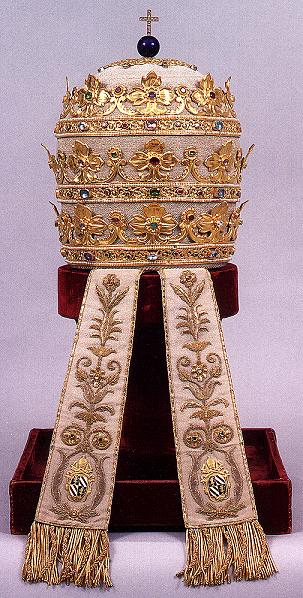 The
Papal Tiara,
also known as the
Triple Tiara,
in Latin as the
Triregnum,
or in Italian as the
Triregno,
Tiara
is the three-tiered jewelled papal crown
of Byzantine and Persian origin that is
the symbol of the papacy. Papal Tiaras were
worn by all popes from Pope Clement V to
Pope Paul VI, who was crowned in 1963. Though
Pope Paul VI abandoned the use of his own
tiara during the Second Vatican Council,
symbolically laying it on the altar of St.
Peter's Basilica, he did not abolish its
use, explicitly requiring in his 1975 Apostolic
Constitution Romano Pontifici Eligendo that
his successor be crowned.
The
Papal Tiara,
also known as the
Triple Tiara,
in Latin as the
Triregnum,
or in Italian as the
Triregno,
Tiara
is the three-tiered jewelled papal crown
of Byzantine and Persian origin that is
the symbol of the papacy. Papal Tiaras were
worn by all popes from Pope Clement V to
Pope Paul VI, who was crowned in 1963. Though
Pope Paul VI abandoned the use of his own
tiara during the Second Vatican Council,
symbolically laying it on the altar of St.
Peter's Basilica, he did not abolish its
use, explicitly requiring in his 1975 Apostolic
Constitution Romano Pontifici Eligendo that
his successor be crowned.
However, his immediate successor, John Paul I, refused to be crowned, and John Paul II, who also declined a coronation, told the congregation at his Papal Inauguration Mass, immediately after John Paul I's sudden death, that it was "not the time" to be crowned, while disputing the claim by critics of the tiara that it represented a papal claim to temporal power.
Though not currently used as part of papal regalia, the continuing symbolism of the papal tiara is reflected in its use on the flag and coats of arms of the Holy See and the Vatican. Until the reign of Benedict XVI it had been one of the ornaments surrounding the personal coat of arms of all popes for a millennium. In a controversial break with tradition, on the first version of Benedict's personal coat of arms the tiara was replaced with the papal mitre, though the mitre did contain three levels reminiscent of a three tiers on the papal tiara. This was the first such use since Pope Paul VI prohibited the use of mitres and croziers on coats of arms in 1969. However the Vatican subsequently issued documents which contained Benedict's coat of arms showing a tiara, not a mitre. It is unclear whether the initial arms announced have been withdrawn, or whether it is proposed to use two alternate designs, a personal set of arms with a mitre, and an official state set of arms for Benedict with a tiara.
Pope John Paul
II's 1996 Apostolic Constitution
Universi Dominici
Gregis
leaves it to individual future popes to
decide whether they wish to have a traditional
Papal Coronation or a more informal Papal
Inauguration. The current pope, Benedict
XVI controversially opted to be inaugurated
in 2005 using a Papal Inauguration Mass
rather than a Papal Coronation, producing
some criticism from conservative Roman Catholics
who expected, given his conservative past
and criticism of the abandonment of Latin
in church ritual, that he would reinstate
the traditional use of the papal tiara.
Though people often talk about the Papal Tiara, in fact there were many. Unfortunately many of the earlier priceless papal tiaras (most notably the tiaras of Pope Julius II and that attributed to Pope Saint Silvester) were destroyed, dismantled or seized by invaders (most notably by Berthier's army in 1798), or by popes themselves; Pope Clement VII had all the tiaras and papal regalia melted down in 1527 to raise the 400,000 ducats ransom demanded by the occupying army of Holy Roman Emperor Charles V. Over twenty silver triregnos exist, of which the earliest, the sole survivor of 1798, was made for Pope Gregory XIII in the sixteenth century. Because Rome was in the hands of the French, Pius VII was crowned in exile, in Venice, with a papier-m ch tiara, for which ladies of Venice gave up their jewels.
Many tiaras were donated to the papacy by world leaders or states, including Queen Isabella II of Spain, Kaiser Wilhelm I of Germany, Emperor Franz Joseph I of Austria and Napoleon I of France. The tiara provided by the latter was made from elements of former papal tiaras destroyed after the capture of Rome, and was given to Pius VII as a 'wedding gift' to mark Napoleon's own marriage to Empress Josephine on the eve of his imperial coronation. Others were provided to a newly elected pope by the See which they had held prior to their election, or to commemorate their jubilees, whether of their ordination, episcopal appointment or length of reign.
Nor was a pope restricted to wearing just one tiara: Pope John XXIII, for example, was photographed on different occasions wearing his own tiara presented in 1959, Pope Pius IX's 1877 tiara, or Pope Pius XI's 1922 tiara.
Pope Paul VI, whose bullet-shaped tiara is one of the most unusual in design, was the latest pope to wear a triple tiara; although any of his successors could reinstate the coronation ceremony or wear one of the tiaras. Most surviving tiaras are on display in the Vatican, though some were sold off or donated to Catholic bodies. In recent times some of the more popular or historic tiaras, such as the 1871 Belgian tiara, the 1877 tiara and the 1903 golden tiara have been sent around the world as part of a display of historic Vatican items.
Most of the surviving Triple Tiaras are have the shape of a circular beehive, with its central core made of silver. Within that one shape, a number of variations occurred; some were sharply conical, others bulbous. All tiaras but the latest one were heavily covered in jewels. Each tiara was structured in the form of three crowns marked by golden decorations, sometimes in the form of crosses, sometimes in the shape of leaves. Most were topped off by a crucifix. Each tiara contained at the back two lappets; highly decorated strips of cloth stitched with golden thread, on which the coat of arms or other symbol of the pope to whom the individual tiara had been given, were stitched.
There are two other unusual tiaras: a papier-mache tiara made when Pope Pius VI was in forced exile without a normal papal tiara to be crowned with, and the one made for Pope Paul VI in 1963. Shaped like a cross between a beehive and a bullet, and made of silver, Pope Paul's tiara contained few jewels. The three tiers were represented simply by three circles running in parallel around the exterior.
The tiara given to Pope Pius IX in 1877 by the Vatican's Palatine Honour guard in honour of his Jubilee (see photograph below) is strikingly similar in design to the earlier tiara of Gregory XVI. It remained a particularly popular crown, worn by among others Pope Pius XI, Pope Pius XII and Pope John XXIII; both were crowned using it. Pope Pius XI's 1922 crown, in contrast was much less decorated and much more conical in shape.
A number of popes deliberately had new tiaras made because they found those in the collection either too small, too heavy or a combination of both. Rather than use the papier-mache tiara, Pope Gregory XVI had a new lightweight tiara made in the 1840s. In his eighties during the 1870s, Pope Pius IX found the other tiaras too heavy to wear and found that of his predecessor, Pope Gregory, too small, so he had a lightweight tiara made also. In 1908 Pope Pius X had another lightweight tiara made as he found that the normal tiaras in use were too heavy, while the lightweight ones did not fit comfortably.
New methods of manufacture in the twentieth century enabled the creation of lighter normal tiaras, producing the 2 lb (900 g) tiaras of Pius XI and John XXIII. That, combined with the existence of a range of lightweight tiaras from earlier popes, meant that no pope since Pius X in 1908 has needed to make their own special lightweight tiara.
Just what the three crowns of the Triple Tiara symbolise is disputed. Even the Holy See and Vatican City, which are two distinct entities, give different nuanced interpretations on their websites. The former link it to the threefold authority of the 'Supreme Pontiff: Universal Pastor (top), Universal Ecclesiastical Jurisdiction (middle) and Temporal Power (bottom)' (Holy See interpretation) (http://www.ewtn.com/jp2/papal3/tiara.htm|) while the latter interpretes the three tiers as meaning 'Father of princes and kings, Ruler of the world, Vicar of our Saviour Jesus Christ' (Vatican interpretation). When popes were crowned, the following words were used:
Accipe thiaram tribus coronis ornatam, et scias te esse Patrem Principum et Regum, Rectorem Orbis, in terra Vicarium Salvatoris Nostri Jesu Christi, cui est honor et gloria in scula sculorum.
(Receive the tiara adorned with three crowns and know that thou art Father of Princes and Kings, Ruler of the World, Vicar of Our Savior Jesus Christ on earth, to him be the honor and glory forever and ever.)
Others have given a spiritual interpretation, the three-fold office of Christ, who is Priest, Prophet and King. (EWTN) (http://www.ewtn.com/holysee/interregnum/terms.asp|) and Pope John Paul II in his inauguration Mass, or 'teacher, lawmaker and judge'. A longstanding traditional interpretation often repeated before Vatican II suggested that the three crowns refer to the 'Church Militant on earth', the 'Church Suffering after death and before heaven', and the 'Church Triumphant in eternal reward'. Another theory suggests they represent the Pope's roles as 'lawgiver, judge and teacher'. Yet another interpretation suggested in the Vatican's own newspaper, L'Osservatore Romano by the Archbishop Cordero Lanza di Montezemolo, who designed Pope Benedict XVI's tiara-less coat of arms, was 'order, jurisdiction and magisterum'.(CNS) while a further theory links the three tiers to the 'celestial, human and terrestrial worlds,' which the pope is supposed to symbolically link.
However ultimately no-one knows what they symbolise for all the theories, including the words used in the coronation, either pre-date or post-date the addition of the third level to the tiara. The various meaning may well have emerged to justify a three-tiered crown created in that format for completely different reasons.
The continuing symbolism of the tiara can be seen in the decision of one self-proclaimed 'Pope Gregory XVII', Clemente Domnguez y Gómez of the Palmarian Catholic Church, who believed that he was the rightful successor of Pope Paul VI, to be crowned with his own tiara in a ceremony in Spain in 1978. (Image of his coronation with his own version of a papal tiara is at the bottom of this page.)
According to James-Charles Noonan the lowest of the three crowns appeared at the base of the traditional white papal headgear in the ninth century. When the popes assumed temporal power in the Papal States, the base crown became decorated with jewels to resemble the crowns of princes. He suggested that a second crown was added by Pope Boniface VIII in 1298 to symbolize spiritual dominion. Very soon after, in or around 1314, a third crown and lappets (cloth strips) were added; Pope Clement V was the first to wear the triple tiara. Though a powerful symbol of the papacy, it has not always been respected even by its wearers. One medieval pope, Innocent VIII, even pawned off his papal tiara. A Protestant theory is that the three crowns (triregnos) fulfilled Daniel's prophecy in the seventh chapter of his book in which the "little horn" of the Roman Papacy uproots three kingdoms before it.
However not all sources agree with this chronology.
Undoubtedly the most famous occasion when the triple tiara was used was the papal coronation, when, in a six-hour ceremony, the new pope would be carried in state on the sedia gestatoria (portable throne - see image of Pope John XXIII above), with attendants fanning the pontiff with ostrich feathers (fans can be seen in the background of photograph of Pius XI above) to the location of the coronation. Traditionally coronations took place in or in the environs of St Peter's Basilica.
Pope Paul VI opted for a significantly shorter ceremony than the traditional six hour ceremony previously performed.
As with all other modern coronations, the ceremony itself was only symbolic; the person duly elected became pope and Bishop of Rome the moment he accepted his election in the Conclave, as popes John Paul I, John Paul II, and Benedict XVI showed by declining a coronation. However the ceremony was not abolished and remains an option for future popes.
The Papal Tiara and the 666 controversy
One common controversy surrounding the papal tiara, particularly coming from Seventh-day Adventists and other Protestants, involves the claim that the words Vicarius Filii Dei (Vicar of the Son of God) exist on the side of one of the tiaras. The controversy centres on the widely made claim that, when numerised (i.e., when those letters in the 'title' that have Roman numerals value are added together) the words produce the number '666', described in the Book of Revelation as the Number of the Beast (who some have claimed would 'wear' a crown similar to a triple tiara). This claim has been made by some evangelical Protestant groups who believe that the pope as head of the Roman Catholic Church is the Antichrist. Heretics dating back to the Cathars and Waldensians in the thirteenth century also held this view of the Church.
Four sources are sometimes given to back up the claim, including two witnesses who claimed to have seen Pope Gregory XVI wearing a tiara with Vicarius Filii Dei on it in 1832 and 1845, the supposed existence of an early twentieth century papal funeral showing a tiara with the writing, and the fact that the tiara with the writing was used to crown Eugenio Pacelli as Pope Pius XII in 1939.
None of the claims hold up to scrutiny. One of the occasions where the Pope was 'seen' wearing the tiara was supposedly during a Pontifical High Mass in St. Peter's Basilica. In fact popes never wore tiaras during Mass. It was never used as a liturgical item. In addition the tiara used for Pius XII's coronation in 1939 could not have been worn by Gregory XVI as it was manufactured thirty-one years after Gregory's death. All the tiaras potentially worn by Gregory still exist; none have writing, nor does the tiara worn by Pius in 1939.
Finally, no evidence as to the existence of the supposed photograph has been produced, nor is it credible that a black and white photograph, taken from a distance inside a darkened St. Peter's Basilica, in the absence of modern photographic technology or even zoom lenses, could have picked up writing on a far-away tiara, had such writing existed. A photograph of a tiara supposedly on the coffin of Pope Pius X, at his canonisation in 1954 -- but in actuality part of the decorations at the base of one of the columns supporting the bronze baldachin over the main (papal) altar in Saint Peter's Basilica -- decades after the supposed original photograph, could not see the jewels on the tiara, much less any supposed writing.
Many historians, academics and mainstream religious leaders view the story as a classic anti-Catholic myth, a story for which no evidence has been found, even by the Seventh Day Adventists who have spent over a century extensively searching for the evidence. Finally, the title Vicarius Filii Dei itself is not a common papal title; however, the Donation of Constantine uses it to refer to St. Peter specifically.
As with all previous popes, Pope Paul VI was crowned with a tiara at the papal coronation. As happened sometimes with previous popes, a new tiara was used, one donated by the city of Milan in honour of Paul's elevation; he had been Cardinal Archbishop of Milan up to his election. Pope Paul's tiara was quite different from earlier tiaras. It was not covered in jewels and precious gems, but was sharply cone-shaped. It was also distinctly lighter in weight than earlier tiaras.
Pope Paul's decision for his reign to abandon the use of one of the most striking symbols of the papacy, the Papal Tiara, proved highly controversial with Traditionalist Catholics, many of whom continue to campaign for its re-instatement. Some indeed branded him an antipope, arguing that no valid pope would surrender the papal tiara. At least one 'claimant' to the papacy after Paul VI's death, Clemente Dom nguez y Gómez, of the conservative catholic Palmar de Troya movement, and who was 'proclaimed' as 'Pope Gregory XVII' by his followers in Seville, Spain in 1978, was 'crowned' using a 'new' 'papal tiara', showing the power of its symbolism. A rival antipope, Pius XIII of the 'True Catholic Church' has made use of the tiara on his coat of arms.
Pope Paul's tiara was presented to the Basilica of the National Shrine of the Immaculate Conception in Washington, D.C. by the Apostolic Delegate to the United States on February 6, 1968 as a gesture of Pope Paul VI's affection for the Catholic Church in the United States. It is on permanent display in Memorial Hall along with the stole of Pope John XXIII, which he wore at the opening of the Second Vatican Council.
A permanent end to the wearing of the Triple Tiara?
In 1978, one of Pope John Paul I's first decisions on his election was to dispense with the 1000-year-old papal coronation and the use of a papal tiara. In doing so he ignored the requirements specified in Pope Paul VI's 1975 Apostolic Constitution Romano Pontifici Eligendo which laid down the rules for future papal elections and which explicitly required the continuation of papal coronations and the use of the papal tiara stating thatthe new pontiff is to be crowned by the senior cardinal deacon.
The existence of this requirement suggests that Pope Paul believed his decision not to wear his tiara was purely a personal decision and was not intended to set future policy on the use of papal tiaras. John Paul I, after what was called a "long and tedious argument" in which he insisted he did not want to be crowned, was instead installed in a revised and simpler Papal Inauguration Mass, so low-key indeed that he had it moved to the morning so as not to disrupt Italian soccer coverage, which would normally be shown in the afternoon.
After Pope John Paul I's sudden death less than a month later, the new pope, John Paul II, opted to continue with John Paul I's precedent of replacing the papal coronation with a modest inauguration, though he did say in his Inauguration homily that it was simply "not the time" to wear a tiara, while dismissing the claims made that the tiara in some way represented the continuation of papal claim to temporal power.
Pope John Paul II explicitly mentioned the word 'inauguration' rather than coronation in his 1996 Apostolic Constitution, in which he wrote
However the phraseology is descriptive, not prescriptive. Instead of explicitly speaking of an 'inauguration ceremony' or 'the Papal Inauguration Mass' it spoke simply of the 'ceremony of the inauguration of the pontificate', an ambiguous phraseology, especially with the inclusion of the word 'the', as any number of different types of ceremonies, even coronations, can be described amounting to the inaugurating (ie, ceremonial beginning) of a pontificate. John Paul's terminology left it up to his successor to decide what sort of solemn ceremony to use to inaugurate his pontificate. All it explicitly required was that some solemn ceremony take place.
With the disappearance of the papal coronation, the British monarch is now the only monarch in a western country to receive a coronation. All others, like modern popes, are inaugurated into office. However, the tiara has not been abolished, merely laid aside in terms of usage. Thus a future pope could decide to be crowned and wear one of the Triple Tiaras: the recent increased usage of some traditional elements, most notably the Tridentine Mass, which in an about turn is now being approved for usage more widely, might open up the prospect of a return of what was the papal symbol pre-Second Vatican Council.
Though unworn, the tiara remained the symbol of the papacy, and still featured as one of the ornaments on the coat of arms of popes, including the uncrowned popes John Paul I and John Paul II. It was, however, apparently replaced by a bishop's mitre in the coat of arms of Pope Benedict XVI, even though the use of the mitre as a heraldic ornament was in fact prohibited by Pope Paul VI. However a subsequent version of Benedict's arms, used on official Vatican documentation, showed them with a tiara. Whether both are meant as alternates to be used in different contexts, or the tiara-less version is being withdrawn and being replaced by the one with the tiara, has not be clarified to date.Should Benedict XVI issue his own Apostolic Constitution on events surrounding the selection of a pope, Benedict XVI may opt to reinstate the requirement for a coronation, allow John Paul's non-perscriptive terminology to continue to be used, or explicitly require a formal Papal Inauguration as the only option.
One of the papal tiaras remains in use, however; it is placed on the head of a statue of St. Peter to honour him as the first pope on the feast of Saints Peter and Paul, June 29.
The 16th Century Ottoman Sultan Suleiman the Magnificent is known to have commissioned Italian craftsmen to make a 4-crown tiara modeled on the Papal design, to demonstrate that his power and authority exceeded that of the Pontiff's. Conversely, the papal coronation ceremony, in which the Pope was fanned with Ostrich feathers and carried in a sedia gestatoria (portable throne), was based on ceremonies witnessed in Constantinople in the Middle Ages.
Medieval tarot cards contained a card showing a woman wearing a papal tiara and known as the Papess/high Priestess. The meaning and symbolism of the card is uncertain. The crowned woman has variously been identified as Pope Joan (a supposed woman pope who featured in medieval myths'some cards also show a child; the Pope Joan myth had suggested that Joan, who had disguised herself as a man and been elected pope, had been found out when she gave birth during a papal procession), Mary, Mother of God, Cybele, Isis, or Venus. The use of a papal tiara worn by a woman in cards produced during the Protestant Reformation, and the use of apparent images of 'Pope Joan' and her child, has been seen as a Protestant attempt to ridicule the papacy.
The papal tiara however disappeared from later cards, who showed the Papess wearing more standard medieval female headgear. The tarot cards also contained a representation of the pope, in some cases crowned with a papal tiara.
| The above article is licensed under the GNU Free Documentation License. From Wikipedia, the free encyclopedia https://en.wikipedia.org/wiki/papal_tiara 6/14/05 |
| Headwear Definitions |
|
|
| Discussion boards are a great place to meet other members of the fashion industry, get advice, and share information. This forum was created to discuss the topic of this page. If you have questions, or information to improve this page, please join in the community discussion below. Please keep the communication on topic and for the purpose of education. |
|
|