Slide Necklaces
Pendants that ride the chain itself
A slide is a pendant made with a channel, tube or pair of loops across its back, through which the chain passes directly, so the pendant is threaded on the chain and slides along it instead of hanging from a bail. The form pairs with smooth, structured chains, omega chains, snake chains and flat herringbone styles, whose surfaces let the slide move freely and sit flat, and it gives a clean, modern line with no visible connector. A related form, the enhancer, has a hinged, locking bail that clips over a strand of pearls or beads as well as a chain. This guide covers slide construction, chain compatibility and sizing, enhancers, wearing and conversion, and care for the moving contact between slide and chain.
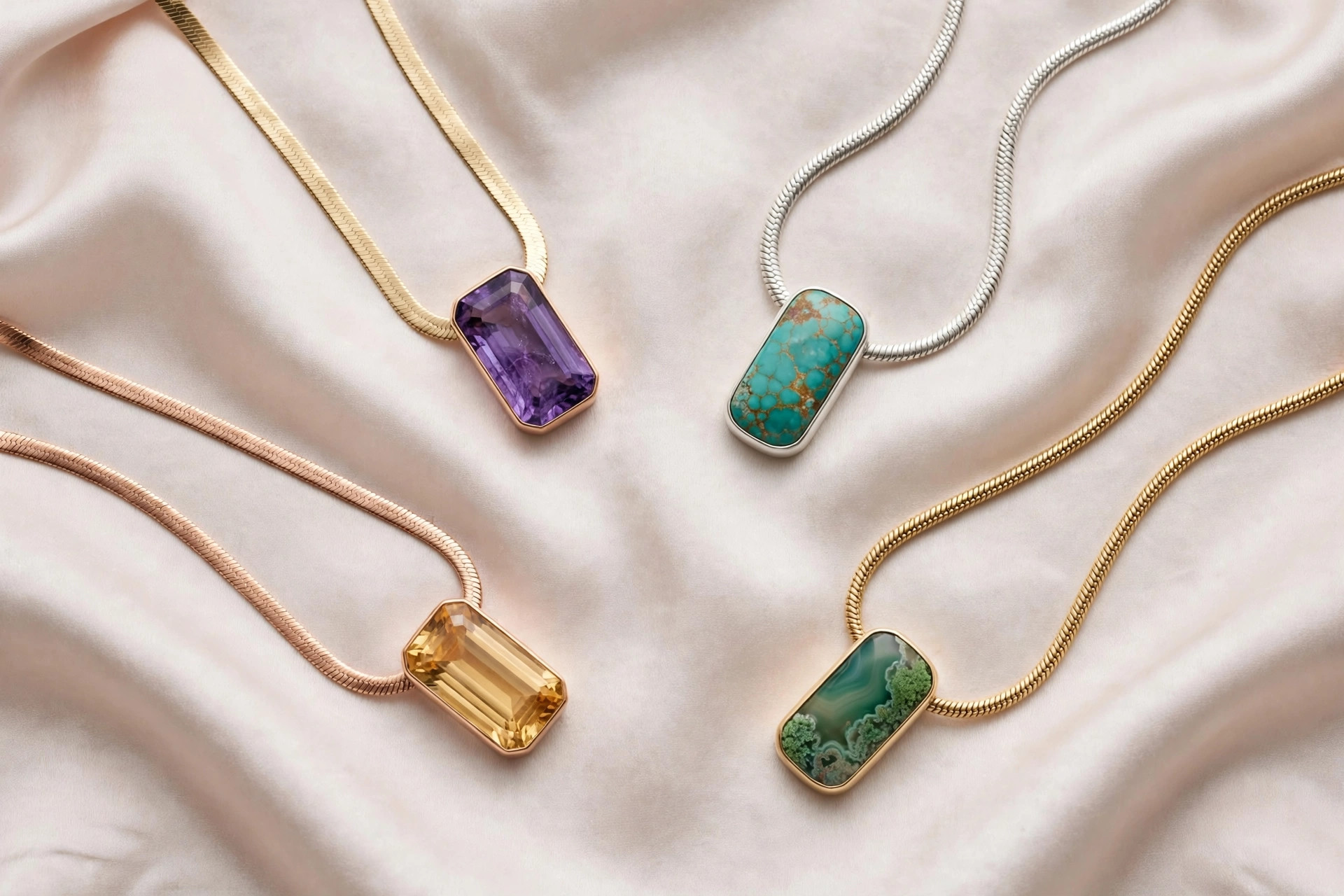
A slide necklace, also known as a slide pendant necklace or slide chain necklace, is a type of necklace design characterized by a movable centerpiece, typically a pendant, that can "slide" along the chain. The pendant is designed in such a way that it can move freely along the length of the chain, allowing it to be repositioned at different points on the necklace.
Here are some key features and details about slide necklaces:
Pendant Mobility: The defining feature of a slide necklace is the pendant's ability to slide along the chain. This mobility allows the wearer to adjust the pendant's position on the necklace, creating a customizable and versatile piece of jewelry.
Pendant Design: The pendant on a slide necklace can come in various shapes, sizes, and styles. It can be a simple and understated piece or an elaborate and ornate design, depending on the wearer's preferences.
Chain Varieties: Slide necklaces can be crafted with different types of chains, including snake chains, cable chains, box chains, or omega chains. The choice of chain style can influence the overall appearance of the necklace.
Materials: Slide necklaces can be made from a variety of materials, including precious metals like gold or silver, as well as alternative metals or materials like stainless steel or leather for more casual designs.
Versatility: The versatility of slide necklaces makes them a popular choice for those who enjoy customizing their jewelry. The pendant can be positioned higher or lower on the chain to create different looks or accommodate various necklines.
Pendant Types: The pendant on a slide necklace can be a decorative element, a gemstone, a locket, or any other design that suits the wearer's style and preferences.
Occasions: Slide necklaces are suitable for both casual and formal occasions, making them a versatile accessory that can adapt to different outfits and settings.
Clasp Design: Some slide necklaces have a special clasp mechanism that allows for easy adjustment of the pendant's position, while others may simply rely on the pendant's design to slide along the chain.
Slide necklaces offer a unique way to wear and showcase pendants, allowing the wearer to personalize their jewelry and change the pendant's placement to suit their outfit or mood. They are appreciated for their adaptability and the opportunity they provide for creative styling.
Learn about other styles of necklace such as solitaires, strand necklaces, lockets and brooch necklaces.
Fit, Movement and Wear
A slide should move along its chain with light finger pressure and stop where it is placed, neither binding nor rattling loosely; a channel lined or sized correctly achieves that, and silicone-insert slide adapters exist for chains slightly under size. Because metal rides on metal, the contact surfaces polish each other over time, one reason omega and snake chains, with their hard, smooth plates, are preferred: link chains wear a slide's channel unevenly and are worn by it in return.
Slides suit gemstone and enamel pendants especially well, holding the piece flat against the chest in a way a swinging bail does not, which is why the form is used for cameos, lockets without hinges at the top, and wide modernist pendants. Worn at 16 to 18 inches on an omega, a slide necklace is a complete, self-contained jewel that needs no other element, and an enhancer version lets the same pendant move to a pearl strand for a second, entirely different necklace.
Common Questions
Which chains work with a slide pendant?
Smooth, even chains without protruding links: omega chains are the classic partner, followed by snake, box and flat chains whose width fits the slide's channel. Link styles such as rope, curb and figaro do not let a slide travel and can jam or scratch it. The chain must also pass its own end fittings through the channel when the slide is put on, so check the clasp's size against the channel, not just the chain's width.
What is the difference between a slide and an enhancer?
A true slide is threaded onto the chain and can only be removed by sliding it off an end, which means the chain's clasp or an end must pass through it. An enhancer looks similar from the front but its bail opens with a hinge and safety lock, so it clips on and off over chains, pearl strands and bead necklaces without restringing. Enhancers are more versatile; true slides sit flatter and cannot come open.
Can a regular pendant be converted to a slide?
Often, yes: a jeweler can add a channel or tube to the back of many pendants, sized to the intended chain, or fit a slide adapter. The conversion suits flat-backed pendants with enough metal to take the addition. Very small, hollow or stone-crowded pendants may not convert soundly, and the jeweler's judgment on the specific piece governs.