Women's Doctor Uniforms
Scrubs, lab coats and the rules behind them — practical medical workwear chosen for fabric, fit and infection control, not for the runway.
Shop Women's Doctor Uniforms Now
Shop Women's Doctor Uniforms on Amazon Shop Women's Doctor Uniforms on eBayThe Amazon and eBay links on this page are affiliate links. If you make a purchase through them, Apparel Search may earn a commission.

Doctor uniforms — scrubs for the whole clinical team, and the lab coat worn over them — are among the most purpose-built garments in any wardrobe. They must identify the wearer's role at a glance, survive industrial-strength laundering, carry instruments and phones, allow a full range of movement from examining a patient to assisting in a procedure, and still look calm and professional at the end of a long clinic day. Although this guide sits in the women's section, the same principles serve physicians, nurses, technicians, dentists and veterinary staff who share the scrub wardrobe.
A note on what this page is not: scrubs are workwear, the opposite end of the spectrum from dress clothing, and no one chooses them for luxury. The satisfactions here are practical — a fabric that breathes through a warm ward, a pocket exactly where your hand expects it, a color code that lets a patient find the right person instantly.
Scrub Fabrics: Cotton-Poly to Performance Stretch
The traditional scrub fabric is a cotton-polyester blend, and it endures because it balances the virtues: cotton brings softness and breathability against the skin, polyester brings strength, colorfastness and a reasonable resistance to wrinkling out of a hot dryer. Classic blends feel a little crisp and structured, hold a crease in the pant and are usually the least expensive option — a real consideration when a clinician needs five or more sets in rotation. Pure cotton scrubs are the softest of all but fade, shrink and wear thin fastest under clinical laundering.
Performance scrubs are the modern upgrade: polyester-rich fabrics with mechanical or elastane stretch, moisture-wicking finishes and a smoother, almost athletic hand. They move through squats, lifts and long reaches without binding, dry quickly and keep their color through hundreds of washes, though some wearers find synthetics warmer or prone to holding odor. Antimicrobial finishes, often silver-based, are widely offered to inhibit odor-causing bacteria on the fabric itself; treat them as a freshness aid, not a substitute for laundering, since no finish turns a worn scrub into a sterile one.
Fit, Sizing and Colors by Facility
Scrub sizing runs from unisex cuts — essentially one pattern graded up and down — to genuinely women's-shaped sets with a contoured waist, a shaped top and pants in petite, regular and tall lengths. The unisex version is cheaper and universally stocked, but many women find the shoulders broad, the waist straight and the rise awkward; a women's cut that skims rather than clings usually looks more professional and moves better. Whatever the cut, scrubs should allow a deep knee bend, a full overhead reach and a seated charting session without the top riding up or the drawstring digging in.
Color is rarely a free choice. Many hospitals assign scrub colors by role or department — one color for nursing, another for surgical staff, another for support services — so patients and colleagues can identify roles instantly, and some facilities supply and launder scrubs themselves, especially for operating areas. Before buying, confirm your facility's code, its rules on printed tops (often welcome in pediatrics, forbidden elsewhere) and whether embroidery of name and credential is required, permitted or provided. Buying the wrong color is the most common and most avoidable scrub-shopping mistake.
Lab Coats and Dress Codes
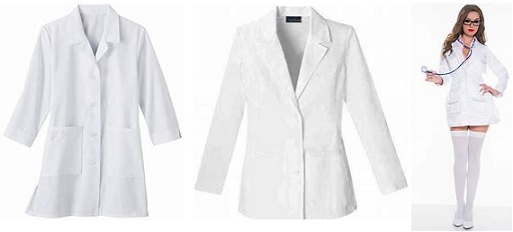
The lab coat remains medicine's most recognizable symbol, and its details are functional: a length that signals seniority in some institutions, with shorter coats traditionally worn by students and full-length coats by attending physicians; snap or button fronts that can be opened quickly; and pockets sized for a stethoscope, reference cards and a phone. Modern lab coats in cotton-poly twill with a little stretch, antimicrobial finishes and stain-release treatments have largely replaced the stiff, board-like coats of memory, and a tailored women's coat with back shaping looks markedly more professional than a borrowed unisex one.
Dress codes vary by setting and are worth learning before your first day. Common rules include wearing scrubs only within the facility, keeping nails short for infection control, confining jewelry, and wearing closed, fluid-resistant shoes — a proper duty shoe rather than anything open. Private practices often relax the color rules but keep the cleanliness ones, and patients notice: a pressed coat and fresh scrubs are part of the profession's bedside manner.
Laundering, Infection Control and Underscrubs
Laundering is where scrub care becomes infection control. Facility-laundered scrubs, especially surgical ones, should never come home at all — that is policy in most operating suites, not preference. For personally owned scrubs, common guidance is to change out of them before leaving when possible, bag them separately, wash them apart from household laundry in the warmest water the fabric allows, and dry them thoroughly on heat, since the dryer does much of the sanitizing work. Treat visible soiling promptly, replace sets that thin or fade badly, and remember that home washing manages risk sensibly rather than sterilizing — another reason high-contamination areas rely on hospital laundry.
Underscrubs complete the system. A fitted long- or short-sleeve layer under the scrub top adds warmth in air-conditioned units, protects skin and provides modesty during reaches and bends; choose smooth, moisture-managing fabrics that do not bunch under the top, in colors your facility permits at the neckline and cuff. Compression socks are the other quiet hero of the scrub wardrobe, easing leg fatigue on long shifts. Together with the right shoes, these layers turn a basic uniform into a working kit that supports the person wearing it from the first round to the last chart.
Related Women's Guides
Scrubs: What They Are and Where They Came From
This page is titled "doctor," but it really covers medical dress generally — the uniforms worn by doctors, nurses and hospital workers. Most patient-care personnel in U.S. hospitals wear some form of scrubs, the sanitary clothing originally designed for surgeons and operating-room staff, who put them on when sterilizing themselves — "scrubbing in" — before surgery. Scrubs are designed to be simple, with minimal places for contaminants to hide, easy to launder, and cheap to replace if damaged or stained beyond repair; their use has spread beyond hospitals to vets, midwives and other workplaces where clothing may contact infectious agents. Read the scrubs definition and hospital gown definition in our glossary for the formal descriptions.
The look is younger than most people think. By the 1950s and 1960s, most hospitals had abandoned white operating-room apparel in favor of shades of green, which provided a high-contrast environment, reduced eye fatigue and made bright red blood less conspicuous. By the 1970s, surgical attire had largely reached its modern state: a short-sleeve V-necked shirt with drawstring pants (or a short-sleeve calf-length dress) in green cotton or cotton/polyester blend, sometimes with a waist-length, long-sleeved "warm-up jacket" with no lapels and stockinette cuffs. Surgical scrubs are still almost always solid light grey, light green or light blue. Continue with our women's medical clothing guide, find medical uniform stores, or browse white coats for women.
Photos

More to Explore on Apparel Search
Looking for Women's Clothing Stores?
This guide helps you choose women's doctor uniforms and scrubs by fabric, fit and facility code. To browse where to buy, visit our women's clothing store directory, where you can find retailers that carry them.