Hospital Gown
Clothing Definitions — definitions of garments and clothing terms from Apparel Search
Search Apparel Search
At a Glance
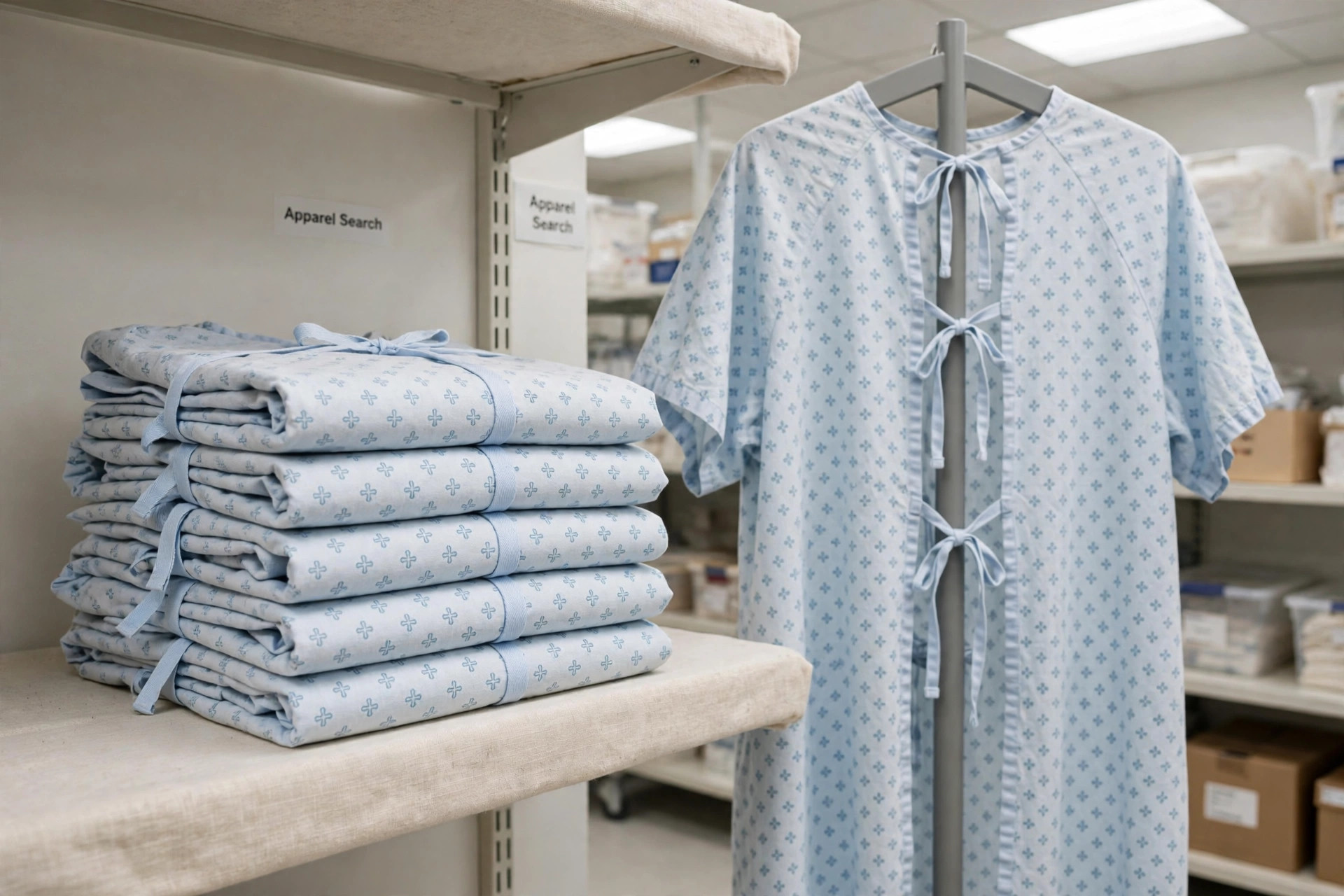
Definition: A hospital gown is a short-sleeved, thigh-length garment worn by patients in medical facilities, usually of cotton, fastened at the back with twill tape ties.
Also known as: Patient gown; johnny gown
Category: Clothing Definitions
A hospital gown is the garment a patient is given to wear in a hospital or other medical facility: short-sleeved, about thigh-length, loose in cut, and fastened at the back with ties of twill tape. It belongs to the wider family of garments called a gown, but it sits at the family's functional extreme — where a ceremonial gown is designed for appearance, the hospital gown is designed for examination, treatment and the laundry. Every feature of it answers a need of the ward rather than of the wardrobe. This page explains the design: why it opens at the back, why its fabric is specified for institutional washing, and how it differs from the surgical gown and from the nightgown it superficially resembles.
Designed for Examination and Treatment
The back fastening is the garment's defining feature, and it exists for the staff, not the wearer. A gown that opens at the back can be opened for examination, monitoring or treatment without being removed entirely, and can be put on and taken off a patient who is in bed, attached to drips or monitors, or unable to sit up. Ties are used instead of buttons, zips or snaps for practical reasons: twill tape survives industrial laundering indefinitely, does not break, melt or corrode, and holds no hard parts against the skin or within the field of imaging equipment.
The rest of the cut follows the same logic. Short sleeves leave the arms clear for blood-pressure cuffs, blood tests and intravenous lines. The thigh length keeps the garment clear of bedding, catheters and mobility aids, and makes it quick to change. The loose, simple cut is produced in a small range of sizes intended to fit almost any patient, because a hospital gown is issued on admission, worn by one patient, and returned to a central laundry — interchangeability is a requirement, not a shortcut.
Made for the Laundry
Laundering decides the fabric. A patient garment must be washed at temperatures that disinfect, again and again, without shrinking out of size or losing what little structure it has. Cotton and cotton blends meet that requirement cheaply and comfortably, which is why cotton is the usual choice, typically in a plain weave printed with a small institutional pattern that shows stains less and identifies the garment as facility stock.
The gown is therefore best understood as institutional clothing, in the same family as scrubs, the washable work clothing worn by the staff treating the patient, and as the wider world of uniforms: plain, hard-wearing, hot-wash garments owned by the facility rather than the wearer, replaced from stock the moment they are stained or worn out. Stock only works when every gown is interchangeable, so the pattern changes slowly and only for functional reasons.
One Pattern, Many Patients
The same pattern is adapted, not redesigned, for different patients. Sizes run larger for maternity and bariatric use, with ties and openings repositioned where a particular examination requires them. Prints and softer colours are used on children's wards, where a less clinical-looking garment is worth having. Longer or three-quarter sleeve versions appear where warmth matters more than immediate arm access, and versions with shoulder fastenings serve imaging and treatment units. In each case the defining features survive the adaptation: a thigh-length body, a back opening fastened with ties, and a fabric specification written for the laundry rather than for fashion.
Disposable versions, made from non-woven fabrics and used once, follow the same pattern for isolation and infection-control settings. Whether reusable cotton or single-use, the garment is specified the same way — by access, coverage and washability — which is what makes the hospital gown a piece of medical equipment that happens to be worn, rather than a piece of clothing that happens to be in a hospital.
Recent decades have added redesigns aimed at the wearer's side of the bargain. Wrap-around styles that fasten more completely, gowns with snap fastenings positioned for monitoring leads, and softer fabrics in less institutional prints all attempt to give the patient more coverage and dignity while keeping the staff's requirements — back or shoulder access, no hard or metal parts, full hot-wash durability — intact. The redesigns that succeed in practice are the ones that change the gown's feel without changing its specification, because a pattern that cannot go through the standard laundry, or that a nurse cannot open quickly, fails the garment's real definition however it looks.
Not to Be Confused With
The two garments share a name and a building, but they are worn by opposite sides of the operating table. A hospital gown is worn by the patient: short-sleeved, thigh-length, non-sterile, fastening at the back with ties so the wearer can be examined and treated. A surgical gown is worn by the surgical team over their scrubs: a sterile, long-sleeved protective gown, fastened so its sterile front stays uncontaminated during an operation. Patient gown opens at the back for access; surgical gown protects at the front for sterility.
Common Questions
What is a hospital gown?
A hospital gown is a short-sleeved, thigh-length garment worn by patients in hospitals and other medical facilities. It is usually made of cotton and fastens at the back with twill tape ties.
Why does a hospital gown open at the back?
So that medical staff can examine and treat the patient without removing the garment entirely, and so it can be put on and taken off a patient who is in bed or connected to monitors and drips. Ties are used because they survive industrial laundering and contain no hard parts.
What is the difference between a hospital gown and a surgical gown?
A hospital gown is worn by the patient and fastens at the back for access. A surgical gown is a sterile, long-sleeved protective gown worn by the surgical team over scrubs during an operation.