Women's Suits Guide
A suit is a set of garments made from the same cloth — at least a jacket with trousers or a skirt — tailored to give one crisp, polished, intentional outfit.
Shop Women's Suits Now
Shop Women's Suits on Amazon Shop Women's Suits on eBayThe Amazon and eBay links on this page are affiliate links. If you make a purchase through them, Apparel Search may earn a commission.
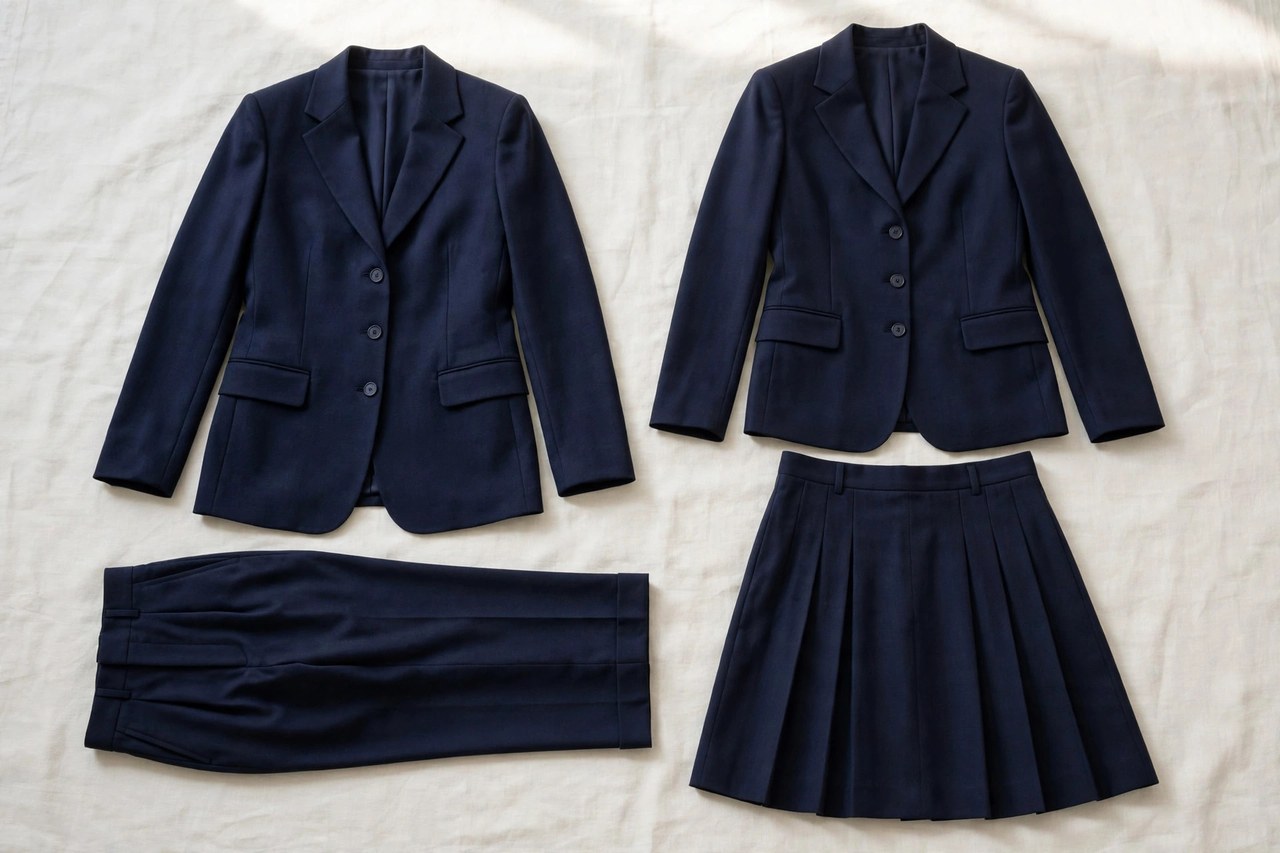
In clothing, a suit is a set of garments made from the same cloth, usually consisting of at least a jacket and trousers — and for women, the skirt suit and the trouser suit are both standard forms. That shared cloth is the whole idea: jacket and bottom cut from one fabric produce a single, unified line that no combination of separates quite reproduces, which is why the suit remains the answer for interviews, board meetings and every occasion where the message is that you mean business.
This guide covers the suit as an ensemble: the pant suit and skirt suit forms, fabrics and colors, how feminine tailoring achieves its crisp, polished fit, and what to wear inside the jacket. The trousers as a separate garment have their own page; here the subject is the matched set and the effect only it creates.
Pant Suits, Skirt Suits and Dress Suits
The pant suit pairs the jacket with matching trousers and is now the default business suit for most women, practical in every season and setting. The skirt suit pairs it with a matching skirt, pencil or A-line, and carries a slightly more traditional formality — by the early to mid-1980s, conservatively tailored skirt suits in standard suit colors were the established norm for professional women, and the form has never left the wardrobe since. The dress suit, a matching dress and jacket, completes the family for occasions that want softness with structure.
Three-piece versions add a matching waistcoat, and separates programs let the same cloth be bought as jacket, trousers and skirt together, building two suits from three pieces. However composed, the test of a suit is unity: same cloth, same dye lot, bought or verified together in daylight. A jacket and trousers that almost match are not a suit.
Fabrics and Colors: From Navy to Everything
Suit fabrics decide drape, season and lifespan. Wool and wool blends are the standard: breathable, crease-resistant, and available from tropical weights for summer to flannels for winter. Crepe gives a fluid, feminine drape; linen and cotton suiting serve hot weather at the price of wrinkles; polyester and blended suiting lower the cost and the care while approximating wool's look, with varying success at its hand and recovery. A first suit should be a mid-weight wool blend in a plain weave, the combination that presses crisply and wears across most of the year.
Black and navy are the traditional business colors, and a navy suit remains the most versatile single purchase — formal without funereal, flattering with almost any top. But women's suits are worn in a wide variety of colors: charcoal and gray for the classic rotation, and cream, burgundy, forest, pastels and brights for the suits that follow the first. Texture — a subtle herringbone, pinstripe or check in the same cloth — adds interest without breaking the matched-set unity that makes a suit read as one decision.
Fit: Feminine Tailoring and the Polished Line
Suit-wearing etiquette for women generally follows the same guidelines used for men, with a few differences and more flexibility — and fit is where that flexibility shows. Feminine tailoring streamlines the profile: the jacket should close without pulling, its shoulder seam ending at your shoulder, sleeves showing a sliver of cuff, and its length chosen against the skirt or trouser proportion. Waist shaping is cut in, not belted on as an afterthought, and a jacket that fits the shoulders can be taken in by a tailor far more easily than one that fits the waist can be given shoulders.
Buy for the largest dimension — shoulders, bust or hip — and tailor the rest; a suit is one of the few garments still built with the seam allowances to allow it. Trousers and skirts follow the fit rules of their own categories, with hems set for the shoes the suit will actually meet. Budget the alteration into the purchase from the start: a mid-priced suit tailored to you will out-dress an expensive one worn straight off the rack, because the crisp, polished appearance shoppers are told to look for is, in the end, fit made visible.
Inside the Jacket, and Beyond the Office
A blouse, white or colored, is the classic partner, but it is not compulsory: depending on the suit, a blouse may not be needed at all, and women's suits are worn equally well with colored tops, fine knits, camisoles or even T-shirts for a deliberately relaxed register. Scarves are the traditional accessory, worn tied at the neck, knotted inside a shirt as an ascot, or under the collar in place of a tie; some women wear ties with a suit, though it has never become as common as it is for men, and the choice remains a personal styling signature rather than a rule.
Suits are for more than business. Church suits are a long-standing category of their own for Sundays and occasions, and suits serve weddings, ceremonies, presentations and every setting where structure communicates respect for the event. Break the set apart between formal duties — the jacket over jeans or a dress, the trousers with a sweater — and a suit earns its wardrobe space several times over. Add some structure to a wardrobe with one well-tailored suit, and the polished option is permanently on hand for the days you need to look like you mean it.
Related Women's Guides
Photos

More to Explore on Apparel Search
Looking for Women's Clothing Stores?
This guide helps you choose women's suits. To browse where to buy, visit our women's clothing store directory, where you can find retailers that carry them.