Treadle
Sewing Definitions — stitches, seams, quilting and sewing terms from Apparel Search
A treadle is a mechanism operated with a pedal for converting reciprocating motion into rotating motion. On a treadle sewing machine, the treadle is the broad foot pedal below the machine: rocking it back and forth drives a flywheel and belt that turn the machine, leaving both hands free to guide the fabric. Treadles once powered sewing machines, looms and spinning wheels in homes and small workshops around the world. Electric motors replaced them in most sewing, but the treadle remains an important part of sewing history and is still used where foot power is preferred or electricity is unavailable.
Why is a treadle important to the fashion industry? Well, they are not as important as they had been in the past but they definitely have historical significance.
Treadles were once used extensively in creating textiles and clothing, powering spinning wheels, looms, and sewing machines.
A treadle is a mechanism operated with a pedal for converting reciprocating motion into rotating motion.
The treadle is the portion "below" the sewing machine in the image below.
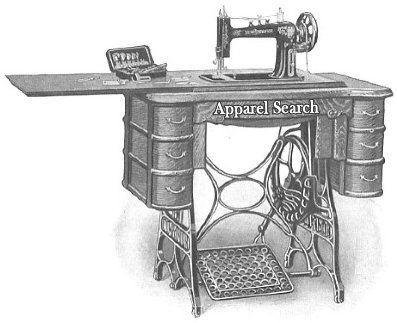
Elias Howe and Isaac Singer popularized their use and they became a fixture in households worldwide.
Today the use of treadle textile machines is mostly relegated to hobbyists and historical re-enactors, but they remain in use in the developing world.
The word treadle is from Old English: tredan, "to tread".
Learn more about sewing machinery from the sewing machine defintion.
Vintage sewing machinery is sometimes used as home decor. The treadle base can be used to make a table base, and other types of interesting furnature.
How a Treadle Turns Foot Power into Stitches
The treadle itself is only the pedal, but it works as part of a simple and durable drive system. The pedal is a broad iron plate, hinged at the back, that the sewer rests both feet on and rocks in a steady heel-and-toe motion. Beneath it, a connecting rod — the pitman rod — joins the pedal to a crank on the axle of a large flywheel set low in the machine stand. Each rock of the pedal pushes and pulls the rod, and the crank turns that back-and-forth movement into continuous rotation of the flywheel.
The flywheel does two jobs. Its weight stores momentum, smoothing the pulses of the pedal strokes into an even turn, and a groove around its rim carries a belt — traditionally leather — up to the smaller handwheel of the sewing machine head. Because the flywheel is much larger than the handwheel, each turn of the flywheel spins the handwheel several times, so a comfortable rocking pace produces a practical stitching speed. The sewer controls that speed entirely with the feet: rock faster to sew faster, ease off to slow down, and stop the pedal to stop the needle.
That foot-powered drive was a genuine advance over the hand-crank machines that came before it. A hand crank ties up one hand with powering the machine, leaving only the other hand to steer the work. A treadle frees both hands, so the sewer can guide fabric with both hands, manage curves and corners more precisely, and keep long seams feeding evenly. For dressmakers, tailors and home sewers producing clothing seam after seam, that combination of steady power and two free hands made the treadle machine the standard household and small-workshop tool for decades.
One Pedal, Many Machines
Sewing machines were the most familiar treadle machines, but the same principle powered much of the textile work of the pre-electric era. Spinning wheels used a treadle to turn the wheel while the spinner's hands drafted the fibers, and hand looms used treadles — often several of them — to lift and lower the shafts that open the shed for the shuttle; on a loom, the pattern of treadles pressed in sequence is part of how the weave pattern is created. Foot-powered lathes, scroll saws, grindstones and other small workshop machines relied on the same pedal, rod, crank and flywheel arrangement.
The word itself records how the power is supplied: treadle comes from Old English tredan, meaning “to tread.” Elias Howe and Isaac Singer popularized the treadle sewing machine in the nineteenth century, and treadle stands — a cast-iron base with the pedal, flywheel and legs, topped by the machine in a wooden cabinet or table — became a fixture in households worldwide. The stands were built to last, which is why so many survive: the iron base is heavy, stable and repairable with simple parts such as a new leather belt.
Treadles Today
Electric motors took over sewing during the twentieth century, offering push-button power without legwork, and most treadle machines left everyday service. Their use today is mostly among hobbyists, quilters and historical re-enactors who value the quiet, unhurried rhythm of foot power and the fine low-speed control it gives. Treadle machines also remain in practical use in the developing world and in other settings where electricity is unreliable, expensive or unavailable: a treadle machine needs no power supply, produces no motor noise, and can be maintained with basic tools.
Vintage treadle equipment has found a second life outside sewing as well. The cast-iron treadle base is frequently reused as a table base, and complete treadle stands and machine heads are collected, restored and used as home decor. For the fashion industry, the treadle's importance is historical but foundational: it was the power source that carried home and small-scale clothing production through the decades between hand sewing and the electric factory age, and the sewing vocabulary of that era — including the treadle itself — still appears wherever vintage machinery is bought, sold, restored or described.
Common Questions
What is a treadle?
A treadle is a mechanism operated with a pedal for converting reciprocating motion into rotating motion. On a sewing machine it is the foot pedal below the machine, and rocking it drives the flywheel and belt that power the stitching.
How does a treadle sewing machine work?
The sewer rocks the treadle pedal with both feet. A pitman rod connects the pedal to a crank on a large flywheel, turning the rocking motion into rotation, and a belt carries that rotation up to the machine's handwheel so the needle stitches while both hands guide the fabric.
Are treadle sewing machines still used today?
Yes, on a smaller scale. Treadle machines are used by hobbyists and historical re-enactors, and they remain in use in parts of the developing world and other places where electricity is unreliable or unavailable. Vintage treadle bases are also reused as table bases and home decor.