Digital Fabric Printers Guide
Welcome to the digital fabric printer guide, developed to help the apparel and textile industries locate production resources — and to explain what digital printing on fabric actually is, from its late-1980s beginnings to direct-to-garment work today.
A Directory for Production Decisions
This guide helps members of the apparel and textile industries locate production resources. If you are planning production that requires printing on fabric or printing on textiles, it would be a good idea to learn about the option of digital printing before committing to a method. Digital printing changes the economics of a print run: no screens to engrave for each color, easier sampling and short runs, photographic detail, and as many colors as a design needs. It also brings its own constraints in speed, fabric preparation, ink and fabric matching, and cost at very large volumes, which is why a guide that separates machinery, services, software, and supplies is more useful than a single mixed list.
Where can you find digital fabric printing machinery, supplies, and services? This hub answers with its companion pages. Digital Fabric Printing Services lists studios and services that print for you. Digital Fabric Printers covers the machinery makers. Further pages in this section cover digital fabric printing software and digital printing supplies, and the wider Textile Printing Guide places digital methods beside the traditional printing routes they complement and, in some work, replace.
What Digital Fabric Printing Is
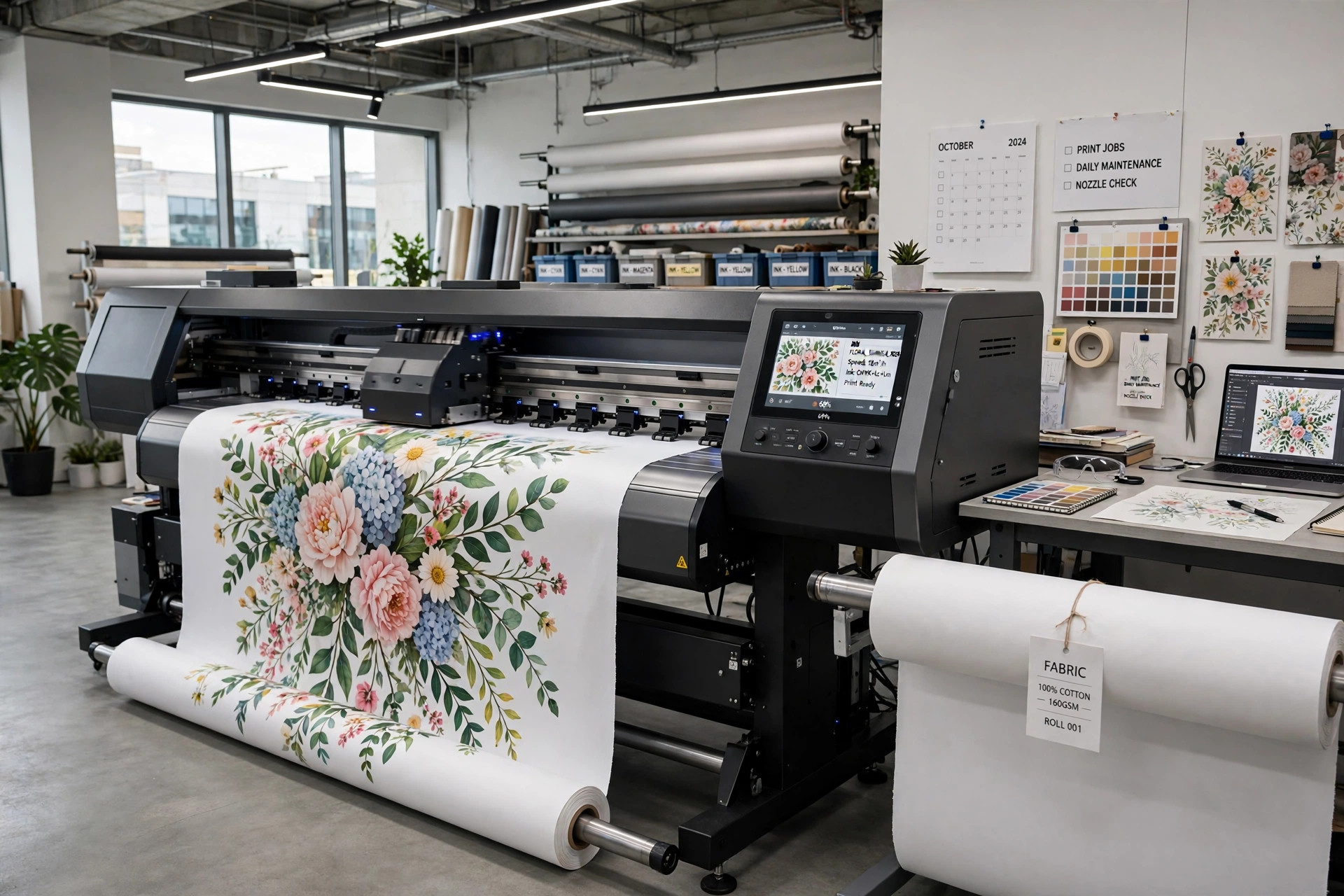
Digital textile printing is any inkjet-based method of printing colorants onto fabric. That broad definition is useful: if an inkjet process puts colorant on textile media, it is digital textile printing, whether the machine prints a single garment, a roll of dress fabric, or furnishings yardage. Most notably, the term is used for printing smaller designs onto garments — T-shirts, dresses, and promotional wear, abbreviated as DTG, which stands for direct to garment — and for printing larger designs onto large-format rolls of textile. Those two uses share printhead and ink technology but differ in handling, preparation, throughput, and the businesses that buy them, so keep them distinct when reading suppliers' claims.
Ink and fabric must be matched. Reactive, acid, pigment, and disperse colorants suit different fibers and end uses, and fabrics may need pre-treatment, steaming or fixation, and washing to reach their final hand and fastness. A beautiful file is only the start; color management, printer and RIP technology, fabric preparation, and post-treatment decide whether the cloth that arrives matches the design that was approved. The service and machinery pages in this section return to those variables from the buyer's and the operator's sides respectively, which is why this hub explains the process before sending you to either list.
A Short History: From Screen Replacement to Sublimation
Digital textile printing started in the late 1980s as a possible replacement for analog screen printing. Early systems were slow and limited, valued first for sampling and strike-offs, where avoiding screens saved days even if production still ran on screens. With the development of a dye-sublimation printer in the early 1990s, it became possible to print with low-energy sublimation inks and high-energy disperse direct inks directly onto textile media, as opposed to printing dye-sublimation inks on transfer paper and, in a separate process using a heat press, transferring it to the fabric. That distinction — direct printing versus transfer printing — still structures product ranges, especially for polyester sportswear and display textiles where sublimation and disperse inks excel.
From those beginnings, digital printing grew along two paths at once. Garment printing made short runs, personalization, and print-on-demand commercially ordinary, letting a design be sold before any inventory was printed. Roll printing made sampling faster, shortened development cycles for mills and brands, and opened production niches where design detail, color count, or run length made screens uneconomic. Neither path erased screen printing, which remains formidable at long runs and for certain effects; instead, production planning became a genuine choice among methods, made design by design. This hub exists to help you make that choice with the right resources in hand.
Choosing Your Next Step in This Section
If you own no equipment and need cloth printed, start with services: a good service bureau will advise on files, fabrics, and quantities while its machines carry the capital cost. If you print repeatedly, are building an in-house facility, or supply other printers, start with machinery, and weigh software and supplies alongside the printer itself, because workflow and consumables decide daily output as much as the headline machine does. If you are still deciding whether digital suits a program at all, compare a digital sample against a screen sample of the same design on the same fabric, and judge detail, hand, fastness, unit cost, and lead time together rather than by print quality alone.
If you can think of additional categories for this directory, please share your thoughts. Digital printing keeps adding categories — new ink sets, new garment and roll systems, new design-to-production software — and a directory that adds categories carefully stays useful longer than one that chases every announcement. Learn more about Digital Fabric Printing in the wider Apparel Search coverage, then return here to choose between services, machinery, software, and supplies.
A Digital Textile Printer at Work

Looking for Fabric Mills and Suppliers?
For printing in the broader fabric world and suppliers of every kind, explore the main Fabric section on Apparel Search, or return to the Fabric Search hub for the other fabric guides.