Herringbone Pattern Guide: Coats, Suiting and Accessories in the Broken Twill
Herringbone explained: how the broken-twill weave is made, herringbone overcoats and jackets, fine herringbone suiting, and scarves, caps and accessories that carry the pattern.
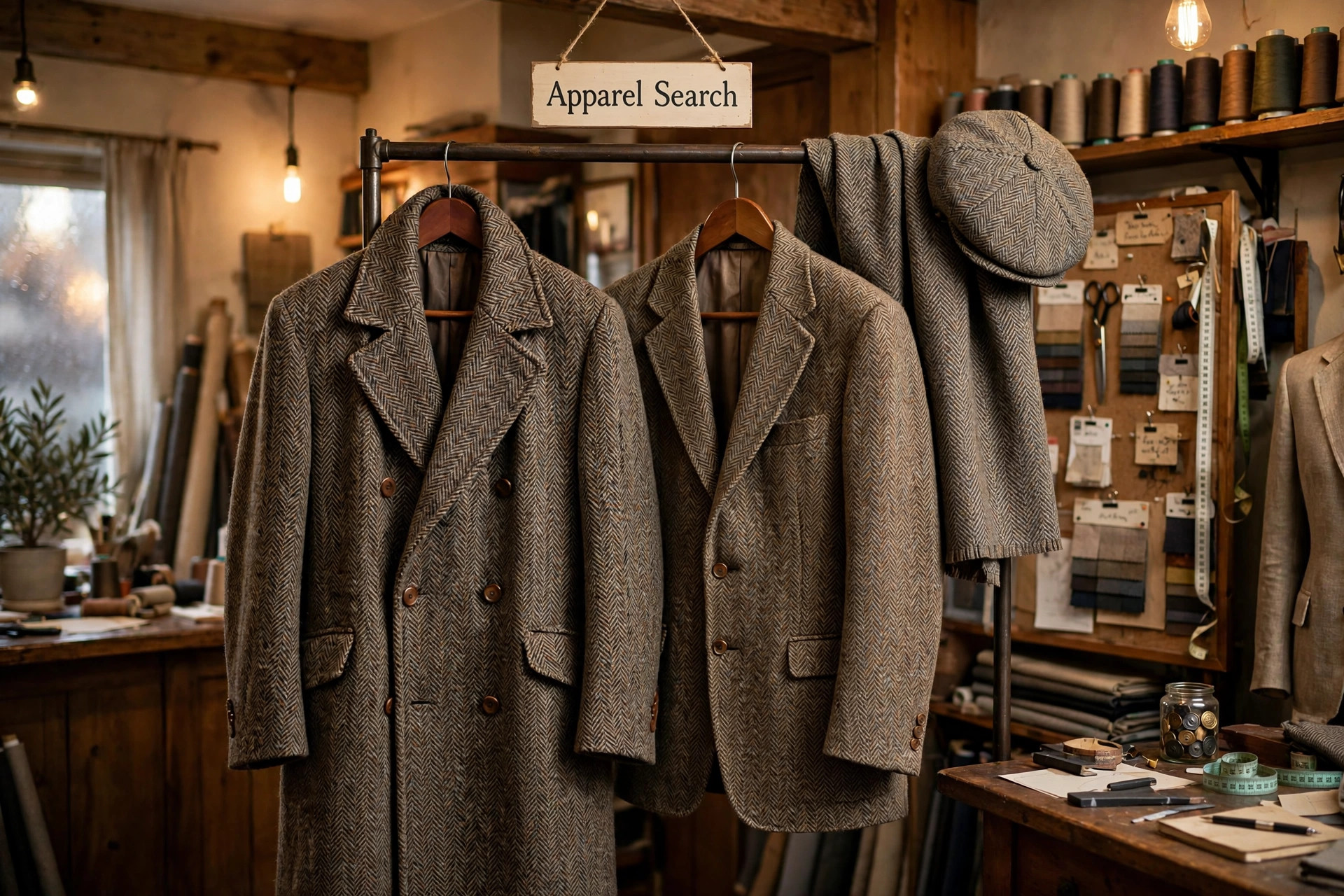
Herringbone is a twill pattern whose diagonal lines reverse direction at regular intervals, forming a broken zigzag named for the skeleton of a herring. Woven into tweeds and tailoring — and imitated in knit stitches — it gives coats, suits and accessories pattern that reads as texture.
The Weave Behind the Pattern
Herringbone starts as a simple twill: warp and weft threads interlace diagonally. Where a plain twill runs one way, herringbone flips direction every few threads, and the meeting points form the distinctive chevron-like columns. Because the colour contrast usually comes from flecked, mixed yarns rather than printed dye, a herringbone cloth rewards close looking and photographs as texture from any distance. The cloth side of the trade is covered by the herringbone fabric mills directory, and the closely related tweed definition explains the flecked wool yarns herringbone is most often woven from.
Herringbone Coats and Jackets
The herringbone overcoat is the pattern's flagship garment: a grey or brown herringbone tweed coat has been standard winter dress for men and women for a century because it hides wear, pairs with every trouser colour and suits both city and country. Blazers follow the same logic at jacket weight. A herringbone jacket over a plain sweater and flannels is a complete smart outfit; the pattern is quiet enough for an office yet far less flat than a solid cloth. Women's herringbone coats and tailored jackets use the identical cloth, often cut longer or belted.
Herringbone in Suiting and Accessories
In suiting, fine herringbone in worsted wool reads almost solid at conversational distance and reveals its structure only up close — the reason it is a safe first patterned suit. Scale decides the effect: pinhead herringbone for business suits, bold wide columns for country coats. Accessories carry the pattern furthest: herringbone scarves, flat caps and gloves add the texture to a plain coat, and the same zigzag geometry appears in metalwork as the herringbone chain necklace, whose flat interlocking links mimic the weave. Knitted herringbone stitch scarves and sweaters reproduce the effect in yarn.
Weight matters as much as scale. A herringbone coat cloth is brushed and heavy, built to shed weather; a herringbone suit cloth is smooth and light. The same zigzag in a summer cotton jacket reads as a different fabric altogether, which is why herringbone appears in wardrobes in every season while most tweeds stay in winter.
Wearing Herringbone Well
Treat herringbone as a neutral. It pairs with solid colours, with stripes in shirts and with small checks, provided the scales differ. Two herringbones in one outfit almost never work unless they are a matched suit. For the full pattern family, return to the knit patterns guide.
Common Questions
What is the difference between herringbone and chevron?
Chevron is a continuous zigzag — an unbroken V repeated across the cloth. Herringbone is a broken zigzag: short diagonal twill lines that reverse direction, leaving small offsets where the columns meet. The break is what gives herringbone its woven, textured look.
Is herringbone appropriate for a business suit?
Yes, in its fine worsted form. A small-scale grey or navy herringbone suit reads as solid from a few paces away and is a long-standing business standard. Save bold, wide herringbone tweeds for jackets, coats and country clothing.
Does herringbone have to be wool?
No. Wool tweed is the classic cloth, but herringbone is woven in cotton for summer jackets, in linen blends, and in silk for scarves and ties. The pattern is a weave structure, not a fibre, so any yarn that holds a twill can carry it.