Capes Manufacturers
A factory directory for fashion capes, costume capes and salon capes.
A cape is one of the oldest garment forms in the world and still a working category in modern manufacturing, covering everything from fashion capes and costume capes to the practical salon capes used in hairdressing. This directory lists factories and manufacturers that produce capes, so designers, costume buyers and salon suppliers can find a production partner.
Cape manufacturing rewards factories that handle flowing, full-cut garments well. A cape uses a lot of fabric, hangs from the shoulders rather than the waist, and succeeds or fails on drape, so the makers below tend to be experienced with costumes, formal accessories or salon textiles rather than basic cut-and-sew basics.
Cape Manufacturing Resources
Types of Capes Factories Produce
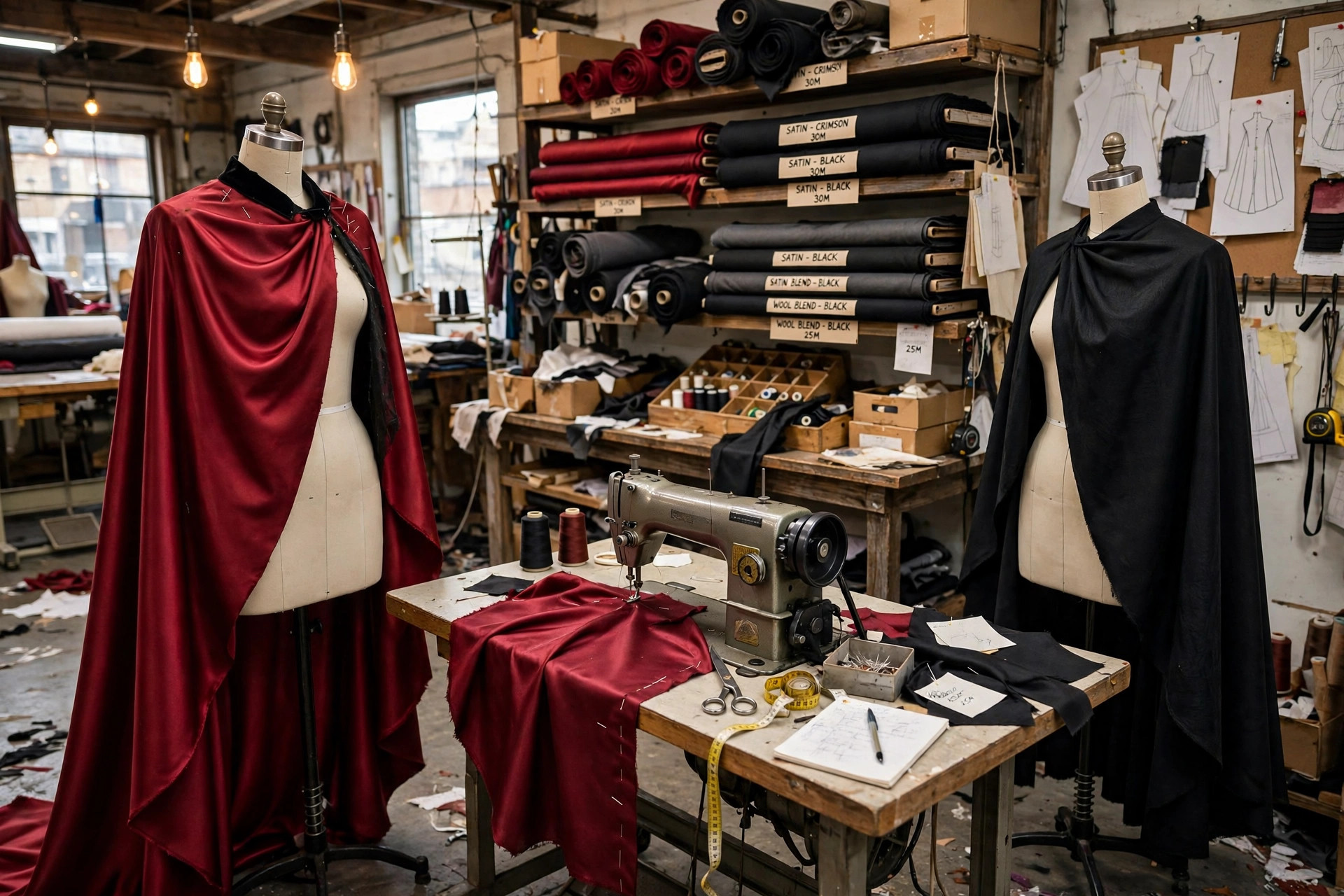
Fashion capes are made in wool, cashmere blends, satin and lace, cut from a half-circle to a full circle depending on the swing the designer wants, and finished with closures ranging from a single button to frog fastenings and ribbon ties. Costume capes, a major part of this category, are produced in volume for carnival, Halloween and theatre, usually in lighter polyester fabrics with satin linings. Salon capes are a different product again: waterproof or chemical-resistant smocks and cutting capes, often in PVC-coated or treated nylon, sized for adults and children and made to be wiped down or laundered constantly.
How a Cape Is Manufactured
Because a cape is essentially one large shaped panel, pattern economy matters. Markers are planned to nest the big curved pieces efficiently, and full-circle styles may be cut in panels with seams placed at the back or sides. After cutting, the work is in the finishing: hems on a long curved edge must be eased so they do not ripple, necklines take a facing, collar or hood, and closures are reinforced because the entire garment hangs from that one fastening point. Lined capes are bagged out and pressed carefully so the lining, usually a slippery satin, sits a fraction shorter than the shell and never peeks below the hem.
For salon capes the process is more industrial: treated fabrics are cut in stacks, snap or tie closures are set by machine, and the finished capes are checked for coating defects and water resistance rather than drape.
Working With a Cape Factory
Send a prospective factory a clear specification: the circle fullness you want, finished length at center back, fabric and lining, closure type, and whether the style includes a hood or collar. Ask for a sewn sample before committing, and judge it hanging, not flat, because a cape only shows its quality in motion. Minimums vary widely: costume and salon cape factories run large volume, while fashion cape makers may accept smaller runs at a higher unit price. Salon buyers should also confirm the cape’s closure format and chemical resistance rating, since those two specifications decide whether the cape suits cutting, coloring or shampoo work.
Cape Factory Listings
Manufacturers producing capes, costumes and salon capes.
Leadtex Clothing
(China) Capes and costumes manufacturer. Established in 1995, they are a professional costume manufacturer located in Jiangsu Province. Since their foundation they have expanded their business scope significantly, accumulating much experience in controlling the quality of materials and patterns.
Manufacturer items: capes, costumes.
Mademoiselle, Inc.
(USA) Mademoiselle, Inc. has served the ladies accessory market since 1940, and is one of the few remaining manufacturers whose scarves are made in the United States. Mademoiselle buyers also search the globe for attractive and innovative products that can be worn and enjoyed by women every day. Mademoiselle products can be found in ladies specialty boutiques, hospital gift shops, catalogs and other retailers throughout the country.
USA manufacturer of scarves and capes.
Address: 4200 W. Schubert, Chicago, IL 60639, USA. Phone: 800-992-5580. E-mail: mademoiselleinc@sbcglobal.net
QingDao Topfibre Co. Ltd.
(China) Professional manufacturer of salon capes, aprons and smocks in China, producing hair cutting capes, shampoo capes, hair dying capes, styling capes, salon gowns, barber aprons (dresser aprons), kids capes, beautician uniforms and disposable capes. Established in 1998, Topfibre concentrates on quality of service, keeping the customer happy, and completes transactions on delivery of the goods: quick, clean and efficient.
Common Questions
What fabrics are used to make capes?
Fashion capes use wool, cashmere blends, satin and lace; costume capes are usually polyester with satin linings; salon capes are made from waterproof or chemical-resistant treated nylon and PVC-coated fabrics that can be wiped down or laundered frequently.
What should be included in a cape production specification?
State the circle fullness (half, three-quarter or full), the finished center-back length, shell and lining fabrics, the closure type, and whether the style has a hood, collar or stand neckline. A sewn sample judged while hanging is the best check of drape.
Why do cape hems ripple, and how do factories prevent it?
A cape hem is a long curved edge, and if the fabric is stretched during sewing it relaxes into waves. Factories prevent it by easing the hem allowance evenly, using the right presser-foot tension for the fabric, and pressing the finished edge so it lies flat in a smooth curve.