There is no runway on earth with the audience of an Olympic opening ceremony, and no fashion show where the models are also the nations. On February 6, 2026, more than ninety delegations walked into Milan's San Siro stadium — with parallel celebrations in Cortina and other host towns — wearing the most considered outfits most of them will ever own. In a fashion capital, at Games themed on harmony, the clothes were a competition of their own.
These were the looks that defined the night: a cashmere robe from Mongolia that stole the show for the second straight Games, a farewell uniform from Giorgio Armani, Canada's map of itself in red, and the winter-white Americans. Our companion feature covers Team USA's Ralph Lauren wardrobe in full.
The Parade of Nations Is a Fashion Show
Every Olympic uniform answers the same impossible brief: be instantly readable as a country from the back row of a stadium, be warm enough for a February night in the Alps, photograph beautifully, and say something true about home. The designers who answer it range from the biggest houses in fashion to tiny national labels, and the results are judged instantly and globally — a modern ceremony's style coverage rivals its sports coverage. Milano Cortina raised the stakes by geography alone: when the host city is Milan, every delegation knows the clothes will be read.
The Night's Winner, Again
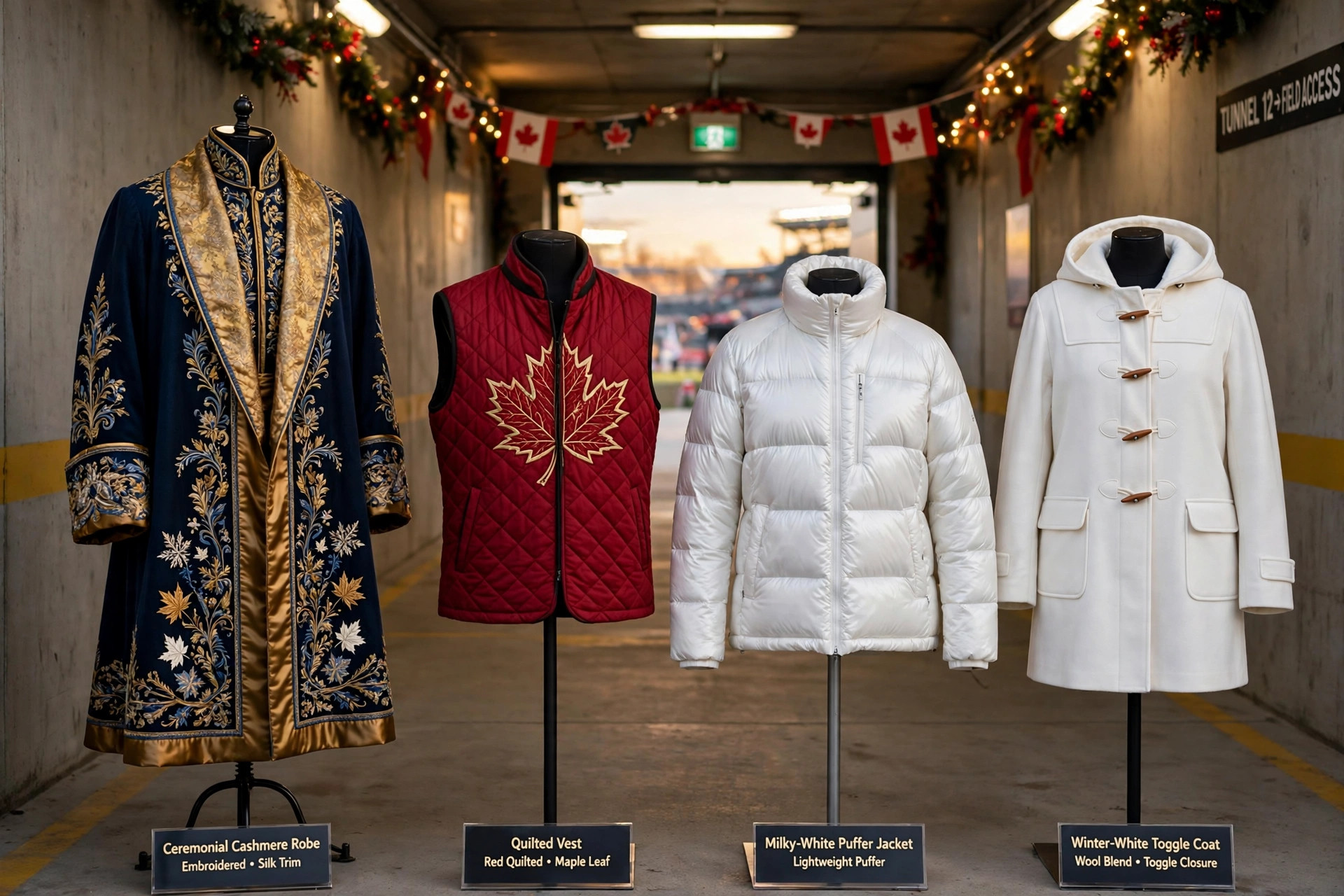
Mongolia's ceremonial outfit was a deel — the robe Mongolians have worn for a thousand years — reimagined for the ceremony in the country's own cashmere, with silk trim and embroidery of traditional horn motifs, its design drawn from the era of the Great Mongol Empire. Goyol Cashmere, one of the world's largest cashmere producers, had already produced Paris 2024's most beloved uniform; in Milan it did it again, and style guides from USA Today onward put Mongolia at the top of the night's best-dressed lists. The lesson travels: heritage, honestly worn, beats spectacle.
A Farewell in Milky White
The host team's kit carried the heaviest story of the Games. Giorgio Armani died in September 2025, making the EA7 Emporio Armani wardrobe for Milano Cortina the last Olympic uniform created under his direction — his fourth Winter Games dressing Team Italia. The kit was milky white, meant to evoke harmony and snow-covered peaks: down jackets, a thermal ski jacket, waterproof trousers, and a star piece — an oversized bomber with “Italia” worked across it and a high knit collar in the green, white and red of the flag. Milan honored its most famous designer with a tribute inside the ceremony he had dressed.
The Country as a Map
Lululemon's third Games for Canada printed the nation onto the clothes: a topographic map of Canada ran across the podium team's bright red puffers, in a palette moving from deep red to iceberg green and blue. The opening ceremony look — a maroon quilted vest with an oversized maple leaf — divided opinion, which is its own kind of success on a night of safe choices. The quiet triumph was the Paralympic wardrobe: seated-fit styles, magnetic zippers and braille details designed in from the start, adaptive clothing treated as design rather than accommodation.
Winter White in a Sea of Color
Ralph Lauren's tenth Games for Team USA went monochrome: a winter-white wool toggle coat, a flag knitted into a turtleneck as intarsia, tailored trousers — craft techniques and restraint against a field of saturated national color. It is covered piece by piece in our Team USA feature.
The Supporting Cast
The depth of the field is the story of modern ceremony fashion. France walked in Le Coq Sportif, the heritage French sport label; Haiti's tropical-print looks by Stella Jean continued her celebrated run of dressing the Haitian team as wearable national art; Iceland arrived in the technical white gear of 66°North, a workwear company from a fishing village that became a global outerwear name. Ninety nations, ninety arguments about what a country looks like — made, for one night, entirely out of cloth.
Soft Power, Sewn
An opening ceremony uniform is the cheapest global advertising a nation can buy and the hardest to fake: it has to be true. Mongolia's two consecutive triumphs were earned by a domestic cashmere industry dressing its own athletes in its own heritage garment. That is why the ceremony has become fashion's most honest runway — the clothes are not selling a fantasy of a country. They are the country, tailored.
How to Read a Ceremony Uniform
Three questions decode any delegation's look. What is it made of? The strongest uniforms use a national material — Mongolian cashmere, American wool, Icelandic technical shells. What silhouette did they choose? Heritage garments (the deel) say continuity; tailored coats say formality; puffers and tracksuits say the future is athletic. Where is the flag? Knitted in, printed over, worn at the collar or carried on a sleeve — the placement is a small essay in national temperament. Milano Cortina's best looks answered all three questions without hesitation. The next class walks in Los Angeles in 2028, where the home team's designer has already been at work for months — and where every nation now knows the ceremony is judged as fashion, because in Milan it was.
The fashion program ran deeper than the delegations. The uniforms worn by the Games' volunteers, workforce and torchbearers were developed with Salomon, the French outdoor company — thousands of workers dressed as a single designed system, in the host country's own technical idiom. A modern Olympics is dressed at every level now: athletes by fashion houses, officials by technical brands, and the whole event read, stitch by stitch, by an audience that has learned to look.
Common Questions
Which team was best dressed at the Milano Cortina 2026 opening ceremony?
By broad consensus of the style coverage, Mongolia. USA Today's opening ceremony style guide put Team Mongolia first, as it had after the team's viral Paris 2024 moment: Goyol Cashmere dressed the delegation in a modern ceremonial deel — the traditional Mongolian robe — in Mongolian cashmere with silk trim and embroidered horn motifs, inspired by the dress of the 13th- to 15th-century Mongol Empire. It was the night's clearest example of a small nation's uniform outperforming the big fashion powers at their own game.
Why was Italy's 2026 uniform so emotional?
Team Italy's EA7 Emporio Armani kit was the last Olympic uniform created under Giorgio Armani himself. Armani, who founded modern Italian ready-to-wear and dressed Italy at four Winter Games through his EA7 line, died on September 4, 2025, at 91. The milky-white kit — snow-colored, with 'Italia' worked across an oversized bomber jacket and the flag at the collar — was presented in his home city, and he was honored with a tribute during the opening ceremony itself.
What did Canada wear at Milano Cortina 2026?
Lululemon, in its third consecutive Games as Team Canada's outfitter, built the wardrobe around the country's geography: a topographic map of Canada printed across podium puffers and woven through a palette of deep reds and iceberg blues and greens. The opening look centered on a maroon quilted vest carrying an oversized maple leaf. The Paralympic wardrobe drew particular praise for adaptive design — seated fits, magnetic zippers and braille details built in rather than adapted afterward.
Do Olympic athletes get to keep their ceremony uniforms?
Yes — the ceremony wardrobe is issued to the athletes as theirs. A modern Olympic kit is extensive: Team USA's athletes, for example, received around 30 pieces including village wear beyond the two ceremony looks. The uniforms are also produced as retail collections in many countries, which is why a team's opening ceremony walk doubles as the launch of a commercial capsule line.
Related Reading
Search Apparel Search