Who Invented Booties Footwear?
An honest answer: this is one fashion staple nobody can credibly claim.
There is no documented single inventor of booties. No patent, designer, or dated launch is reliably credited with creating them, because booties were not invented in a single moment — they developed gradually as a hybrid footwear style, part shoe and part boot, cut to end at or just above the ankle. When a style emerges that way, across many makers and many seasons, history records the style rather than a person.
That may be a less satisfying answer than a name and a date, but it is the truthful one, and it is typical of footwear. This page explains what actually defines a bootie, why the question has no neater answer, and how to shop for the style with confidence even without an inventor to attach to it.
Footwear Guides & Questions
A Shoe-Boot Hybrid, Not a Single Invention
A bootie occupies the middle ground of the shoe closet. It has the closed, supportive structure of a boot, but it stops low — at or just above the ankle — where a boot would keep climbing the leg, and it is styled and worn the way a shoe is, with dresses, skirts, trousers, and jeans across most of the year. That in-between identity is the whole point of the style, and it is also why no inventor story attaches to it: hybrids arise by trimming and adapting existing forms, not by inventing new ones from nothing.
Shoemakers have always shortened and lengthened footwear to suit weather, work, and fashion. An ankle-height boot is an obvious, useful answer to a recurring problem — how to get a boot's coverage and sturdiness without a boot's height, weight, and warmth — so versions of the idea appeared wherever boots were worn. Fashion later adopted the shape, refined it with heels, finer leathers, suede, buckles, and cut-out details, and gave the result its diminutive, affectionate name: booties, the little boots.
What Makes a Bootie a Bootie
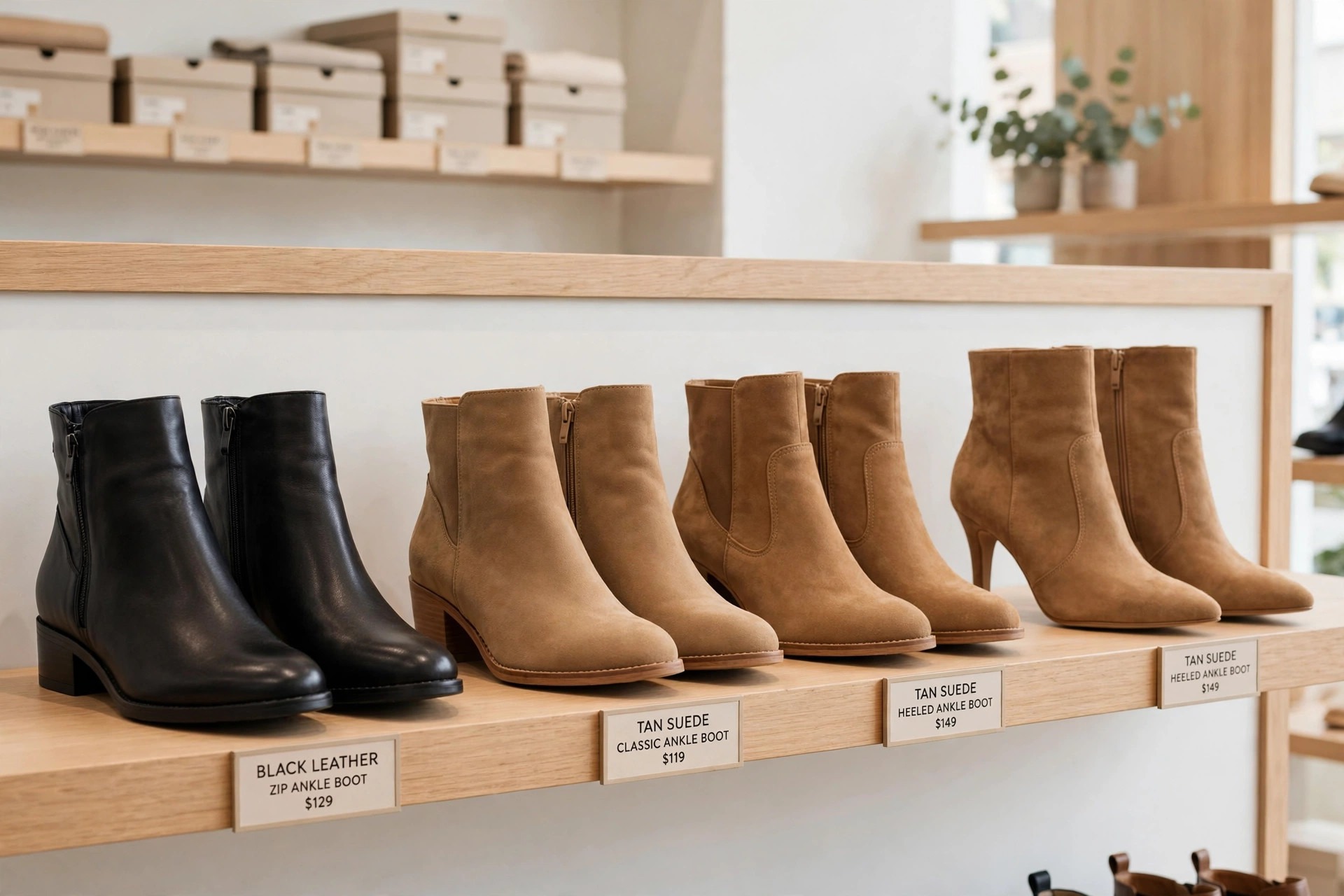
Height is the defining feature. A bootie ends at or slightly above the ankle bone; significantly higher and you are looking at a short boot, and significantly lower, with the ankle fully exposed, you are looking at a shoe. Beyond height, booties vary enormously: flat or heeled, pointed or round toed, lace-up, zippered, or pull-on, in leather, suede, fabric, or synthetic materials, and in looks ranging from rugged and work-ready to sleek and evening-appropriate.
That variety explains the question shoppers often ask alongside the inventor question — are booties shoes or boots? The honest answer is that they are deliberately both. Retailers file them with boots because of their structure and coverage, while stylists deploy them as shoes because of their proportions and versatility. Neither filing is wrong; the category was built, by many hands over a long period, to sit exactly on that border.
Why So Many Styles Have No Inventor
Fashion loves an inventor story, and a few garments genuinely have one — a named designer, a dated debut, a documented first. Most everyday styles, however, evolve the way booties did: anonymously, incrementally, and in many places at once, as makers respond to the same needs and copy each other's good ideas. Shortening a boot required no new technology, no new material, and no permission, so nothing stopped the ankle boot from being reinvented continually until it was simply part of the standard footwear vocabulary.
Treat any source that names a lone inventor of booties, without a patent or contemporary record behind the claim, with friendly skepticism. The absence of an inventor is not a gap in the record waiting for a hero; it is the normal history of a practical style. What can be traced is the style's rising and falling popularity as hemlines, trouser cuts, and tastes change — booties surge whenever cropped pants and shorter skirts make the ankle a focal point of an outfit.
Wearing and Choosing Booties Today
Because the style bridges shoe and boot, booties work across more of the wardrobe than almost any other footwear. Ankle height pairs naturally with cropped and rolled trousers that show the top of the bootie, with jeans of nearly every cut, and with dresses and skirts where a tall boot would overwhelm the line. A small heel adds polish for evening wear, while flat, sturdy versions handle everyday walking with a boot's support and a shoe's lightness.
When choosing a pair, fit at the ankle is the detail to judge carefully: too loose and the bootie gaps and rubs, too tight and it fights the ankle bone with every step. Check that the opening clears the bone comfortably, that the heel height suits how much walking you actually do, and that the material matches your weather — suede is beautiful and fair-weather, while smooth leather shrugs off a wet pavement far better. The unnamed generations of shoemakers who developed the style would approve of judging it the practical way: by fit, not by story.
Common Questions
Are booties shoes or boots?
They are intentionally both. A bootie has a boot's closed structure and ankle coverage, but it is proportioned and worn like a shoe, pairing with dresses, skirts, and cropped trousers across most seasons. Retailers usually shelve booties with boots, while stylists use them wherever a polished shoe would go. The hybrid nature is the definition of the style, not a contradiction — booties were developed precisely to sit between the two categories.
Why is there no known inventor of booties?
Because booties evolved rather than being invented. Shortening a boot to ankle height is a simple, practical adaptation that many shoemakers arrived at independently, long before fashion adopted and named the style. There is no founding patent, designer debut, or dated first pair to credit. Most everyday footwear and clothing styles share this pattern: they develop gradually through countless makers, and history records the style itself instead of a single creator.
What is the difference between booties and ankle boots?
In practice, very little — the two terms describe the same ankle-height footwear, and many retailers use them interchangeably. Booties tends to suggest the more fashion-forward, shoe-like end of the range: dressier materials, finer heels, and styling with skirts and dresses. Ankle boots leans toward the sturdier, more casual end. If a distinction matters when you shop, judge the individual pair by its height, heel, and material rather than by which name it carries.
If You Have More Questions About Fashion
You may want to try these sections here on Apparel Search: