CRM Software for the Fashion Industry
Customer relationship management built around how fashion actually sells: accounts, seasons and style-level demand
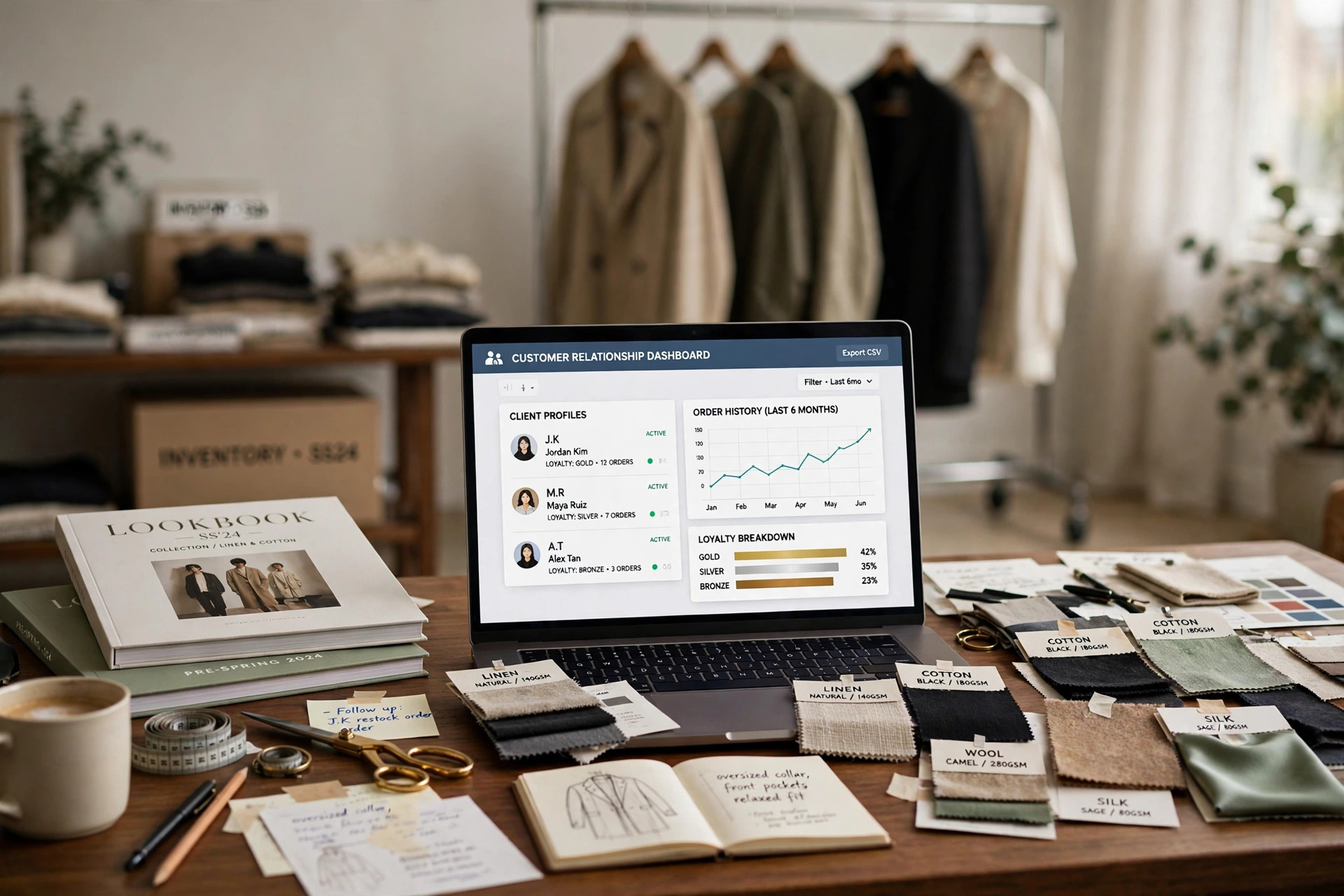
CRM — customer relationship management — software holds what a fashion company knows about its customers in one place: who they are, what they bought, what they were shown, what they returned and what they are likely to want next. For a wholesale apparel business those customers are retail accounts with buyers, seasons and credit terms; for a retail brand they are shoppers with sizes, preferences and loyalty. Either way, the relationship is the asset the software manages.
Generic CRM assumes a customer buys a product. Fashion customers buy a matrix — a style in colors and sizes, this season, at a price point — and they buy on a calendar. The apparel-specific systems in this directory build that reality into forecasting, order processing and account management instead of bolting it on afterwards.
Related Software Guides
What CRM Does for an Apparel Business
At the heart of every successful business are the people who make things happen, and CRM is the system that keeps their knowledge from living in notebooks and inboxes. Contact and account records, order history, correspondence and follow-ups sit in one shared place, so when a salesperson leaves or a buyer changes stores, the relationship history stays with the company. Modern CRM tools are proactive and easy to use, adapting to the way people and systems already work.
The customer side has changed as well: buyers and shoppers now know more than ever before, often making buying decisions before a sales team can engage. CRM helps the team adapt to that journey — seeing which accounts viewed a line, which styles drew interest, and where a follow-up will actually land — rather than discovering demand only when the order deadline passes.
Forecasting at Style, Color and Size Level
The most fashion-specific part of apparel CRM is demand forecasting. To get to market with the right product at the right time, a company has to anticipate demand not just by style but at the color and size level, using color and size percentages drawn from its own selling history. A forecast that is right in total but wrong in sizes is a markdown waiting to happen; the apparel suites forecast the matrix, not just the total.
In an integrated suite, that forecast feeds everything downstream — intelligent allocations of stock to accounts, advance ship notices, style-based order processing, decoration order processing for embellished product, and customer-specific packaging rules. CRM in this form is not a separate address book; it is the customer-facing layer of the same system that runs PLM, financials, import management, EDI and e-commerce.
CRM Systems in This Directory
FDM4 America builds an apparel-specific suite — CRM alongside financials, PLM, import management and a forecast module that anticipates demand at style, color and size level — offered in licensed, SaaS subscription or hosted models, with continual support through implementation and custom development as the business changes. The company brings more than 35 years in the industry; it is listed at 11500 S. Eastern Ave, Suite #150, Henderson, NV 89052, phone 866-676-3364, contact Mike Cutsey.
Microsoft Dynamics is the general-business entry: modern, adaptable business applications including CRM, designed to empower individuals with intuitive tools. Salesforce.com is arguably the most recognized CRM brand, offering a robust and comprehensive product for businesses large and small; its social commerce guidance — how to drive online sales with social shopping — is linked below as an example of CRM thinking applied to fashion retail. The vendors' pages follow in the references.
More Software Guides
Common Questions
What does CRM software do for a fashion company?
It centralizes everything the company knows about its customers — wholesale accounts or retail shoppers — including contacts, order history, preferences and follow-ups, and connects that knowledge to forecasting, order processing and marketing so the relationship survives staff changes and seasons.
How is apparel CRM different from general CRM?
Fashion demand lives at style, color and size level and runs on a seasonal calendar. Apparel CRM and the suites around it forecast demand using color and size percentages, process style-based orders, and handle fashion-specific work such as decoration orders, pre-packs and customer-specific packaging rules.
Is CRM sold separately or as part of a suite?
Both. General platforms such as Microsoft Dynamics CRM and Salesforce are standalone CRM products. Apparel specialists such as FDM4 supply CRM as one module of an integrated suite with PLM, financials, EDI, e-commerce and warehouse functions, available licensed, hosted or by subscription.