V-Neck Shirts
Fashion Terms — the Apparel Search fashion terminology directory
A v-neck top is a type of shirt, sweatshirt, sweater, jacket, etc., with a neck that has an opening shaped like the letter V. V-necks were introduced so that the neckline of the shirt does not stand out when an outer shirt is worn over it, thus reducing or eliminating the visible cloth above the outer shirt of a crew neck shirt. A V-neck T-shirt has a V-shaped neckline, as opposed to the round neckline of the more common crew neck shirt.
A v-neck top is a type of shirt, sweatshirt, sweater, jacket, etc., with a neck that has an opening shaped like the letter V.
The neck opening looks like a “V”.
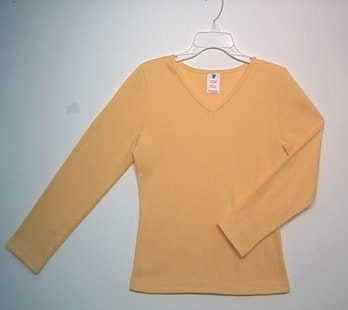
V-necks were introduced so that the neckline of the shirt does not stand out when an outer shirt is worn over it, thus reducing or eliminating the visible cloth above the outer shirt of a crew neck shirt.
A V-neck T-shirt has a V-shaped neckline, as opposed to the round neckline of the more common crew neck shirt.
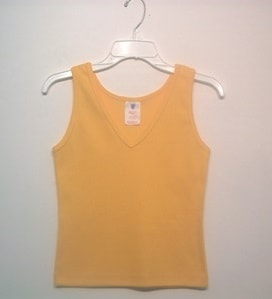
Learn more about shirt necklines in our apparel definitions section.
Thank you for using the Apparel Search website.
Choosing a V-Neck Depth
The depth of the V is the main style decision. A shallow V ends just below the collarbones and behaves almost like a crew neck, keeping an undershirt hidden under a buttoned outer shirt while showing only a small triangle under an open collar. A mid-depth V is the standard T-shirt and sweater cut: it lengthens the look of the neck, frames a pendant or chain, and layers cleanly under blazers and cardigans. A deep V drops much further and is a deliberate casual statement, usually cut in soft jersey so the point lies flat. Shoppers comparing shirts should check the band or ribbing that finishes the V: a well-made band is cut slightly shorter than the opening so it pulls the edges smooth, and it should recover its shape after a gentle stretch rather than rippling or gaping at the point, where stitching takes the most strain.
V-Neck, Crew Neck and U-Neck Compared
The three common openings differ only in geometry, but the geometry changes how a garment is worn. The crew neck's closed round opening is the warmest and the most formal of the three under a jacket, and it is the neckline that shows as a half-circle above an outer shirt — the very problem the V-neck was introduced to solve. The V-neck trades coverage for openness and a longer neck line. The U-neck follows the V downward but rounds the bottom instead of meeting at a point, softening the angle; the scoop neck widens that same curve across the collarbones. For undershirts specifically, the working rule is simple: choose a V deep enough to stay below the lowest button you leave open, and match white, black or skin-tone fabric to the outer shirt so the layer stays invisible, which is the purpose the style was created for.
Wearing a V-Neck
As a top layer, a V-neck T-shirt or sweater pairs naturally with open overshirts, unstructured jackets and scarves, and the point of the V gives a plain knit a focal detail without any print or logo. In knitwear the V is also the classic frame for a collared shirt and tie underneath, where the opening shows the knot and the collar points. Fit matters more than with a crew neck, because the open neckline draws the eye to the shoulders and chest: a V-neck that is too loose sags at the band, and one that is too tight pulls the point sideways. The retailer links carried on this page — Hanes, Nordstrom and Old Navy — show the range of depths and fabrics the style is sold in.
Common Questions
What is a V-neck shirt?
A shirt — or a sweatshirt, sweater or jacket — whose neck opening is shaped like the letter V, with two straight edges meeting at a point below the throat.
Why were V-necks introduced?
So that the neckline of an undershirt would not stand out when an outer shirt is worn over it, reducing or eliminating the visible cloth above the outer shirt that a crew neck undershirt would show.
What is the difference between a V-neck and a crew neck?
A crew neck has a round neckline that sits close to the base of the neck. A V-neck opens downward in a V shape, so it shows less above an open outer shirt and leaves the neck and collarbones more open.