Yoke of Shirts
Fashion Terms — the Apparel Search fashion terminology directory
A yoke is a shaped pattern piece which forms part of a garment, usually fitting around the neck and shoulders, or around the hips to provide support for looser parts of the garment, such as a gathered skirt or the body of a shirt. On a dress shirt the yoke is the panel under the collar that drapes over the shoulders and holds the shirt's back over the body — the piece that behaves as a hanger and creates the crisp lines of the shirt's back.
A yoke is a shaped pattern piece which forms part of a garment, usually fitting around the neck and shoulders, or around the hips to provide support for looser parts of the garment, such as a gathered skirt or the body of a shirt. Yoke construction was first seen in the 19th century. Bodice yokes were first seen in the 1880s, whilst the yoke skirt, a skirt suspended from a fitted hip yoke, was first seen in 1898.
The yoke of a dress shirt is the area under the collar, that drapes over the shoulder and holds the shirt’s backing over the body. It is essentially the piece of the garment that behaves as a hanger, and creates the crisp lines of the shirt’s backside.
Dress shirts have different types of yokes. The primary methods are a single yoke or a split yoke.
What is the difference between a “one piece yoke” and a “split yoke”? A one piece yoke is made from a single piece of fabric. A split yoke is split down the middle and sewn together in the middle.
The benefit to wearing a split yoke shirt is that it provides more stretch. The fabric of most high quality woven cottons will not stretch very much at all if you try to stretch it vertically or horizontally. However, if you try to stretch it diagonally it stretches a bit. The benefit of the split yoke is that by rotating the fabrics to the angled orientation, the design is essentially adding stretch to the yoke across it’s width. This added stretch will provide comfort to the wearer.
How to Measure a Shirt: Yoke Width
Button up the shirt and spread the shirt out on its front. Measure for the point where the yoke meets the sleeve, straight across, to the same point on the other side. When taking this measurement, pull the two ends of the yoke tight but don’t stretch the fabric.
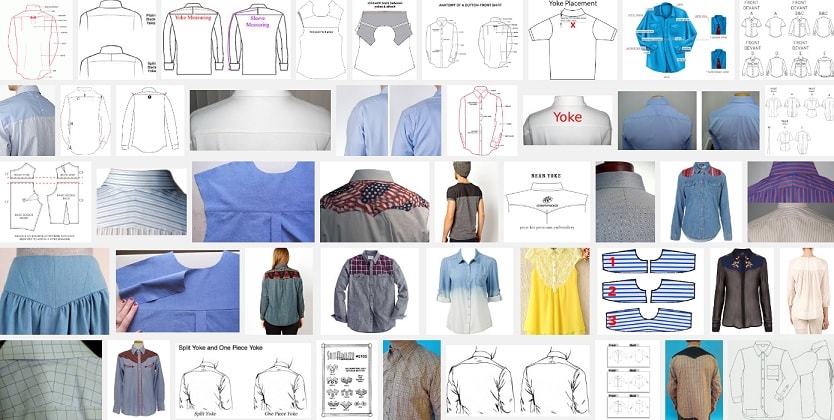
You may also want to learn about Western Wear.
If you are very interested in shirt construction, you may also want to learn about gussets.
You may want to also learn about the various types of necklines & collars for shirts.
Thank you for using the Apparel Search website.
Yokes Beyond the Shirt
The shirt yoke is the best-known example, but the same construction idea runs through many garments. A bodice yoke, first seen in the 1880s, fits the upper chest and shoulders so gathers, pleats or a fuller bodice can fall from its lower edge. The yoke skirt, first seen in 1898, hangs a gathered or flared skirt from a fitted hip yoke, which keeps the waist and hips smooth while the skirt below moves freely. Western shirts make a feature of the yoke, cutting it into points or curves across the front and back and often finishing it with piping or contrasting fabric — one reason the western wear page in this directory is a natural companion to this one. Denim jackets and jeans use a back yoke the same way, shaping the seat of the jeans and the shoulders of the jacket so the heavier fabric sits correctly on the body.
Why Yoke Construction Matters
A yoke does three jobs at once. It fits: because it is shaped and usually cut on a stable grain, it holds the garment to the body's frame at the shoulders or hips while everything below it can be cut looser. It supports: fullness such as gathers, pleats and the body of a shirt hangs from the yoke's lower edge instead of pulling directly at the neck or waist. And it finishes: the yoke seam is a visible design line, so makers use it for style — a deeper or shallower yoke, a curved or pointed edge, a contrasting fabric or a matched pattern across a split yoke's center seam all change the garment's character without changing its basic pattern. In quality shirtmaking the split yoke has a practical benefit as well as a visual one: the center seam lets each half be angled so the fabric's slight diagonal give works across the shoulders, and a careful maker can adjust the two halves independently for a wearer whose shoulders are not perfectly level.
Reading a Yoke When You Shop or Sew
For a shopper, the yoke is a quick quality check: the seam should sit evenly on both shoulders, any pattern should match across a split yoke's center seam, and the back below the yoke should hang without diagonal pulls when the arms move. For a sewer or pattern maker, the yoke line is where fit is decided — moving it changes how much fullness falls from it and where that fullness lands — and the measurement method set out on this page, across the back from sleeve joint to sleeve joint with the shirt buttoned and laid on its front, is the figure to compare against a pattern or a size chart. Related construction reading in this directory covers gussets, the small inserts that ease movement at stress points, and the necklines and collars that meet the yoke at the top of a shirt.
Common Questions
What is a yoke on a shirt?
The yoke of a dress shirt is the area under the collar that drapes over the shoulder and holds the shirt's backing over the body. It is the piece of the garment that behaves as a hanger, and it creates the crisp lines of the shirt's backside.
What is the difference between a one-piece yoke and a split yoke?
A one-piece yoke is made from a single piece of fabric. A split yoke is split down the middle and sewn together in the middle, which rotates the fabric to an angled orientation; because woven cotton stretches a little on the diagonal, the split yoke adds a bit of stretch across its width and comfort for the wearer.
How is a shirt's yoke width measured?
Button up the shirt and spread it out on its front. Measure from the point where the yoke meets the sleeve, straight across, to the same point on the other side, pulling the two ends of the yoke tight without stretching the fabric.