|
Research
jeans in
our new fashion products section.
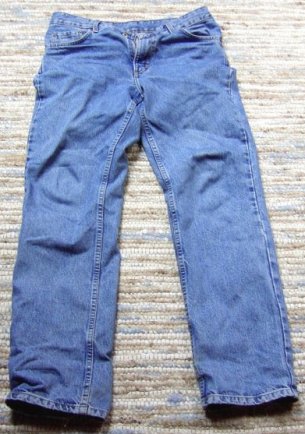
Jeans are
trousers made from
denim. Originally work
clothes, they became popular among teens starting in the 1950s.
Popular brands include
Levi's and
Wrangler.
Jeans were invented in Genoa, Italy
when that city was an independent Republic, and a naval power.
The first jeans were made for the Genoese Navy because it
required an all-purpose pant for its sailors that could be worn
wet or dry, and whose legs could easily be rolled-up to wear
swabbing the deck and for swimming. These jeans would be
laundered by dragging them in large mesh nets behind the ship,
and the sea water would bleach them white. The first denim came
from Nimes, France ... hence the name
denim. The French word for these pants was very similar
to their word for Genoa; this is where we get the term 'jeans'
today.
Jeans were developed
in America in 1853, when
Levi Strauss came to San
Francisco to open a west coast branch of his brothers' New
York dry goods business. One of Levi's customers was Jacob
Davis, a tailor who frequently purchased bolts of cloth
from the Levi Strauss & Co wholesale house. After one
of Jacob's costumers kept purchasing cloth to reinforce
torn pants, he had an idea to use copper
rivets to reinforce the
points of strain, such as on the pocket corners and at the
base of the button fly. Jacobs did not have the required
money to purchase a patent, so he wrote to Levi suggesting
that they both go into business together. After Levi accepted
Jacobs offer, on May 20, 1874, the two men received patent
#139,121 from the United States Patent and Trademark Office,
and the blue jean was born.
Jeans have been often compared to four-wheel
drive vehicles and hiking boots, because
they can go anywhere. Levis are known for
their rugged construction, personal "shrink-to-fit",
and versatility. Originally worn by miners,
farmers, and cowboys, Levis are now worn
in all walks of life.
Levis and Water
The concept of wearing
jeans in water dates from their very beginning
and continues today. Levis were originally
produced in only three sizes, and the wearer
would jump into a body of water - either
a creek, a pond, or a horse trough, to shrink
them to fit. Today, Levis are available
in a variety of styles, from tight to loose
fit, and are sold either pre-washed or shrink-to-fit.
And may never even be worn in water, if
the wearer chooses not to. However, the
best method of 'breaking-in' Levis remains
the same ... buy them with a snug fit, wear
them new, jump into a hot tub or spa --
then swim, and allow them to dry-on, for
a personal fit.
Levis are practical
for outdoor activities, most athletics,
and aquatics. The famous 'top and levis'
-- a neoprene jacket and shrink-to-fit Levis
remains one of the best skindiving and scuba
suits or diveskins, offering protection
from overexposure to the sun, stings, and
abrasion. Levis 501, 505 and 512
Red Tab are the best for swimming
and diving, and provide the same thermal
protection as 1mm neoprene. When worn with
a 2-3mm top, you can swim and dive comfortably
in water 5 - 10 degress f. cooler than you
normally would. In addition, Levis (and
Wranglers, etc.) are approximatley 1.5 pounds
negatively bouyant, enabling a diver to
descend underwater more easily than with
an all-neoprene diveskin (which is positively
bouyant, and requires lead weights to achieve
the same result). This is especially important
in open water and in the ocean - where salt
water makes the diver more bouyant than
in fresh water. The very same jeans that
might feel 'heavy' to a beginner swimmer
when they go into a pool, are a second skin
to the experienced intrepid swimmer/diver
in open water. Some swimmers and divers
reserve specific pairs of jeans and diveskin
jeans for the water, just as they do with
their neoprene wetsuits and lycra skins.
The preferred approach is to be able to
go from dryland to water and back to dryland
wearing the same jeans or skins always when
on, in, or underwater.
Jeans Used For SCUBA Diving
Levis
'skins' provide swimmers
and divers with additional
convenience because in warm
weather and climates where
a complete diveskin is needed
underwater, but not at the
warmer surface (which might
cause over-heating), the
neoprene jacket can be removed
and you can swim with just
your jeans or with a lycra
top. Most swimmers and diver
combine their 'skins' with
dive fins and a mask/snorkle
for a very practical and
functional set of swim/dive
gear. The surge in the denim
fabric acts as shark dendrils
in that it funnels the water
over the swimmer/diver's
body allowing them to become
hydrodynamic and swim faster
underwater.
Water Rescue
Rescue Divers, Aquatic
First Responders, and Rescue
Swimmers find jeans
practical and a life-saving
measure because of their
versatility and because
they protect the rescuer
from sharp metal and fiberglass
when doing saves resulting
from boat accidents and
submerged vehicles. Jeans
or skins enable the rescuer
to be prepared to swim and
dive to respond to an in-water
emergency without the added
inconvenience and waste
of precious time required
to 'suit-up'. It must be
remembered that if the rescuer
is put at risk or injured
while responding to a water
emergency, then the victim
might encounter more serious
injury or even face death.
Additionally, the increased
protection that Jeans and
Skins provide in water allow
the rescuer to face risks
more boldly during storms
and place themselves between
the victim and hazards in
the water such as a rocky
shoreline, piers and jettys,
to prevent the victim from
sustaining more injury during
egress from the water.
During World
War II,
families
in the U.S.
would send
Levis to
their sons
in the U.S.
Navy and
U.S. Marines
stationed
in the Pacific
-- beause
their fit
was better
for swimming
than the
baggy dungarees
issued by
the military.
In the U.S.,
Levis first
became widely
popular
for swimming
in the 1960's
with the
introduction
of "White
Levis"
for surfers
on the West
Coast. White
Levis fit
lean and
tapered,
and made
of unbleached,
unshrunk
denim, which
shrank and
bleached-out
to a perfect
white in
chlorinated
pools and
in the ocean.
Jeans in
Advertising
It is only
expected
that any
product
which emphasizes
fun, adventure,
and athletics
in a water
environment
would be
appealing.
Consequently,
Levi's
have been
advertised
in a variety
of underwater
commercials
where the
athletic
guy always
attracted
the pretty
girl, including
The Mermaid,
The Levis
Swimmer,
The French
Dictionary,
and numerous
scuba diving
and beach
commercials
in the 1990's
and early
2000's.
Advertised
as 'your
second skin',
Levis are
considered
by athletic,
intrepid
swimmers
and divers
to be an
extension
of their
aquatic
body, and
are worn
for swimming,
diving,
whitewater,
snorkling
and scuba.
Levis Strauss
has shrink
tanks in
some of
it stores,
allowing
the customer
to purchase
a pair of
jeans, submerge
in a tank
of water
while their
new jeans
shrink,
and then
stand in
front of
a 'human
dryer' to
dry their
jeans, so
that their
new Levis
will shrink
to a personal
fit on their
body.
Levis' competitors
have also
utilized
water and
swimming
settings
for their
commercials.
Nautica
Jeans advertises
their jeans
in a water
commercial
with wakeboarding
champion
Brian Grubb
demonstrating
his incredible
wakeboarding
skills while
wearing
NAUTICA
Dimensional
Denim Jeans.
Diesel
Jeans has
print ads
with male
and female
models underwater
wearing
Diesel Jeans.
Sears
featured
their River
Canyon Blues
in water
commericals,
with the
model diving
off a pier,
and surf
swimming
in form-fitting
Sears RCB
Jeans.
Wrangler
Jeans are
traditionally
worn as
western
wear, and
are popular
among professional
cowboys
and people
who prefer
true western
style jeans
that are
good with
boots and
a cowboy
hat. The
most popular
denim weight
for Wranglers
is 15oz.,
which makes
them actually
heavier
(thicker)
than other
brands,
including
Levis, which
top out
at 14 3/4
oz denim.
Wranglers
are regular
or slim
fit (936),
with straight
leg or boot
cut. Very
rugged and
dependable,
Wranglers
are designed
for outdoor
activities,
days in
the saddle,
and shrink
to a good
personal
fit. People
in the West
and in the
Outdoors
everywhere
appreciate
the I-can-go-everywhere
nature of
rugged,
dependable
Wranglers.
Many a cowboy
has cooled
off in a
stock tank
or creek,
escaping
the summer
heat, wearing
their Wranglers.
Ironically
the television
commercial
depicting
a college-age
male emerging
from a western
river wearing
Levis, is
as much
a statement
about Wranglers
as Levis
-- where
the quick
dip in a
clean river
in a rugged
environment
might be
to cool
off, or
might include
a bar of
soap to
bathe and
wash your
jeans at
the same
time. Like
Levis, Wranglers
will form-fit
for swimming,
enabling
cowboys
to ford
western
rivers or
rescue a
calf from
a river
without
a second
thought
about getting
wet. The
method for
fording
a river
or lake
while riding
a horse
entails
either remaining
in the saddle
while your
horse swims
across the
water, or
hanging
on to the
saddle horn
and swimming
along side,
and re-mounting
when you
reach the
opposite
shore. Because
of the athletic
nature of
their sport,
professional
competition
rodeo cowboys
will sometimes
shrink their
Wranglers
in water
to achieve
a personal
fit for
athletic
support
during rodeo
bull and
bronco riding
competition.
WRANGLER
is an Official
Sponsor
of the PCRA.
Indigo Definition
Denim Definition
Designer Jeans
Pant Definition
Daisy Dukes (shorts)
Trouser Definition
Levi
Strauss & Company
Capris
Clothing Definitions
|