1890's Period in Fashion History presented by Apparel Search
Fashion Industry Fashion History Color Trend Forecasting Artist Guide Merchandising Fashion Industry News Definition List
|
|
During the 1890s
in European and European-influenced
countries, fashionable women's
clothing styles shed some
of the extravagances of
previous decades (so that
skirts were neither crinolined
as in the
1850s,
nor protrudingly bustled
in back as in the late
1860s
and mid-1880s, nor tight
as in the late
1870s),
but
corseting
continued unmitigated, or
even slightly increased
in severity. Early 1890s
dresses consisted of a tight
bodice
with the
skirt
gathered at the waist and
falling more naturally over
the hips and
undergarments
than in previous years.
The mid 1890s introduced
leg o' mutton
sleeves,
which grew in size each
year until they disappeared
in about 1896. During the
same period of the mid 90's,
skirts took on an A-line
sillouette that was almost
bell-like. Changing attitudes
about acceptable activities
for women also made sportswear
popular for women, with
such notable examples as
the bicycling dress and
the tennis dress. The late
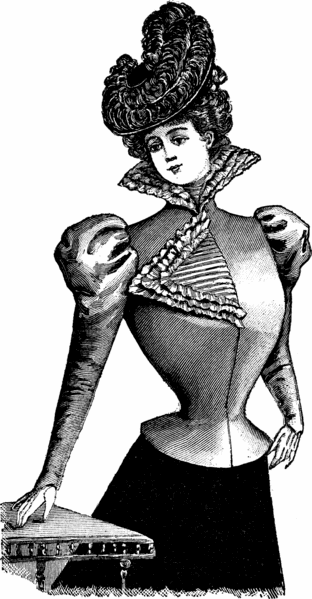
1890s returned to the tighter
sleeves often with small
puffs or ruffles capping
the shoulder but fitted
to the wrist. Skirts took
on a trumpet shape, fitting
more closely over the hip
and flaring just above the
knee. Corsets in the 1890s
helped define the hourglass
figure as immortalized by
artist
Charles Dana Gibson.
In the very late 1890s the
corset elongated, giving
the women a slight S-curve
silhouette that would be
popular well into the
Edwardian era.
Influence of aesthetic dress
The 1890s in both Europe and America saw growing acceptance of artistic or aesthetic dress as mainstream fashion, especially in the adoption of the uncorseted tea gown for at-home wear. In America in this period, Dress, the Jenness Miller Magazine (1887-1898), reported that tea gowns were being worn outside the home for the first time in fashionable summer resorts.
| The above article is licensed under the GNU Free Documentation License. From Wikipedia, the free encyclopedia https://en.wikipedia.org/wiki/1890s_in_fashion Retrieved and modified by Apparel Search 1/13/06 |
Designer Definition (from U.S Department of Labor)
|
|

Learn about another era in fashion:
1980's Fashion History / 1980's Fashion Term (terms section)