Garment District - clothing definitions presented by Apparel Search
The Garment District is a neighborhood of the New York City borough of Manhattan, located between Fifth and Ninth Avenues from 34th to 42nd Street. It has been known since the early 20th century as the center for fashion design and manufacturing in the United States. The Garment District is the fashion center of New York City. Approximately one square mile in area, the district is bordered by the Javits Convention Center at the extreme west, the New York General Post Office, Penn Station, and Madison Square Garden in the center, and the Empire State Building in the east. The neighborhood is home to the warehouses and workshops of the fashion industry.
Role in fashion
New York is the fashion capital of the United States, generating over $14 billion in annual sales, and setting design trends that are mirrored worldwide. The industry sustains tens of thousands of jobs in the city, and brings hundreds of millions of dollars to New York through conferences, expositions, Fashion Week and tourism. The fashion industry is the largest single contributor to the city's manufacturing sector. The Garment District is at the center of this billion dollar clothing industry. One third of all clothing manufactured in the US is designed and produced in this neighborhood. Many of the clothing manufacturers maintain outlet stores open to the public.
New York is home to America's world renowned fashion talent. From the industry's most famous designers to its most promising entrepreneurs, fashion makers locate their businesses here, taking advantage of the city's unlimited creative resources. Oscar de la Renta, Calvin Klein, Donna Karan, Liz Claiborne and Nicole Miller, to name a few, are located in the Garment District. While New York's days as the textile-manufacturing capital of America may be over, it remains the fashion capital for designers, couture houses and showrooms.
While most of the clothing manufacturing has left the island, there are still numerous fabric shops in the Garment District. Some only carry bridal fabrics and laces, others specialize in woolens but most have a little bit of everything. Most of the goods in these stores are the leftovers from the manufacturers in the city. Apparel fabric wholesalers also have retail stores or showrooms in or near the Garment District. Wholesalers of trims or buttons and other fasteners are clustered nearby. In fact, the Garment District buildings often house similar kinds of businesses to make it easy for buyers to shop the market on foot..
History
New York first assumed its role as the center of the nation's garment industry by producing clothes for slaves working on Southern plantations. It was more efficient for their masters to buy clothes from producers in New York than to have the slaves spend time and labor making the clothing themselves. In addition to supplying clothing for slaves, tailors produced other ready-made garments for sailors and western prospectors during slack periods in their regular business. Prior to the mid-nineteenth century, the majority of Americans either made their own clothing, or if they were wealthy, purchased "tailor-made" customized clothing. By the 1820s, however, an increasing number of ready-made garments of a higher quality were being produced for a broader market. The production of ready-made clothing, which continued to grow, completed its transformation to an "industrialized" profession with the invention of the sewing machine in the 1850s. The need for thousands of ready-made soldiers' uniforms during the American Civil War helped the garment industry to expand further. By the end of the 1860s, Americans bought most of their clothing rather than making it themselves. German and Central European immigrants to America around the mid 19th century arrived on the scene with relevant business experience and skills just as garment production was passing from a proto-industrial phase to a more advanced stage of manufacture. In the early twentieth-century a largely Eastern European immigrant workforce powered the garment trades. Writing in 1917, Abraham Cahan credited these immigrants with the creation of American style: Foreigners ourselves, and mostly unable to speak English, we had Americanized the system of providing clothes for the American woman of moderate or humble means. The average American woman is the best-dressed woman in the world, and the Russian Jew has had a good deal to do with making her one.
Gangland
In the early 1920s, the United Hebrew Trades union askedLepke Buchalter and his Jewish and Italian gangster friends from Brooklyn to work as union enforcers. Buchalter deployed 250 enforcers, who threatened owners and threw acid on the merchandise of companies that dared buck the union. Sometimes, his troops squared off with those of another Jewish gangster, Dutch Schultz, who broke strikes for the garment bosses. Occasionally, the two gangsters would work both sides of a strike for mutual benefit. Buchalter allegedly struck up an alliance with Sidney Hillman, legendary founder of the Amalgamated Clothing Workers of America that represented 50,000 garment industry laborers and a close advisor to Franklin Delano Roosevelt.
But the ambitious Buchalter was not content merely with being hired union muscle. Grasping how the industry functioned, he launched a plan to control it. The business, he realized, couldn't operate without the 1,900 workers who cut the cloth and shipped the goods. If you had the power to withhold their labor at will, you'd have leverage over the entire industry.
By the early 1930s, Buchalter had persuaded the Amalgamated cutters
local to align with him by offering their officials protection from rival union forces, and he managed to get the drivers behind him, too. In exchange for labor peace
he could now shut down business with a word
Buchalter coerced the garment companies into doling out sweetheart contracts to trucking firms that gave him kickbacks. Buchalter died in the electric chair in 1944 for the murder of a trucker. Before his execution he offered to give information on top figures within the Roosevelt cabinet, such as Hillman, who allegedly had links to the mafia. Thomas E. Dewey, then District Attorney of New York, turned down the offer, sending Buchalter to the chair.
It took Carlo Gambino, who assumed control of the garment district in 1957, to transform what was a mob-influenced industry into a full-fledged organized crime cartel. He and his family used their control of the unions to take over the trucking companies that serviced the Garment District, so that few manufacturers could get a delivery or make a shipment without their say-so.
Already in the early 1950s, Carlo had set up his son Joseph as a minor partner in Consolidated Carriers Corporation, in exchange for giving that firm a union-friendly edge on the competition, and son Thomas joined later. As other Consolidated partners retired, the Gambinos became owners of what had become the district's most important trucking company, and they acquired interests in other trucking firms, sometimes partnering with rival crime families like the Luccheses.
By the mid-1980s, operating 90 percent of the trucks that serviced the garment district, the mob held the industry in a vise-like grip. In the early 1990s, to take just one example, a production manager for fashion designer Nicole Miller testified that once, when he tried to use a small gypsy trucker, trench-coated mob goons showed up and stood around menacingly, hands in pockets, until the frightened independent operator fled. District kingpin Thomas Gambino, honored as the garment industry's Man of the Year at a 1981 dinner at the Plaza Hotel, grew extremely rich: by 1992, investigators estimated his personal wealth at $75 million.
But the $2.5 billion garment industry suffered. Records from the early 1990s showed that mob trucking companies generated yearly revenues of about $50 million and operating profits of $22 million, a hefty 44 percent profit margin, compared with the 10 to 15 percent margins that typical city truckers averaged. The added costs that mob trucking imposed, in other words, amounted to $15-17 million yearly. The estimated mob tax on the district as a whole
if extortion, double billing, and other illegal activities are included
was a staggering $60 million a year by the early 1990s. Combined with New York's inflated legitimate taxes, it accelerated the flight of garment jobs from the city. From the mid-1950s, when the Gambinos took over the garment district, until 1992, the business shrank 75 percent, costing New York 225,000 jobs.
The mob helped bump off a once vibrant industry.
Decline of the industry
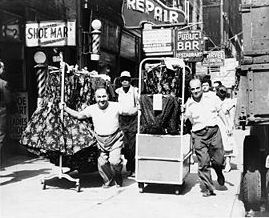
Manufacturing in the state of New York, and in New York City in particular, faded in the late 20th century. This has been exemplified by the decline of the Garment District. The district lost well over a thousand factory jobs per year, and men pushing racks of garments from one workshop to another ceased to crowd the streets. Factories and showrooms are increasingly becoming condo apartments and retail. A number of factors have contributed to the decline, from excessive rents to low overseas wages.
Some organizations have been working to protect the industry, such as "The Fashion Center Business Improvement District", a not-for-profit corporation established in 1993 to promote the city's apparel industry and to improve the quality of life and economic vitality of the Garment District. The Center is funded by the district's property owners and businesses. Zoning was used to impede non manufacturing use of factory buildings, to little avail.
Some politicians have also taken up the cause. Candidate for Manhattan Borough President Brian Ellner wrote the following in his blog in August 2004:
We should
support
a limited
development
of the
Garment
District,
protecting
companies
and the
jobs struggling
to survive
from button
makers to
fabric cutters
to designers
creating
new affordable
residential
and commercial
space and
pursuing
preservation
for the
area's rich
history.
And we need
to find
new industries
for the
thousands
of workers
who have
already
lost their
jobs. Fashion
manufacturing
is one of
the main
pathways
to the middle
class for
immigrant
workers,
and we must
ensure that
other pathways
exist.
The Garment District's access to transport makes it desirable to businesses. It is within walking distance of Pennsylvania Station and Grand Central Terminal where NJ transit, Amtrak, LIRR (Long Island Rail Road) and Metro North Railroad have services. As fashion manufacturing declines, buildings are converted to office space. Businesses such as accountants, lawyers, public relations and many high-tech companies move into the area. Companies that are located in the area included LivePerson, Amnesty USA, Simplicato and Enigmedia. A Save the Garment Center campaign has sprung up to try to preserve the district.
-
Save the Garment Center is a campaign spearheaded by designers Nanette Lepore and Anna Sui as well as many local designers, organizations and fashion manufacturers to preserve New York City's fading Garment District. The loss of jobs and culture as a result of non-conducive zoning laws has led many in the industry to join together on a campaign to save what is left of the once-vibrant garment center. Fashion Week in September 2008 was filled with T-shirts that embodied the cause and provided contact information of city officials.
Landmarks
- The Fashion Walk of Fame - the only permanent landmark dedicated to American fashion
- Needle threading a button - at the Fashion Center Business Improvement District's Information Kiosk at Seventh Avenue and 39th Street
Additional links of interest:
Did you know that New York has an excellent garment district?
Learn about New York Fashion Schools.
|
||
|
|

| The above article is licensed under the GNU Free Documentation License. From Wikipedia, the free encyclopedia (https://en.wikipedia.org/wiki/garment_district,_manhattan). 7/17/09 Modified by Apparel Search. |
|
|