Women's Maternity Sleepwear Guide
Maternity sleepwear is the whole night-time wardrobe — nightgowns, pajama sets and robes — built for broken sleep now and night feeds later.
Shop Women's Maternity Sleepwear Now
Shop Women's Maternity Sleepwear on Amazon Shop Women's Maternity Sleepwear on eBayThe Amazon and eBay links on this page are affiliate links. If you make a purchase through them, Apparel Search may earn a commission.

This is the umbrella guide to sleeping while pregnant. Maternity sleepwear covers three garments — the nightgown, the pajama set, and the robe layered over either — and one continuous job: be comfortable at 2 p.m. for a nap, at 2 a.m. for the fourth bathroom trip, and, soon enough, at every hour for feeding a newborn. Our pajamas guide (linked below) goes deep on the matched-set branch; this page maps the whole drawer.
Sleep in the third trimester is broken by physics: a bump that dictates position, a bladder with no capacity, legs that cramp. Sleepwear cannot fix any of that, but bad sleepwear can make all of it worse — a waistband in the wrong place, a fabric that traps heat, a front that tangles when you roll. The right pieces disappear, which is the entire goal.
Nightgowns: The One-Piece Answer
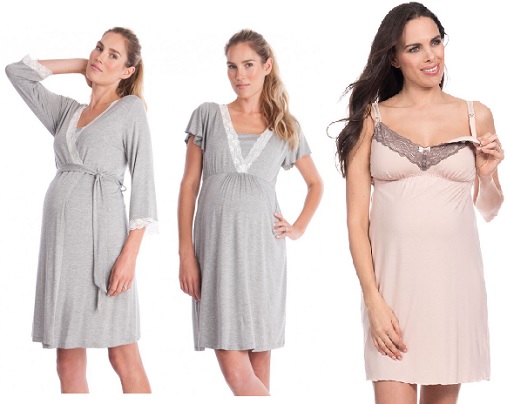
The maternity nightgown skips the waistband problem entirely. Empire-cut gowns fall from under the bust; stretch-jersey gowns skim and grow; and nursing nightgowns add clip-down straps, lift-up layers or button plackets — the styles hospitals and midwives see most, because they handle examinations, skin-to-skin and feeding without anyone getting dressed or undressed. Lengths run from knee to full; knee length is the practical pick for getting in and out of bed a dozen times a night.
Details that matter at 3 a.m.: straps that stay up, openings that work one-handed in the dark, and seams that don't print through onto skin you'll be lying on. A gown that twists is a gown with too little structure at the top.
Sets, Robes and Temperature
Pajama sets (the subject of their own guide) bring the waistband back, gently: under-bump bands or soft panels, matched with nursing-friendly tops. The robe is the third piece and the most-used: it covers gowns and sets for the doorbell, the nursery run and the hospital corridor, adds warmth in the exact places gowns lack it, and — in a fabric with some dignity — makes the whole sleep drawer presentable to visitors.
Temperature is the silent specification. Pregnancy raises nighttime body temperature and night sweats are common in late pregnancy and the first postpartum weeks. Natural, breathable fabrics — cotton, modal, bamboo viscose — in layers you can shed beat any single warm garment. Keep one light set even in winter; you will thank it.
From Hospital Bag to Fourth Trimester
Sleepwear is the rare maternity category where need increases after delivery: the hospital stay, then weeks of nights that are mostly awake. Stock accordingly — two nursing gowns or sets in rotation, one robe, dark colors, nothing precious. Our original guide pointed readers to the main women's sleepwear guide for the full category beyond maternity; between that page and the pajamas guide below, the drawer is fully mapped.
Buy sleepwear a little earlier than feels necessary and a little softer than seems rational. It is the clothing of the hardest-working nights of your life, and it should be kind.
Fabrics, Compared Honestly
Sleepwear fabric claims deserve translation, because the labels all promise softness and the differences are thermal. Cotton breathes and absorbs, and stays comfortable through night sweats, at the price of drying slowly. Modal and bamboo viscose feel cooler against the skin and drape more fluidly — the warm sleeper's favorites — and wash well if handled gently. Polyester satin and microfleece are the warm end: lovely in a cold house in January, a sauna in August, and best kept for the robe layer where they can be shed. Silk is the luxury answer and genuinely temperature-balancing, but its care demands make it a pre-baby pleasure more than a fourth-trimester tool. Buy for the nights you actually have: warm sleeper, breathable fabric; cold house, layers. The fabric is the sleepwear.
Photos From Our Original Guide
Related Women's Guides
Looking for Women's Clothing Stores?
This guide helps you choose women's maternity sleepwear. To browse where to buy, visit our women's clothing store directory, where you can find retailers that carry them.