Material
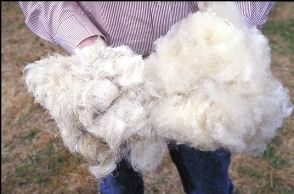 Most of the fiber from domestic sheep has two qualities
that distinguish it from hair or fur: it is scaled in such
a way that it helps the animal move out burrs and seeds
that might embed themselves into its skin; and it is crimped,
in some fleeces more than 20 bends per inch.
Most of the fiber from domestic sheep has two qualities
that distinguish it from hair or fur: it is scaled in such
a way that it helps the animal move out burrs and seeds
that might embed themselves into its skin; and it is crimped,
in some fleeces more than 20 bends per inch.
Both the scaling and the crimp make it possible to spin
and felt the fleece. They help the individual fibers "grab"
each other so that they stay together. They also make the
product retain heat, as they trap heat in their bends. Insulation
also works the both ways;
bedouins and
tuaregs use wool clothes to keep the heat out.
The amount of crimp corresponds with the fineness of
the wool fibers. A fine wool like
merino may have up to a
hundred crimps per inch, where the coarser wools like karakul
may have as few as one to two crimps per inch.
Hair, by contrast, has little if any scale and no crimp
and little ability to bind into yarn. On sheep, the hair
part of the fleece is called kemp. The relative amounts
of kemp to wool vary from breed to breed, and make some
fleeces more desirable for
spinning,
felting or
carding into batts for
quilts or other insulating products.
Wool grows in several natural colors such as black, brown
(also called moorit) grey and the most commonly available
white. Wool of any color takes
dye easily and can be felted.
Wool straight off a sheep is highly water-resistant.
It is said to be "in the grease", the grease being
lanolin, and can be worked into yarn and knit into water-resistant
mittens, as did the
Aran Island fishermen. Wool retains heat better than
most fabrics when wet.
The spinning capacity of wool is determined by the technique
known as
wool classing, whereby
a qualified woolclasser might group wools of similar gradings
together to maximise the return for a farmer wishing to
yield the most from the sheep's fleeces.
Processing
Wool straight off a sheep contains a high level of grease
which contains valuable lanolin, as well as dirt, dead skin,
sweat residue, and vegetable matter. This state is known
as "grease wool" or "wool in the grease".
Before the wool can be used for commercial purposes it must
be scoured, or cleaned. Scouring may be as simple as a bath
in warm water, or a complicated industrial process using
detergent and alkali. In commercial wool, vegetable
matter is often removed by the chemical process of chemical
carbonization.
In less processed
wools, vegetable matter may be removed by hand, and some
of the lanolin left intact through use of gentler detergents.
This semi-grease wool can be worked into yarn and knitted
into particularly water-resistant mittens or sweaters, such
as those of the Aran Island fishermen. Lanolin removed from
wool is widely used in the cosmetics industry, such as hand
creams.
After shearing, the wool is separated into five main
categories: fleece (which makes up the vast bulk), broken,
pieces, bellies and locks. The latter four are pressed into
wool packs and sold separately. The quality of fleece is
determined by a technique known as
wool classing, whereby
a qualified woolclasser groups wools of similar gradings
together to maximise the return for the farmer or sheep
owner. Prior to Australian auctions all Merino fleece wool
is objectively measured for micron, yield (including the
amount of vegetable matter), staple length, staple strength
and sometimes color and comfort factor.
History
As the raw material has been readily available since
the widespread domestication of
sheep and similar animals,
the use of wool for clothing and other fabrics dates back
to some of the earliest civilizations. Prior to invention
of shears - probably in the Iron Age - they probably plucked
the wool out by hand or by bronze combs.
In medieval times, the wool trade was serious business.
English wool exports - which bordered on European monopoly
- were a significant source of income to the crown. Over
the centuries, various British laws controlled the wool
trade or required the use of wool even in burials. In 1699
English crown forbade its American colonies to trade wool
with anyone else but the England itself.
In the Renaissance, Medicis of Florence built their wealth
and banking system on wool trade with the aid of the Arte
della Lana, the wool guild. Spain allowed export of
Merino lambs only with
royal permission. German wool - based on sheep of Spanish
origin - begun to overtake British one only at the end of
19th century. Australia's colonial economy was based on
sheep raising and Australian wool trade overtook Germans
by 1845.
