Hugh Grant: Fashion Celebrity Guide
Floppy hair and blue shirts to the cardigans of Heretic — the rom-com wardrobe and its second act
Hugh Grant's first fashion era was a hairstyle: the floppy fringe of Four Weddings and a Funeral and Notting Hill, worn with blue Oxford shirts and rumpled blazers, became the international uniform of the charming Englishman for a decade. His second era is the more interesting wardrobe story — the peacock villainy of Paddington 2, the fur-collared schemer of The Gentlemen, an Oompa-Loompa in Wonka, and the cardiganed menace of Heretic, each costume a joke at the expense of the first era, told by the man who wore it. This guide follows both wardrobes and the career that connects them, through Bridget Jones: Mad About the Boy in 2025.
Signature Looks and Style Eras
The floppy years. Four Weddings and a Funeral (1994) — morning suits, waistcoats and that hair — made Grant a star and won him a Golden Globe; Sense and Sensibility (1995) put him in period dress, and Notting Hill (1999) fixed the civilian version: blue shirt, blazer, chinos, the bookshop owner's uniform that men copied for years because it looked achievable. Bridget Jones's Diary (2001) added the cad's version — Daniel Cleaver in dark suits and open collars — and Love Actually (2003) made him the prime minister who dances in a suit. Two Weeks Notice, Music and Lyrics and About a Boy kept the formula polished into the 2000s.
The turn. Cloud Atlas (2012) let him play villains under prosthetics, and Florence Foster Jenkins (2016) began the acclaimed second act — a performance critics ranked among his best. A Very English Scandal (2018), as Jeremy Thorpe in sharp period tailoring, won him Emmy and Golden Globe nominations. The wardrobe darkened with the roles: this Grant dresses to be watched with suspicion.
The villain wardrobe. Paddington 2 (2017) dressed his Phoenix Buchanan in a wardrobe of disguises — the film is practically a costume parade, and many critics called it his finest performance. The Gentlemen (2019) gave him a tabloid investigator's fur-collared coat and sunglasses; Dungeons & Dragons (2023) a rogue's finery; Wonka (2023) shrank him into an Oompa-Loompa's striped suit and green hair; and Heretic (2024) put him in glasses, sweaters and a checked cardigan — suburban knitwear as horror costume — earning Golden Globe and BAFTA nominations. Bridget Jones: Mad About the Boy (2025) brought Daniel Cleaver back, older and in excellent tailoring, closing the circle.
The Blue Shirt: A Case Study
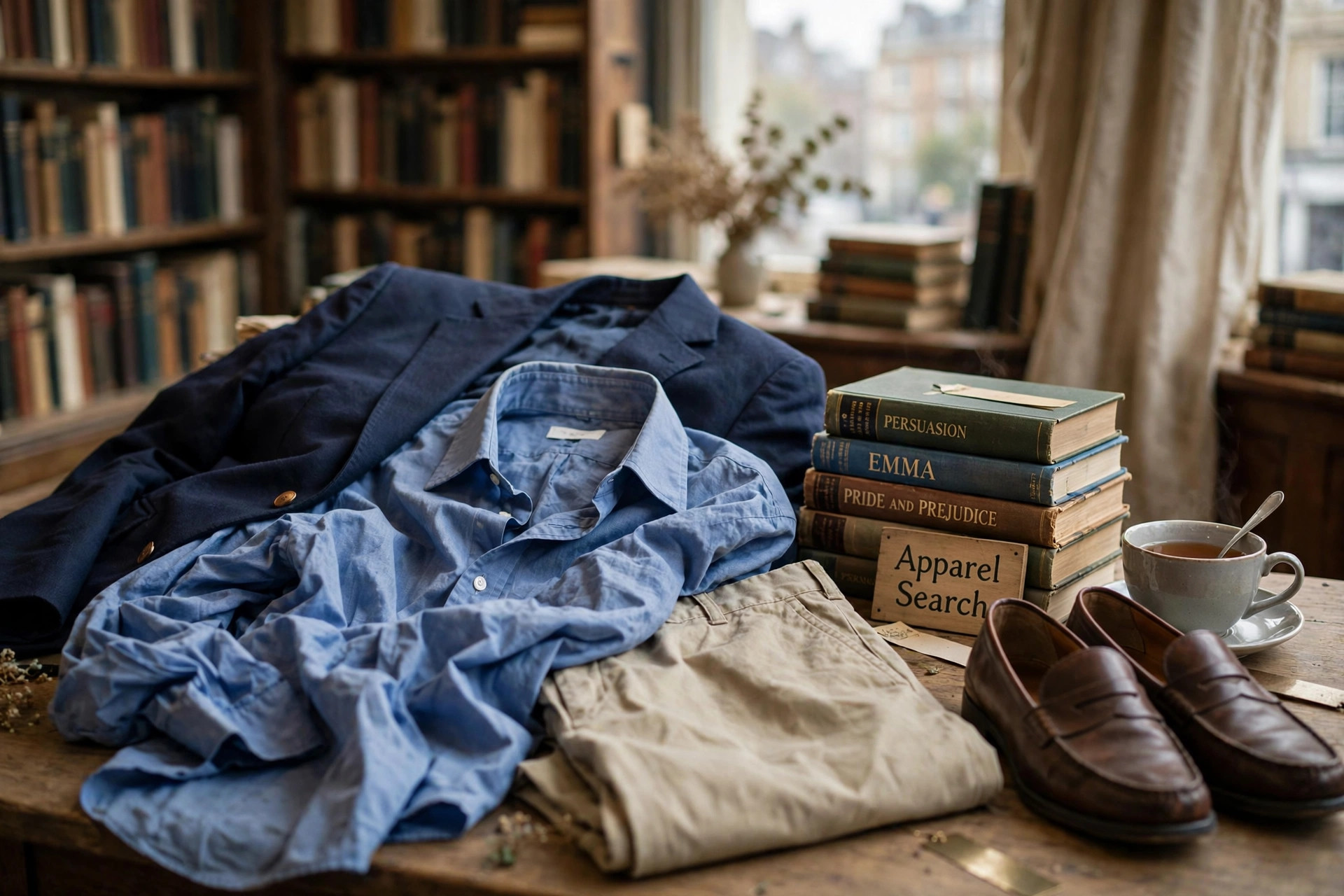
Fashion historians of the ordinary could write a chapter on Grant's blue shirts. The Notting Hill costume department understood that the character — a divorced bookshop owner — had to dress like a man who owned good basics and stopped there; the shirts, blazers and chinos were deliberately unremarkable, and became remarkable because Grant wore them as if apologising. The lesson the look taught a generation of men: fit and fabric over fashion, and never look as if you tried. His off-screen dressing has followed the same rule ever since — dark suits, open-collar shirts, no experiments — which is why the Heretic cardigan, a deliberate dowdiness, lands as a costume rather than a choice.
Style in the Second Act
What changed in the second act is intention. The rom-com wardrobe was designed to be liked; the villain wardrobe is designed to be read — Buchanan's cravats, Fletcher's fur collar, Mr. Reed's cardigan each announce the character's vanity or menace before a line is spoken. Grant has said in interviews of the period that he enjoys playing the unpleasant characters more, and the clothes agree: they are the best costumes of his career, and they work because the audience remembers the blue shirt underneath them.
The Constant
Through both eras the off-duty constant is English understatement: navy, grey, white, good shoes, nothing logo'd. It is the same wardrobe as the 1994 version, aged in place — the blazer a little sharper, the hair grey, the glasses now real. In a guide full of reinventions, Grant is the case for the alternative strategy: pick the uniform young, then let the roles do the changing.
The Undoing and the Wealth Wardrobe
Between the film villains, Grant's television work added a wardrobe worth noting: The Undoing (2020), HBO's hit thriller, cast him as Jonathan Fraser, a wealthy New York oncologist, and dressed him in the soft armour of the Upper East Side — long wool coats, cashmere, scarves, tailoring that whispers money. The performance, and the coats, became a fashion story of their own during the broadcast, with viewers hunting the outerwear as eagerly as the plot's solution. It proved the second-act Grant could carry a wardrobe of pure status dressing and make it look like evidence.
A cameo in The Regime (2024), opposite Kate Winslet, completed the recent television set. Read together, the later roles form a gallery of men whose clothes are their alibis — the actor-manager's disguises, the investigator's fur collar, the oncologist's cashmere, Mr. Reed's cardigan — each wardrobe designed to be believed, and each performance a study in why you should not. The blue-shirted charmer of 1994 is still in there; the second act's pleasure is watching the same face use better costumes for worse men.
Career in Brief
Hugh John Mungo Grant was born on September 9, 1960, in London and read English at Oxford, where he acted with the Oxford University Dramatic Society. After early roles including Maurice (1987) and The Remains of the Day (1993), Four Weddings and a Funeral (1994) made him an international star and Golden Globe winner. Notting Hill and Mickey Blue Eyes (1999), Bridget Jones's Diary (2001), About a Boy (2002) and Love Actually (2003) defined the British romantic comedy of the era, with Grant as its leading man.
The second act — Cloud Atlas (2012), Florence Foster Jenkins (2016), Paddington 2 (2017), A Very English Scandal (2018), The Gentlemen and The Undoing (2020), Dungeons & Dragons and Wonka (2023), Heretic (2024) and Bridget Jones: Mad About the Boy (2025) — recast him as one of the screen's favourite villains and character actors, with Emmy, Golden Globe and BAFTA nominations across the run.
Following Hugh Grant's Style
Grant keeps no public social-media presence in his own voice; his looks appear at premieres and in the press coverage gathered through the search routes below. The Male Fashion Celebrities ranges lead onward to the other profiles in this guide, and the full Fashion Celebrity Guide covers the female section and red carpet coverage.
Common Questions
What made Hugh Grant's style famous?
The 1990s combination of floppy hair, blue Oxford shirts and rumpled blazers in Four Weddings and a Funeral (1994) and Notting Hill (1999) — the charming-Englishman uniform that a generation of men copied.
What is Hugh Grant's acclaimed later role in Paddington 2?
Phoenix Buchanan, a vain, washed-up actor turned villain, played through a parade of disguises in Paddington 2 (2017). Critics widely called it one of his finest performances.
What did Hugh Grant play in Heretic?
Mr. Reed, a softly spoken recluse in glasses, sweaters and a checked cardigan who traps two young missionaries in his house, in the 2024 A24 thriller Heretic — a performance nominated for Golden Globe and BAFTA awards.
Did Hugh Grant return to Bridget Jones?
Yes — he reprised Daniel Cleaver in Bridget Jones: Mad About the Boy (2025), reuniting with Renée Zellweger, having played the role in the series since 2001.
Bing & Google Search Results
Bing Search Results:
Google Search Results:
Male Fashion Celebrities ranges: Male Fashion Celebrities A-G | Male Fashion Celebrities H-P | Male Fashion Celebrities Q-Z