Leonardo DiCaprio: Fashion Celebrity Guide
American actor of Titanic and The Aviator — photos, style and news
Leonardo DiCaprio is the great minimalist of movie-star dressing. For thirty years, from the Titanic premieres to the One Battle After Another tour of 2025, his public wardrobe has barely wavered: a dark, perfectly cut suit, an open collar or a plain tie, no jewellery, no logos, nothing to date the photograph. The interest is all on screen, where his roles have worn everything from Romeo's Hawaiian shirts to Jordan Belfort's Armani power suits to the faded plaid robe that became the defining costume of 2025. This guide follows both wardrobes — the plain one he chooses, and the extraordinary ones his characters wear.
Signature Looks: The Art of Dressing Down a Premiere
The constant suit. DiCaprio's red-carpet formula — dark two-piece, white or black shirt, minimal accessories — was set by the late 1990s and has survived every menswear cycle since: skinny suits, wide suits, the no-tie era, the return of the tie. At the London premiere of One Battle After Another in September 2025 he wore the formula at its purest: an all-black suit, open collar, hands in pockets.
The nineties heartthrob. Before the minimalism came the era that made him: Romeo + Juliet (1996) put him in printed Hawaiian shirts that are still copied every summer, and Titanic (1997) fixed the image of the dinner jacket worn by a third-class passenger who dressed above his ticket. The floppy centre-parted hair of those years was as influential as any garment.
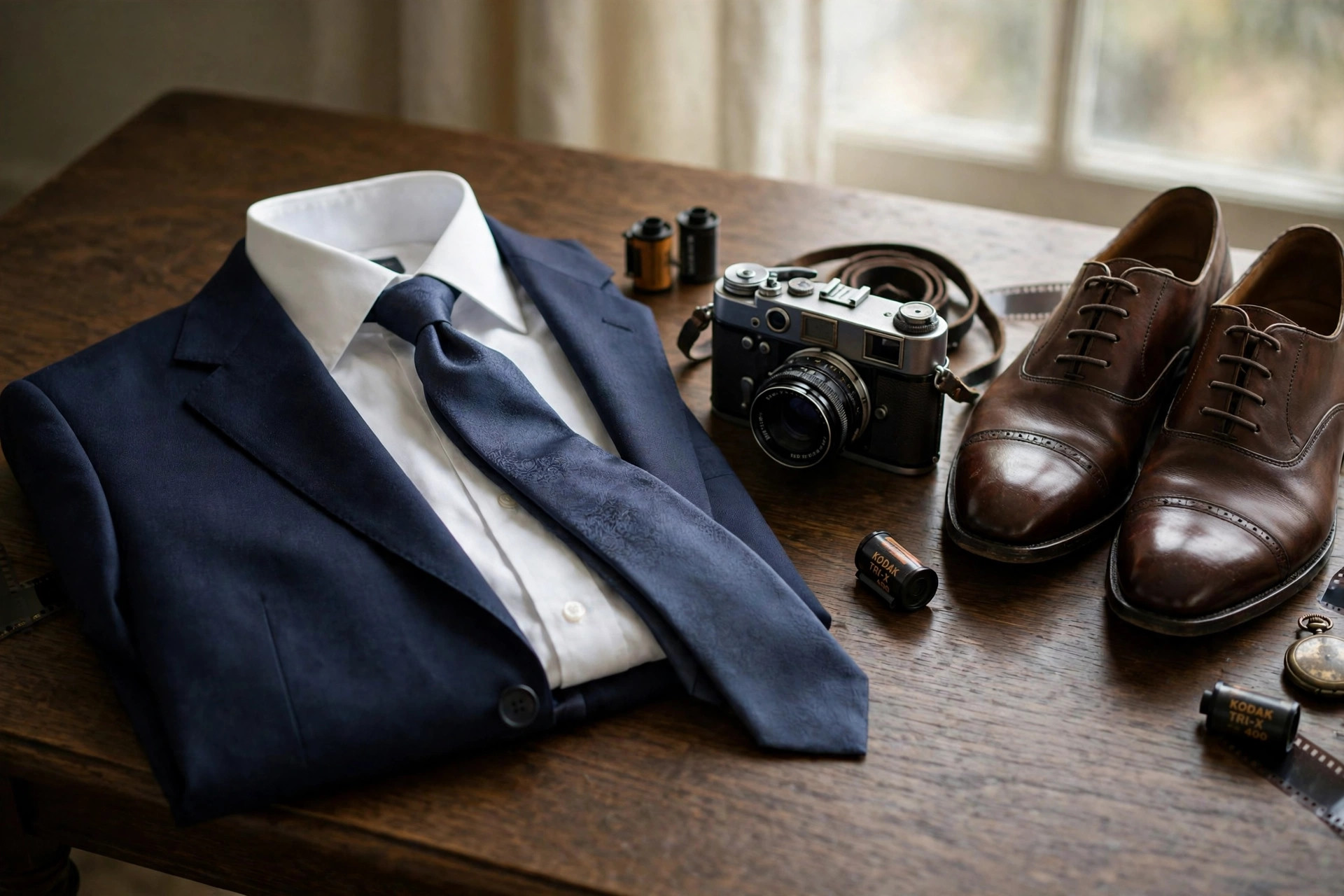
Off duty. His private uniform is the most imitated of all, precisely because it refuses fashion: plain tees, hoodies, shorts, sneakers and a baseball cap. It is anti-style as a privacy strategy — the world's most recognisable actor dressing to be unrecognisable — and it has made the occasional suited appearance land with doubled force.
The Screen Wardrobes: Armani to the Plaid Robe
DiCaprio's collaborations with Martin Scorsese trace a wardrobe history of American money: the street clothes of Gangs of New York, Howard Hughes's evolving tailoring in The Aviator, the FBI suits of The Departed period pieces aside, and above all The Wolf of Wall Street (2013), where Jordan Belfort's Giorgio Armani suits — broad-shouldered, double-breasted, worn with statement ties — became the definitive image of 1980s excess and revived the power suit for a new generation.
The counterpoint arrived in 2025. In Paul Thomas Anderson's One Battle After Another, costume designer Colleen Atwood dressed DiCaprio's washed-up ex-revolutionary Bob Ferguson in a faded plaid robe, aged and cheap by design, over sunglasses and trail shoes the actor picked himself. The robe — deliberately the opposite of a designer garment — became the most talked-about costume of the year, and the film went on to lead the awards season, winning Best Picture at the Academy Awards. Few careers contain both the Armani suit and the plaid robe; the distance between them is the range.
Two more costumes complete the map. The Great Gatsby (2013) dressed him as Jay Gatsby in the cream and pastel tailoring of 1920s Long Island — suits made with Brooks Brothers, worn with the longing of a man who bought his wardrobe as a love letter — while The Revenant (2015) buried him in the frontier furs and skins of Hugh Glass, a performance carried through blizzards in period trapping gear. Between Gatsby's cream suit and Glass's bearskin sits the whole DiCaprio method: the plainer the man dresses himself, the more completely a costume can take him over.
The Decade Since the Oscar
DiCaprio won the Academy Award for Best Actor for The Revenant at the 2016 ceremony, closing the longest-running storyline in modern awards coverage. The work since has been selective: Once Upon a Time in Hollywood (2019), the satire Don't Look Up (2021), Killers of the Flower Moon (2023) — his tenth collaboration with Scorsese — and One Battle After Another (2025).
Through his company Appian Way Productions, founded in 2004, he has produced many of these films and a run of documentaries. The second career is environmental: the Leonardo DiCaprio Foundation dates to 1998, he was named a United Nations Messenger of Peace in 2014, and his foundation work merged into the Earth Alliance in 2019. The plain wardrobe and the plain speaking belong to the same public design — nothing decorative, everything directed at the work.
Why the DiCaprio Formula Works
Consistency as branding. Where other stars use fashion to announce change, DiCaprio uses it to announce permanence: the same suit silhouette for three decades tells the audience that the performance, not the packaging, is the event. It is also why his screen costumes carry such weight — when a man this controlled wears a plaid robe or an Armani power suit, the wardrobe itself becomes the character study.
There is an environmental logic to it as well. DiCaprio has spoken for years about consumption and waste, and a public wardrobe built on a few long-kept suits rather than a new look for every appearance is that philosophy worn rather than said. The durability is the message, in the tailoring as in the advocacy.
Career in Brief
Leonardo Wilhelm DiCaprio was born in Los Angeles on November 11, 1974, and began in television commercials and series such as Santa Barbara and Growing Pains. Critical praise came with This Boy's Life (1993) and What's Eating Gilbert Grape (1993), leading roles in The Basketball Diaries (1995) and Romeo + Juliet (1996), and international fame in Titanic (1997). From the 2000s he built a defining partnership with Martin Scorsese — Gangs of New York, The Aviator, The Departed, Shutter Island, The Wolf of Wall Street and Killers of the Flower Moon — alongside Inception, Django Unchained and The Great Gatsby. He won the Academy Award for The Revenant (2015), and his recent films are Once Upon a Time in Hollywood (2019), Don't Look Up (2021) and One Battle After Another (2025). He founded Appian Way Productions in 2004.
Following Leonardo DiCaprio's Style
DiCaprio keeps no public personal social media presence for style, so his current looks appear in premiere and awards coverage; the search routes below gather his photos, videos, news and blog posts through Bing, Google and YouTube. He is filed in the L letter of the Male Fashion Celebrities H–P range alongside John Legend and Liam Neeson, and the range pages below lead to every male profile from A to Z.
Browse the male directory ranges: Male Fashion Celebrities A-G | Male Fashion Celebrities H-P | Male Fashion Celebrities Q-Z
Common Questions
How did Leonardo DiCaprio start his career?
Born and raised in Los Angeles, DiCaprio started his career by appearing in television commercials prior to landing recurring roles in TV series such as the soap opera Santa Barbara and the sitcom Growing Pains in the early 1990s. He made his film debut in the comedic sci-fi horror film Critters 3 (1991) and won praise for This Boy's Life and What's Eating Gilbert Grape in 1993.
Which film made Leonardo DiCaprio internationally famous?
DiCaprio achieved international fame in James Cameron's Titanic (1997), after recognition for supporting roles in What's Eating Gilbert Grape (1993) and Marvin's Room (1996), and leading roles in The Basketball Diaries (1995) and Romeo + Juliet (1996).
What production company does Leonardo DiCaprio own?
DiCaprio founded Appian Way Productions in 2004. Its productions include many of his own starring films and documentaries; earlier credits on this page's record include Gardener of Eden (2007) and Orphan (2009), and the company has produced his recent work through Killers of the Flower Moon (2023) and beyond.
What is Leonardo DiCaprio's most recent major film?
One Battle After Another (2025), directed by Paul Thomas Anderson, in which DiCaprio plays ex-revolutionary Bob Ferguson. Costume designer Colleen Atwood dressed the character in a faded plaid robe that became the year's most discussed costume, and the film won Best Picture at the Academy Awards after leading the 2025 awards season.