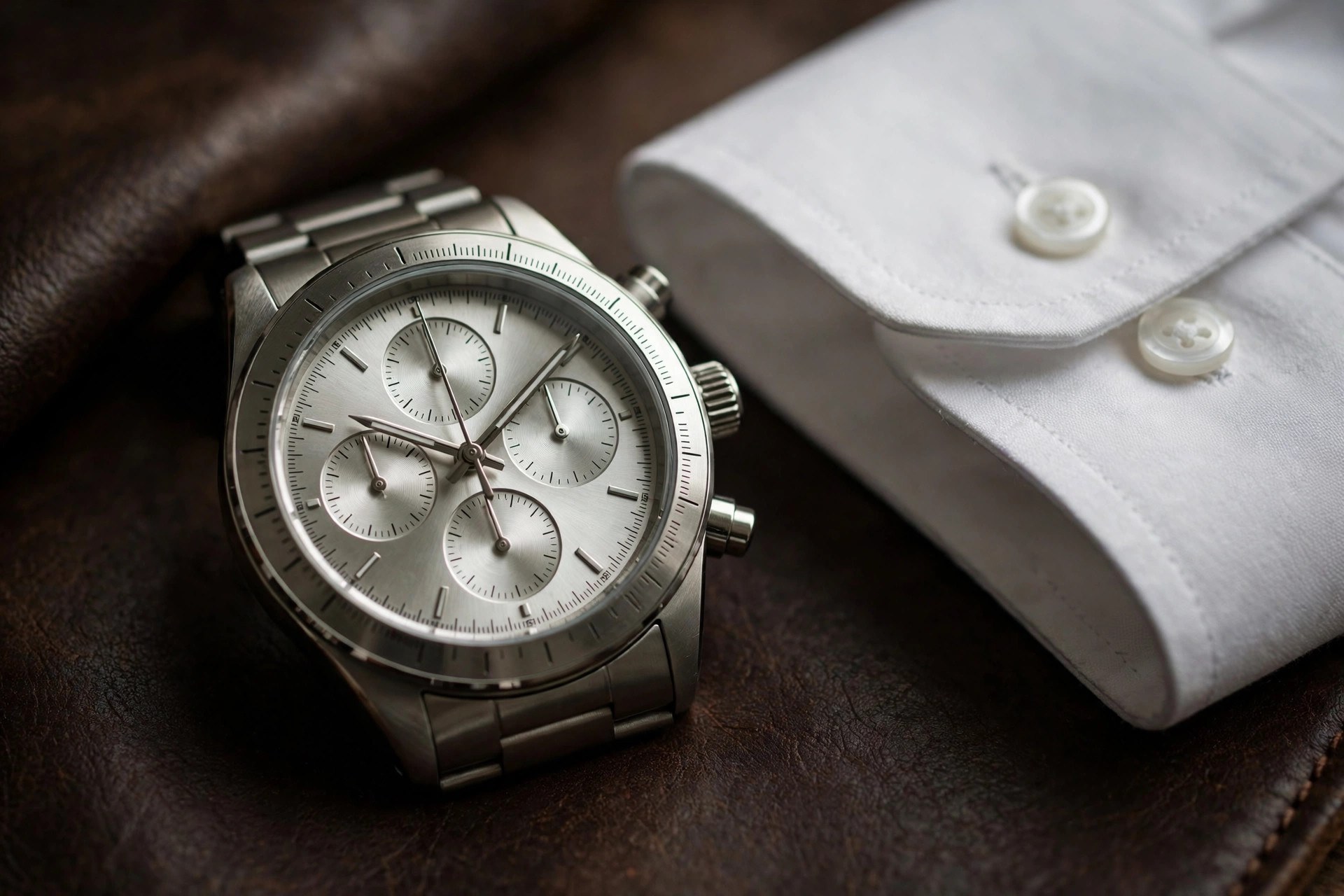
A chronograph is a watch with an independent stopwatch function built in. Alongside the ordinary time display it can start, stop and reset a timed interval, shown on small subdials. The name joins the Greek chronos (time) and graphein (to write) — early versions literally marked the dial with ink. Today the chronograph is as much a style as an instrument: the busiest, most technical-looking watch face there is.
How a Chronograph Works: Pushers and Subdials
Almost every chronograph follows the same layout. The pusher at 2 o'clock starts and stops the stopwatch; the pusher at 4 o'clock resets it to zero. The large central seconds hand you see sweeping (or ticking) is usually the stopwatch seconds — the ordinary running seconds live on a small subdial, which surprises many first-time owners. Start the chrono and that big hand comes alive; stop and reset, and it snaps back to 12.
The subdials divide the measurement. Typically there are two or three: a minutes counter (often 30 or 60 minutes), an hours counter (often 12 hours), and the small running seconds. A watch with two counters is a bi-compax, with three, tri-compax — layout language collectors use constantly. Read a stopped chrono by adding the counters: minutes on its subdial, seconds from the central hand, hours on theirs. After a reset, every counter should return exactly to zero; a hand that resets off-centre needs adjustment, which on many quartz models the owner can do via a crown procedure in the manual.
The Tachymeter, Explained Simply
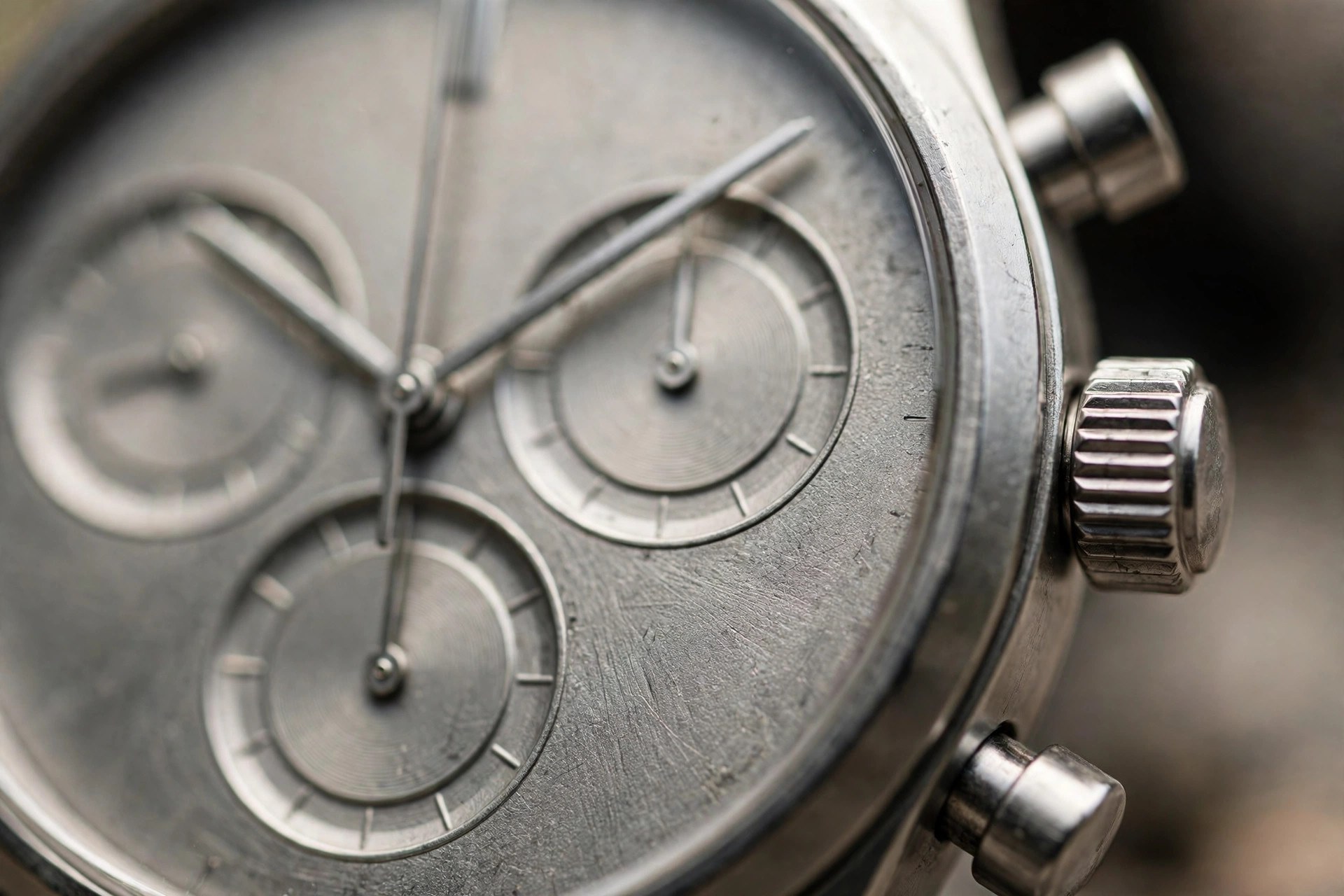
The numbered scale around many chronograph bezels or dial edges is a tachymeter: it converts elapsed time into a rate per hour. Start the stopwatch at one point and stop it at the next — after travelling one mile, one kilometre, or completing one unit of anything — and the central seconds hand points at your speed or rate. Drive one measured mile in 40 seconds and the hand points to 90: ninety miles per hour. Finish a task in 20 seconds and it reads 180 units per hour.
The honest caveat: a tachymeter only works for intervals between about 7 and 60 seconds, and in the phone era almost nobody calculates speed with one. It survives because it looks technical and carries the racing heritage of the great 1960s chronographs. Treat it as design and history, not a feature you will use weekly — and do not pay a premium for it alone. Other scales exist too: telemeters (distance, from the speed of sound) and pulsometers (pulse rate), each rarer and each explained by the same start-stop logic.
Types: Quartz, Mechanical, Flyback and Rattrapante
A quartz chronograph uses a battery movement: accurate, slim, affordable, and its stopwatch often measures to a tenth of a second. A mechanical chronograph — hand-wound or automatic — runs the stopwatch through gears, a clutch and a column wheel or cam; it costs far more, needs servicing every five years or so, and is what collectors mean by a serious chronograph. Neither is better in the abstract: quartz wins on accuracy and price, mechanical on craft and longevity.
Two specialist complications appear at higher prices. A flyback chronograph lets you reset and restart with one press of the lower pusher instead of stop-reset-start — designed for pilots timing successive legs. A rattrapante, or split-seconds chronograph, has two stopwatch hands so it can time two events at once, and it is one of the most expensive complications in watchmaking. At fashion-watch level you will also meet decorative subdials that show day, date or 24-hour time but do not time anything: check the pushers actually run a stopwatch before assuming a busy dial is a chronograph.
Choosing and Wearing One
Chronographs are thick and visually busy, so size honestly. Cases run 38–44 mm; below about 15 mm thickness a chronograph wears under a shirt cuff comfortably, above it, it mostly will not — try before buying if you wear tailoring daily. Legibility is the real test: counters you cannot read at a glance are decoration. High-contrast subdials, a clean minute track, and lume on the main hands matter more than complication count.
Water resistance deserves one check before any of that: many chronographs are rated only 30 or 50 metres, which means splash-proof, not swim-proof, and you should never operate the pushers in or under water unless the maker explicitly allows it. Screw-down pushers, where fitted, must be screwed back in after timing. A watch you cannot wear near water without thinking is not better or worse — it is simply a watch whose limits you need to know.
Style-wise, a steel chronograph on a bracelet is a sport watch that can stretch to smart-casual and most offices; on a leather racing strap it reads vintage; a black-dial panda (white subdials) or reverse-panda look is the classic enthusiast choice. It is not a dress watch — with formal tailoring, a slim plain watch remains correct, in the same way the right tie knot depends on the formality of the occasion. Finally, do not run the stopwatch permanently on a mechanical chronograph; it adds wear and drains the power reserve. Run it when you are timing something — which, once you own one, turns out to be surprisingly often: coffee, parking meters, speeches, laps. For the wider watch landscape, start with our watches guide.
Common Questions
- What is the difference between a chronograph and a chronometer?
- A chronograph is a function: a watch with a built-in stopwatch. A chronometer is a certification: a watch whose movement has passed independent accuracy tests. A watch can be either, both, or neither.
- Why is my chronograph's big seconds hand not moving?
- Because it is the stopwatch hand, and it only moves when the stopwatch is running. Your watch's running seconds are on a small subdial. Press the top pusher and the big hand starts.
- What does a tachymeter actually do?
- It converts a timed interval into a rate per hour. Time one mile and read the scale where the seconds hand stops: that number is miles per hour. It works for intervals of roughly 7 to 60 seconds.
- Is a quartz or mechanical chronograph better?
- Quartz is more accurate, slimmer and far cheaper. Mechanical is more intricate, repairable for generations, and prized by collectors, but costs more to buy and service. Choose by budget and interest, not by status.
- Can you wear a chronograph with a suit?
- In most modern offices, yes — a moderate-size steel chronograph is accepted smart-casual to business wear. For formal occasions and black tie, a slim, plain dress watch is still the correct choice.