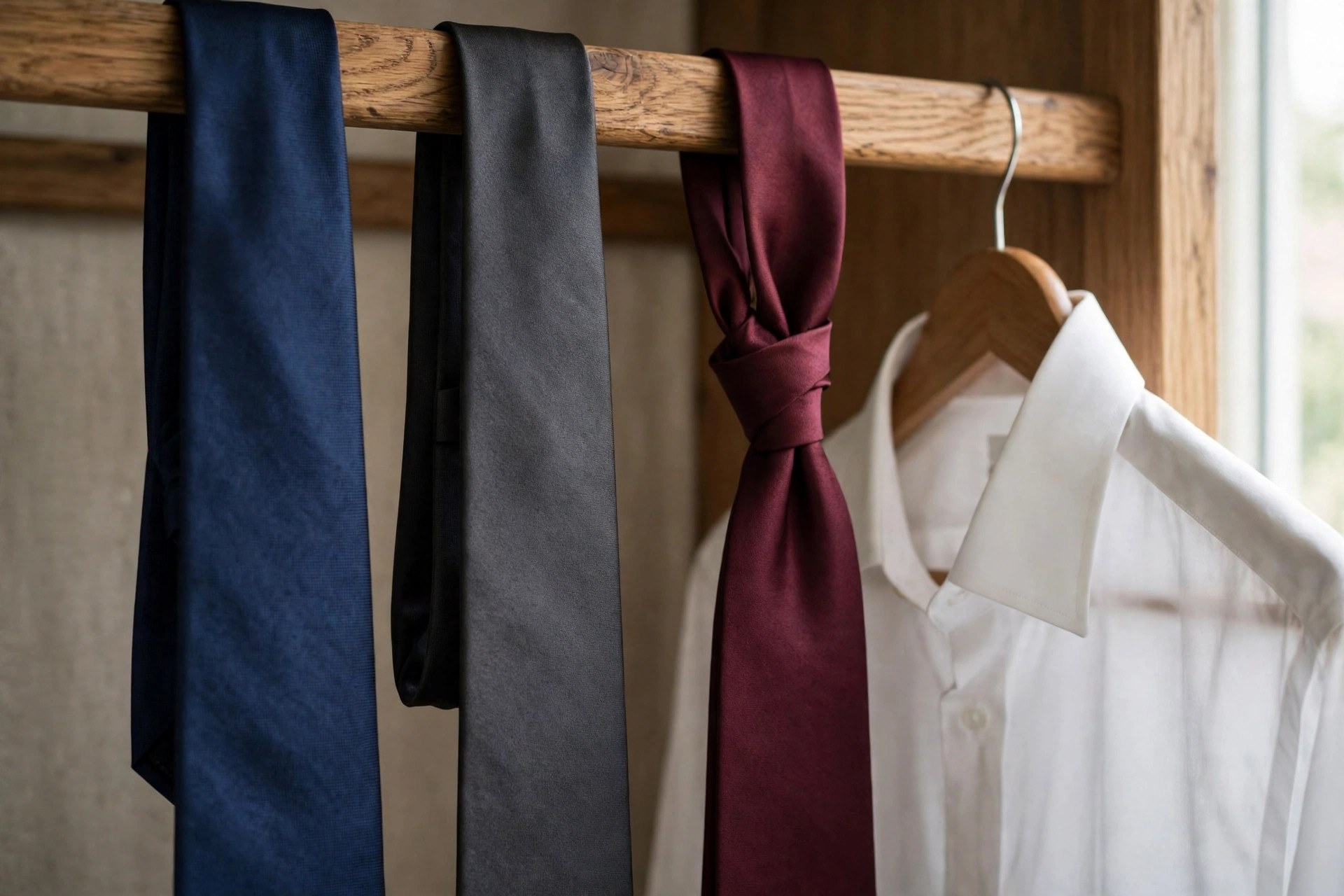
A tie knot is the folded, interlaced finish that holds a necktie at the collar — and it does far more than hold. The knot sets the proportion of the whole outfit: its width against your collar spread, its symmetry against your face, and its formality against the occasion. Five knots cover almost every situation, and learning two of them well is better than knowing ten badly.
Start With the Collar, Not the Knot
The most common tie mistake is choosing a knot in isolation. Look first at the collar. A narrow point collar leaves a small gap between the points, so it needs a slim knot. A spread or cutaway collar leaves a wide triangular gap that looks empty unless a wider knot fills it. A button-down collar, with its soft roll and narrow opening, suits the smallest knots of all.
Tie fabric matters just as much. A thick wool, knit or heavily lined silk tie makes a much larger knot than the same knot tied in thin unlined silk, because every fold multiplies the fabric. With a chunky tie, step down a knot size; with a fine, light tie, you can safely step up. Finally, consider your build and face: a broad knot balances a wide face and a large frame, while a slim knot suits a narrower face and a smaller collar size.
The Four-in-Hand: The Everyday Default
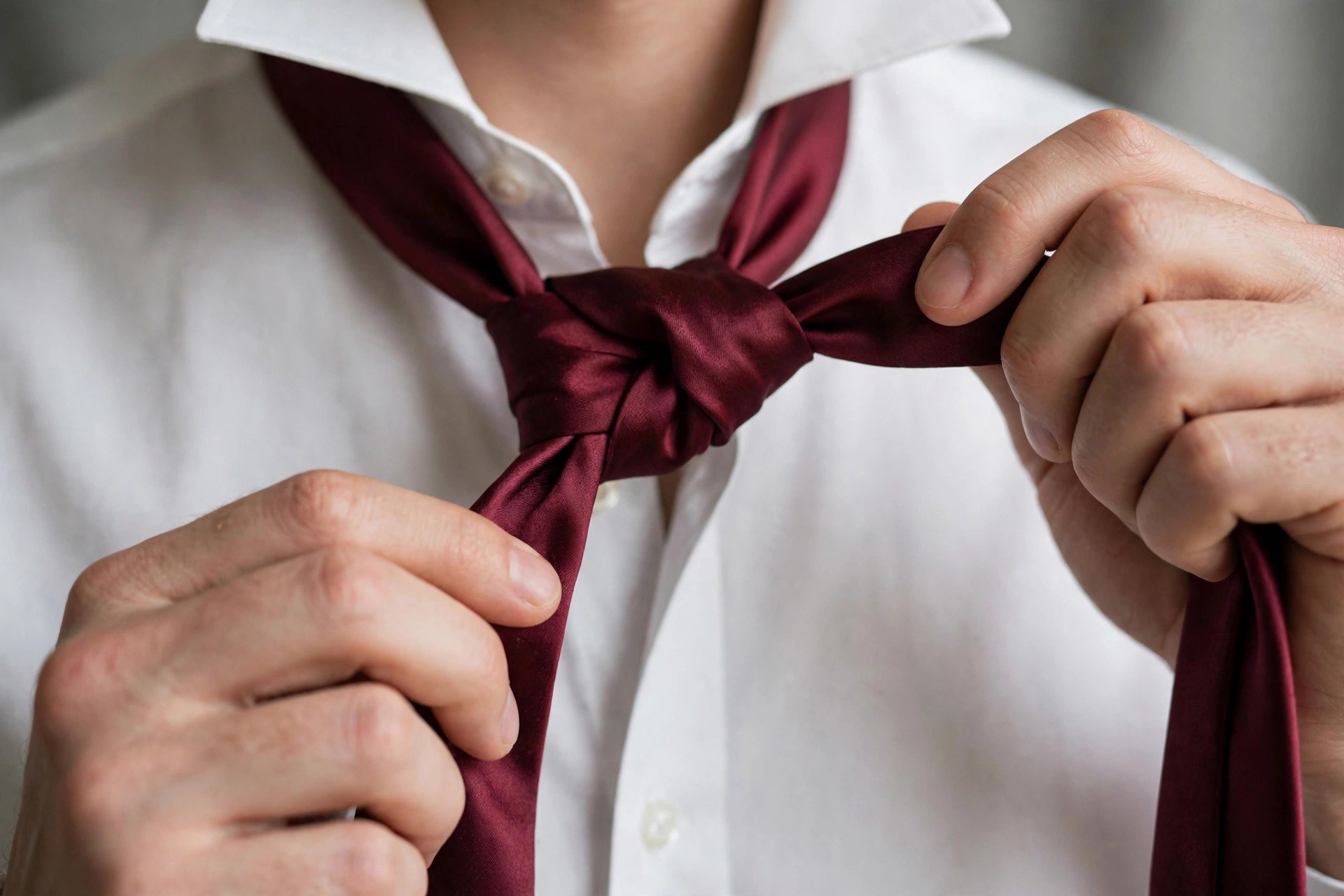
The four-in-hand is the knot most men wear, and for good reason: it is quick, slightly asymmetric, and works with most collars. Its gentle slant is a feature, not a flaw — it keeps a formal outfit from looking stiff. In summary: drape the tie with the wide end on your dominant side, about 30 cm lower than the narrow end. Cross the wide end over, bring it under and back across the front, up through the neck loop, then down through the small horizontal loop you just made. Slide it up snugly and centre it.
Reach for the four-in-hand with point and button-down collars, knit and slim ties, and everyday business or smart-casual dress. It is also the safest knot for shorter ties, because it uses the least length of any knot here.
Half-Windsor and Full Windsor
The half-Windsor is a medium, triangular, nearly symmetrical knot — a clear step up in presence from the four-in-hand without the full Windsor's bulk. In summary: start with the wide end lower, cross it over, bring it up through the neck loop and down to one side, across the front to the other side, up through the neck loop again, and down through the front loop. It suits medium-spread collars, most business suits, interviews and weddings, and it is the best all-round formal knot for average builds.
The full Windsor is the widest, most formal knot: a broad, symmetrical triangle built by wrapping both sides of the neck loop before the final pass. It demands a spread or cutaway collar to hold it, a longer and preferably thinner tie, and a confident occasion — a formal wedding, a presentation, a ceremonial uniform. On a small collar or a thick tie it overwhelms the shirt, and it uses so much length that the narrow end may end up very short.
Pratt (Shelby) and the Small Knot
The Pratt knot — also called the Shelby knot — begins with the tie inside out, seam facing outward, and the wide end crossed under the narrow end. Bring the wide end up through the neck loop and pull it down to centre, then across the front, up through the loop, and down through the front band. The result is a clean, symmetrical, medium knot that sits unusually neatly and releases easily at the end of the day. It suits point and medium-spread collars and is an excellent choice when a four-in-hand looks too slight but a Windsor would be too much.
The small knot, sometimes called the oriental knot, is the simplest of all: tie inside out, cross under, across, up and through. It makes the smallest, neatest knot in this guide, ideal for button-down collars, skinny ties, and thick fabrics that would bulk out any larger knot. Its one quirk is a tendency to twist slightly, so check it in the mirror before you leave.
Length, the Dimple and Finishing Well
Whatever the knot, the finished tie should just reach the middle of your belt buckle or waistband — not above it, and never hanging below it. If the tie is too long, restart with the wide end lower or choose a knot that uses more length; if it is too short, do the opposite. The narrow end should hide behind the wide end, in the keeper loop if there is one, and should never be longer than the wide end.
The dimple — the small vertical crease just below the knot — is the finishing touch that separates a deliberate knot from a pulled-tight one. As you slide the knot up, pinch the fabric on either side of its centre with thumb and forefinger and hold the pinch while you tighten. Practise twice and it becomes automatic. Before you finish, check the knot is centred, snug against the collar with no shirt band showing above it, and that the collar itself sits flat over the tie all the way round.
Common Questions
- Which tie knot is best for a job interview?
- The half-Windsor or a neat four-in-hand. Both look deliberate and professional without drawing attention to themselves. Match the knot to the collar: half-Windsor for a spread collar, four-in-hand for a standard point collar.
- What is the easiest tie knot to learn?
- The four-in-hand. It has the fewest steps, forgives small errors, works with most collars and ties, and its slight asymmetry looks natural rather than wrong.
- Why does my tie end up too short?
- The knot is using too much length, or you started with the wide end too high. Start the wide end lower, or switch from a full Windsor to a half-Windsor or four-in-hand, which use less fabric.
- Which knot suits a spread collar?
- A wide knot — the half-Windsor for most men, the full Windsor for a very wide cutaway collar or a large frame. A small knot leaves an empty gap either side in a spread collar.
- Should a tie knot be perfectly symmetrical?
- Not necessarily. The four-in-hand is deliberately slightly asymmetric and is entirely correct for business and formal wear. Symmetry matters more in very formal settings, where a half or full Windsor is the safer choice.