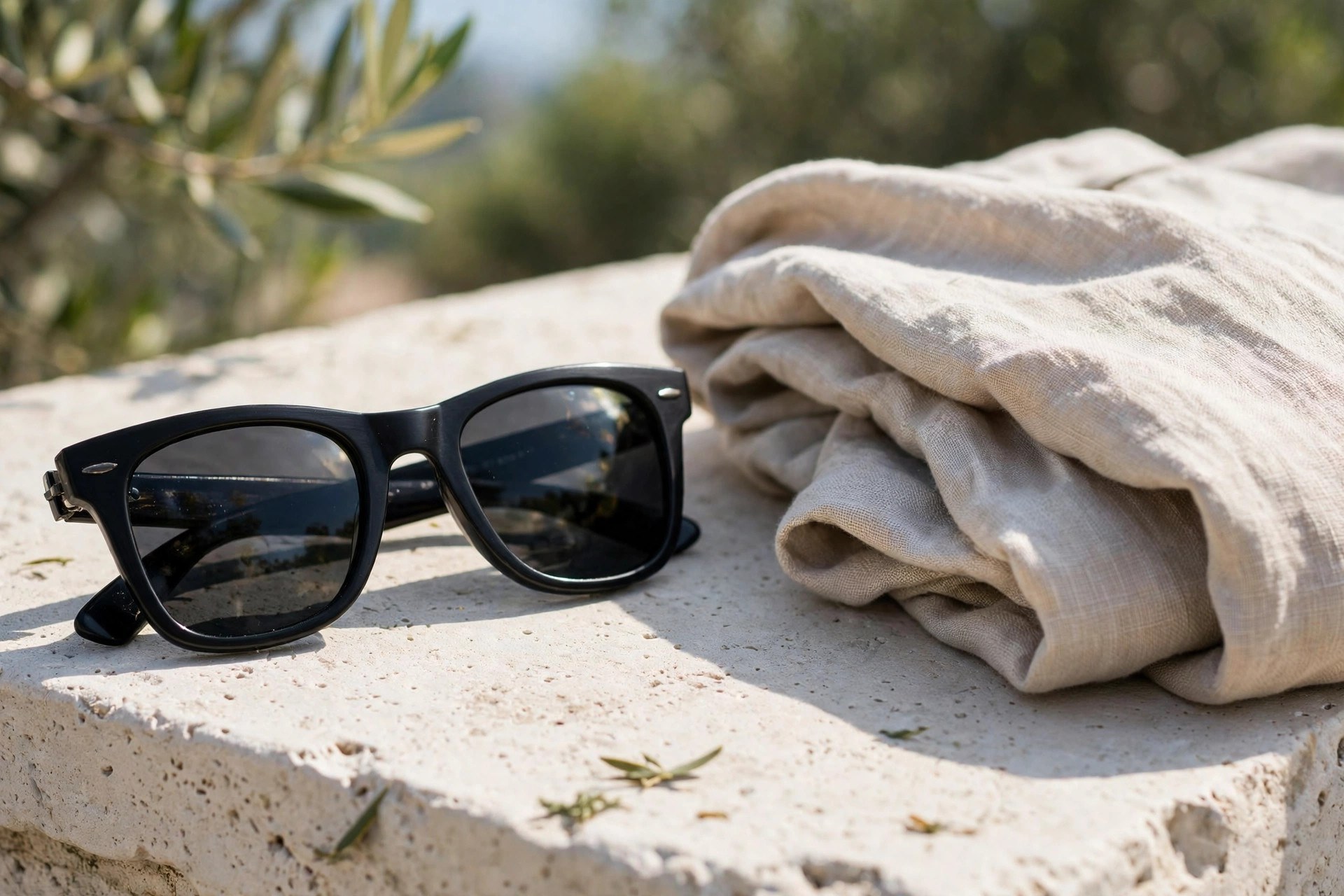
Wayfarer sunglasses are defined by a bold, trapezoidal acetate frame: a strong straight brow line, lenses that are wider at the top than the bottom, thick temples, and small metal rivets at the front corners. It is the frame shape launched by Ray-Ban in 1952 (Wayfarer is a Ray-Ban model name, now widely used for the style) — and unlike most sunglasses shapes, it has never fully gone away.
A Short History of an Unkillable Frame
The original 1952 design was radical because it was plastic. Sunglasses before it were mostly thin metal frames; the chunky acetate Wayfarer, designed by Raymond Stegeman, looked like the tail-finned cars of its decade. Through the 1950s and 60s it became the off-duty frame of film stars and musicians — James Dean, Audrey Hepburn in Breakfast at Tiffany's, Bob Dylan — which fixed its associations early: creative, cool, slightly rebellious.
Sales faded in the 1970s as oversized frames took over, then a product-placement deal put Wayfarers on Tom Cruise in Risky Business (1983) and sales exploded again — the frame is credited with one of the great placement-driven revivals in fashion. The 2000s brought the 'New Wayfarer', a softer, slightly smaller and less tilted version, and endless interpretations from other makers at every price. The shape survives trend cycles for a practical reason: its strong geometry suits a very wide range of faces, which most statement frames do not. Generic buying advice lives on our women's sunglasses guide and men's sunglasses guide; this page is about this one frame.
Original, New, and Folding Versions

The classic original has a noticeable forward tilt (pantoscopic tilt), a larger lens, and the most pronounced trapezoid — the boldest, most retro look, and the least forgiving on small faces. The New Wayfarer softens all three: smaller, rounder-edged, sitting more upright, and for many people it is the easier everyday wear. Folding versions hinge at the bridge and temples and collapse into a small case — genuinely useful for travel and clutches, at a small cost in sturdiness.
Beyond the originator, the style is made by dozens of brands in acetate, bio-acetate and cheaper injection-moulded plastic. What separates a good pair is hinge quality (five or seven-barrel metal hinges outlast plastic pins), acetate that is polished rather than coated, and lenses with real UV400 protection — the shape alone says nothing about lens quality, so check the rating, especially on very cheap pairs.
Which Face Shapes Do Wayfarers Suit?
This is the frame's superpower: the strong brow line and tapered lens flatter most faces. On round faces, the angular top line adds definition and contrast. On square faces, the slightly curved lower edge softens a strong jaw while the bold brow holds its own. On oval faces — the easy case — almost any size works. On heart-shaped faces, the wider top echoes the forehead and the narrower bottom does not widen the chin, which is why the shape so often suits them.
The two cautions are very small and very long faces. A petite face can be overwhelmed by the original large version; choose the new, smaller sizing and a narrower bridge. A long face should avoid the tallest lenses, which add visual length; a medium lens height keeps the proportions balanced. Whatever your face, the frame should not extend much beyond your temples, the brow line should sit at or just above your own brows, and your eyes should sit near the centre of each lens.
How to Wear Them — and Sizing Notes
Wayfarers read casual-cool first and formal never, which defines their styling range. They are perfect with denim, tees, leather jackets, summer dresses, and the whole smart-casual spectrum, and they add deliberate ease to a blazer. They are the wrong choice with black tie or very formal tailoring, where a thinner, quieter frame (or none) is correct. Tortoiseshell is the most versatile colour after black — warmer on pale skin and softer against formal clothes — while bright colours and white frames push the look fully retro.
One more practical point separates a pair you will keep from a pair in a drawer: try them in daylight, not shop light, and check the view from the side in a mirror. The temples should run straight back without pressing hard above the ears, the lower rim should clear your cheeks when you smile, and the lenses should not sit so close that your eyelashes brush them. Discomfort that is mild in a two-minute try-on becomes constant on a two-hour drive, and acetate can be adjusted by an optician — but only within limits, so the starting fit has to be close.
Sizing is printed inside the temple as three numbers: lens width, bridge width, temple length, in millimetres. Medium Wayfarers sit around 50–52 mm lens width. If a pair slides down, the fix is usually the bridge fit or temple adjustment by an optician, not a smaller lens. Store them in their case — acetate scratches less than metal bends, but it still scratches — clean lenses with a microfibre cloth, and keep them off the top of your head, which gradually stretches the temples and loosens the fit.
Common Questions
- Are Wayfarer sunglasses still in style?
- Yes — they are one of the few frames considered a permanent classic rather than a trend. Sales surge and dip with each decade, but the shape has been continuously produced since 1952 and is treated as a wardrobe staple.
- What is the difference between original and New Wayfarer?
- The original is larger, bolder and tilts forward more, with the strongest trapezoid shape. The New Wayfarer is slightly smaller and softer-edged, sits more upright, and suits smaller faces and subtler styling.
- Do Wayfarers suit everyone?
- Nearly. Their angular brow flatters round, square, oval and heart-shaped faces. Very small faces should choose the smaller sizing, and very long faces should avoid the tallest lens versions.
- Are cheap Wayfarer-style sunglasses safe?
- Only if the lenses genuinely block UV — look for a stated UV400 or 100% UVA/UVB rating. Dark lenses without UV protection are worse than none, because your pupils open wider behind them. Frame quality varies; lens protection is the non-negotiable.
- Can Wayfarers take prescription lenses?
- Usually yes. The frame is sturdy and the lens shape is straightforward for most prescriptions, though very strong prescriptions may suit the flatter New Wayfarer better. Ask an optician to confirm before ordering.