Women's Oxford Pumps Guide
The oxford pump puts a heel under the lace-up shoe: menswear's most formal construction, re-cut as a heeled, feminine silhouette with all its broguing and polish intact.
Shop Women's Oxford Pumps Now
Shop Women's Oxford Pumps on Amazon Shop Women's Oxford Pumps on eBayThe Amazon and eBay links on this page are affiliate links. If you make a purchase through them, Apparel Search may earn a commission.
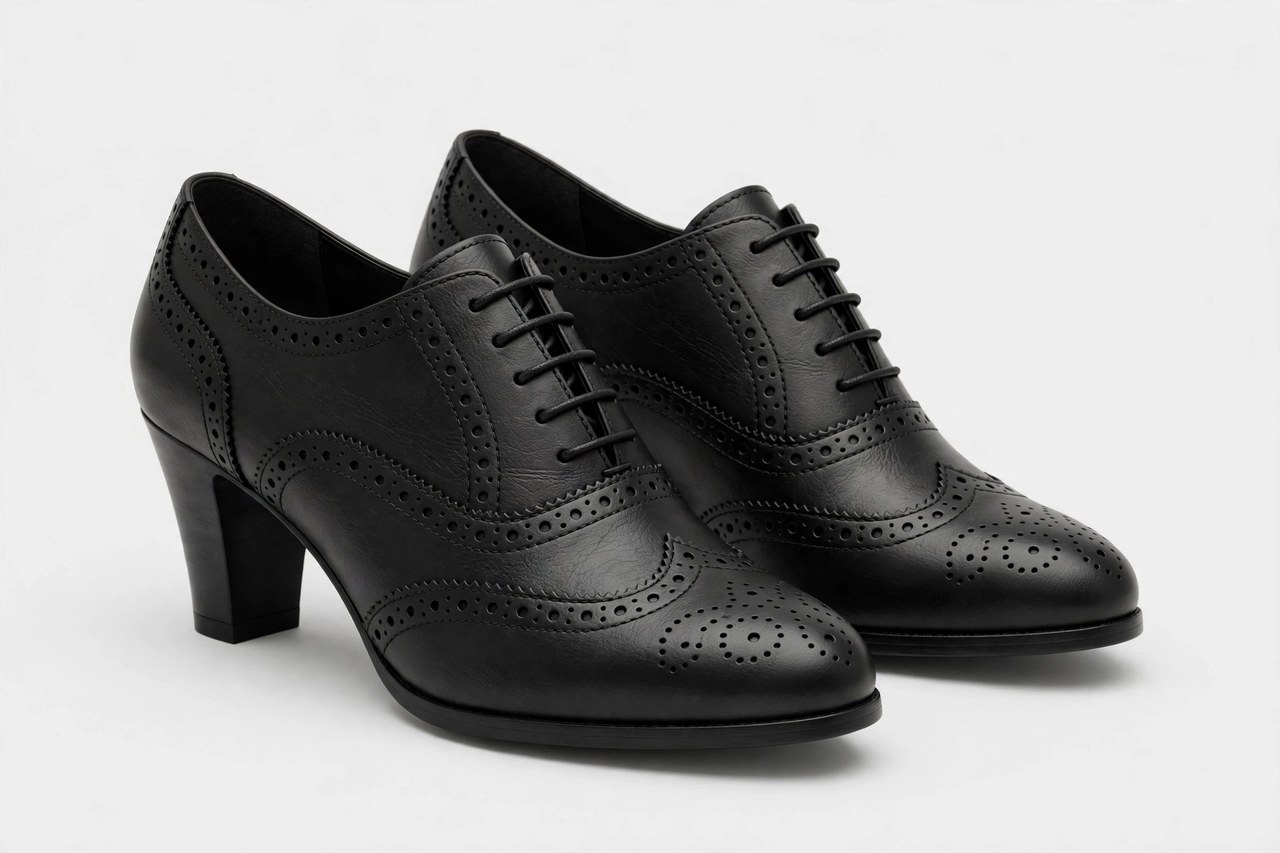
An oxford pump is a hybrid with a clear pedigree: it takes the oxford shoe — the lace-up whose eyestay panels are stitched under the vamp, giving the clean, closed lacing that makes oxfords the most formal of shoes — and builds it on a pump's heeled last. The result is a shoe with two personalities in agreement: the lacing, broguing and polished leather of the boardroom, carried on a heel that makes it unmistakably a woman's dress shoe.
This guide covers the heeled branch of the oxford family; the flat oxford shoe has its own guide (linked below), and the differences are more than the heel — fit, styling and occasion all shift when the lace-up goes up. Here we deal with heel shapes on oxfords, the decorative vocabulary the style carries (broguing, spectators, wingtips), and how to fit a shoe whose laces are both its ornament and its adjustment system.
Heels on an Oxford: Shapes and Heights
The classic oxford pump heel is the stacked leather-look heel at a mid height — the direct descendant of the men's shoe's stacked heel, scaled up — and it keeps the style's tailored character best. The block heel is its modern, walkable sibling, especially on platform-leaning fashion versions. Stiletto oxford pumps exist at the fashion extreme, where the contrast between sober lacing and a needle heel is the entire point. Kitten-heeled versions bridge to the flat guide's territory. As a rule, the more formal the occasion, the more the heel should stay in the stacked or slender mid range; very high oxford pumps read as fashion shoes, which is a legitimate but different intention.
The decorative vocabulary transfers whole from the men's original. Brogueing — the punched perforation patterns along seams — ranges from the plain cap-toe oxford pump (most formal) through half-brogues to full wingtip pumps whose W-shaped toe cap sweeps back along the sides. Spectator versions two-tone the leather (black and white classically, also tan and cream). On a heeled shoe these details concentrate the eye at the toe, which shortens the foot visually — a plain cap toe in a dark leather is the lengthening, formal choice; a wingtip spectator is the statement.
Fitting a Laced Heel
The oxford pump's laces are a genuine fitting instrument, which flat-fronted pumps lack: they let you set the shoe's grip at the instep precisely, snug for narrow feet, eased for high insteps. Fit with the laces tied as you will wear them, in the afternoon, and judge three things: the heel stays seated when you walk (the laces should make heel slip nearly impossible in the right size), the toes have length without pressing the cap, and the lacing closes to a neat, even V — eyelets straining wide apart means the shoe is too narrow, whatever the length feels like.
Break-in is real in a heeled leather oxford: the quarters and vamp are the same structured leathers as the flat shoe, but the heel changes the pressure map, loading the ball of the foot. Wear new pairs for short outings first, consider a thin gel forefoot pad for long days, and rotate rather than repeating days during the first weeks. Once broken in, the style is among the most secure heeled shoes made — the closed lacing holds the foot so the heel can do its work without the toes gripping to keep the shoe on.
Styling and Care
Oxford pumps dress at the tailored end of a wardrobe. They are the natural shoe for trouser suits and tailored dresses (where they echo the suiting's menswear roots), for pencil skirts and midi dresses in the cooler months, and for any outfit that wants polish with a scholarly or vintage inflection — the style carries 1930s and collegiate echoes that a plain pump cannot. Hosiery is part of the look: sheer tights for formality, fine socks worn visibly for the fashion version. Keep the rest of the outfit's tailoring crisp; the oxford pump looks lost under sloppy hems.
Care is the men's shoe ritual, and the style deserves it: trees or tissue between wears, rest days, cream polish for smooth leather (broguing takes polish down into the perforations — use a brush, never a cloth wad, to keep the holes clean rather than clogged), and heel tips and lace replacement before either fails publicly. Laces are a consumable in this style: carry the spare pair that good makers include, because a snapped lace on a laced heel is not a walkable shoe. Kept this way, an oxford pump ages like the classic it is modeled on — the leather deepens, the shape holds, and the shoe outlives the trends it predates.
Related Women's Guides
Photos

More to Explore on Apparel Search
Looking for Women's Clothing Stores?
This guide helps you choose women's oxford pumps. To browse where to buy, visit our women's clothing store directory, where you can find retailers that carry them.