Women's Oxford Shoes Guide
The women's oxford is the lace-up flat with the closed lacing and tailored finish of the classic men's shoe — re-proportioned for a woman's foot and wardrobe.
Shop Women's Oxford Shoes Now
Shop Women's Oxford Shoes on Amazon Shop Women's Oxford Shoes on eBayThe Amazon and eBay links on this page are affiliate links. If you make a purchase through them, Apparel Search may earn a commission.
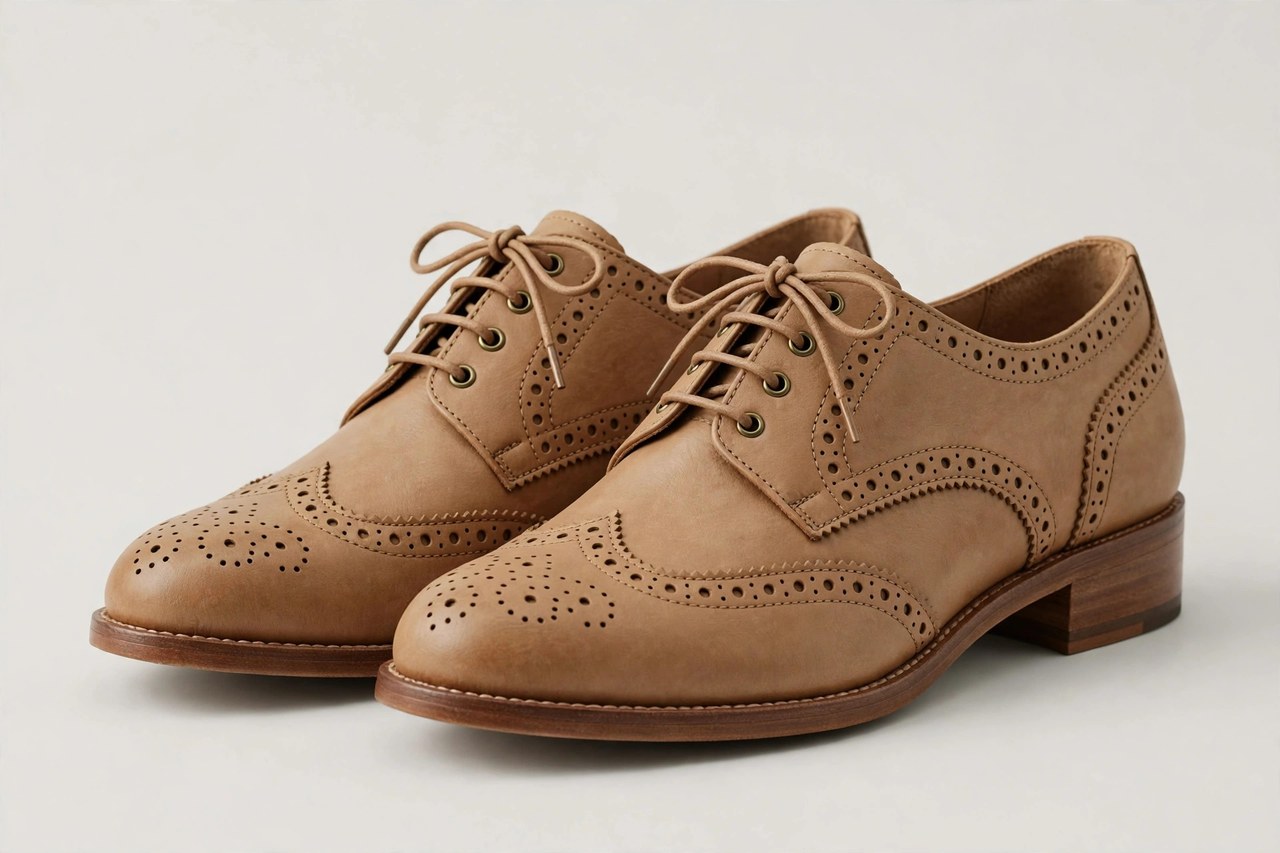
An oxford is defined by its lacing. In an oxford shoe, the panels holding the eyelets (the eyestays) are stitched underneath the front part of the shoe, the vamp, so the lacing closes over a clean, unbroken surface. That closed-lacing construction is the whole definition: it is what makes an oxford an oxford, what gives it the sleekest profile of any lace-up, and what places it at the formal end of the shoe family. Its open-laced counterpart, where the eyestays sit on top of the vamp, is the derby (or blucher) — roomier, more adjustable, slightly less formal.
This is the umbrella guide to women's flat oxfords: the construction and its derby rival, the decorative ranks from plain toe to full brogue, and how the style is fitted and worn. Its heeled descendant, the oxford pump, has a guide of its own (linked below) — everything here is the flat original.
Oxford vs. Derby, Plain vs. Brogue
The oxford/derby distinction matters practically, not just pedantically. The oxford's closed lacing looks cleaner and dresses up further, but it opens less wide and adjusts less, so it fits standard and narrower insteps best. The derby's open lacing accommodates high insteps and orthotics and reads a degree more casual. Many women's lace-ups sold as oxfords are technically derbies; buy the fit and the look you need, and use the terms to understand what you are getting rather than to police the label.
Decoration ranks the family by formality. The plain oxford — no cap, no broguing — in black is the most formal flat lace-up a woman can wear. The cap toe adds a stitched toe seam. Brogues add punched perforation patterns: quarter and half brogues brogue the cap and seams; the full brogue or wingtip sweeps its perforated cap into a W along the sides. Spectator oxfords two-tone the pattern in contrasting leathers. Each step of decoration moves the shoe a step from the boardroom toward the countryside and the wardrobe's playful end — a black plain oxford and a tan wingtip are the same construction wearing opposite intentions.
Fit, Comfort and the Women's Last
A good women's oxford is built on a women's last: narrower heel, different instep geometry and toe shape than a sized-down men's shoe, and the difference decides all-day comfort. Fit in the afternoon with the socks or tights you will wear: the lacing should close to a modest, even gap (eyelets nearly meeting means too wide; a wide strained V means too narrow or too low in volume), the heel should hold without slipping once the laces are snug, and the toes need a thumb's width of length in a shoe that will crease at the ball from the first walk.
Leather oxfords break in; synthetic ones mostly do not, which is the practical argument for leather in a style defined by structure. Expect a quality pair to feel firm for the first several wears and then mold to the foot — the cork or leather insole compresses into your footprint, which is why a broken-in oxford is famously personal footwear. Cushioned and comfort-sole versions trade a little of that molding for immediate softness, a fair trade for women on hard floors all day. Rotate pairs, and the insole recovers its shape and the leather dries fully between wears.
Styling and Care
Women's oxfords style across the wardrobe's tailored half: with trousers and suits they are the suit's own shoe; with midi skirts and dresses they supply the grounded, bookish counterpoint that keeps a soft outfit from floating; with jeans they dress the denim up a full register. Color steers the effect — black for formality, tan and cognac for the heritage look, white and pastel leathers for the modern fashion version, metallics and patents for evening. Visible fine socks or sheer tights are both established finishes; the shoe is one of the few that can carry a sock as a deliberate detail.
Care is simple, regular and rewarding. Shoe trees or tissue after wear; a brush-down to clear the broguing's perforations; cream polish matched to the leather (neutral for two-tone spectators, carefully, so the contrast survives); edge dressing for the sole and heel stack; and resoleing when the sole thins — a welted oxford can be resoled repeatedly, making it one of the few shoes that improves its economics the longer you own it. Kept in rotation and polished monthly, a good pair of women's oxfords is a five-to-ten-year shoe, and it looks better in year five than it did in the shop.
Related Women's Guides
Photos

Looking for Women's Clothing Stores?
This guide helps you choose women's oxford shoes. To browse where to buy, visit our women's clothing store directory, where you can find retailers that carry them.