Women's Peasant Dress Guide
The peasant dress borrows its easy, gathered shape from European folk dress: roomy, comfortable, embroidered with earthy florals and finished with the gathered peasant sleeve.
Shop Women's Peasant Dresses Now
Shop Women's Peasant Dresses on Amazon Shop Women's Peasant Dresses on eBayThe Amazon and eBay links on this page are affiliate links. If you make a purchase through them, Apparel Search may earn a commission.
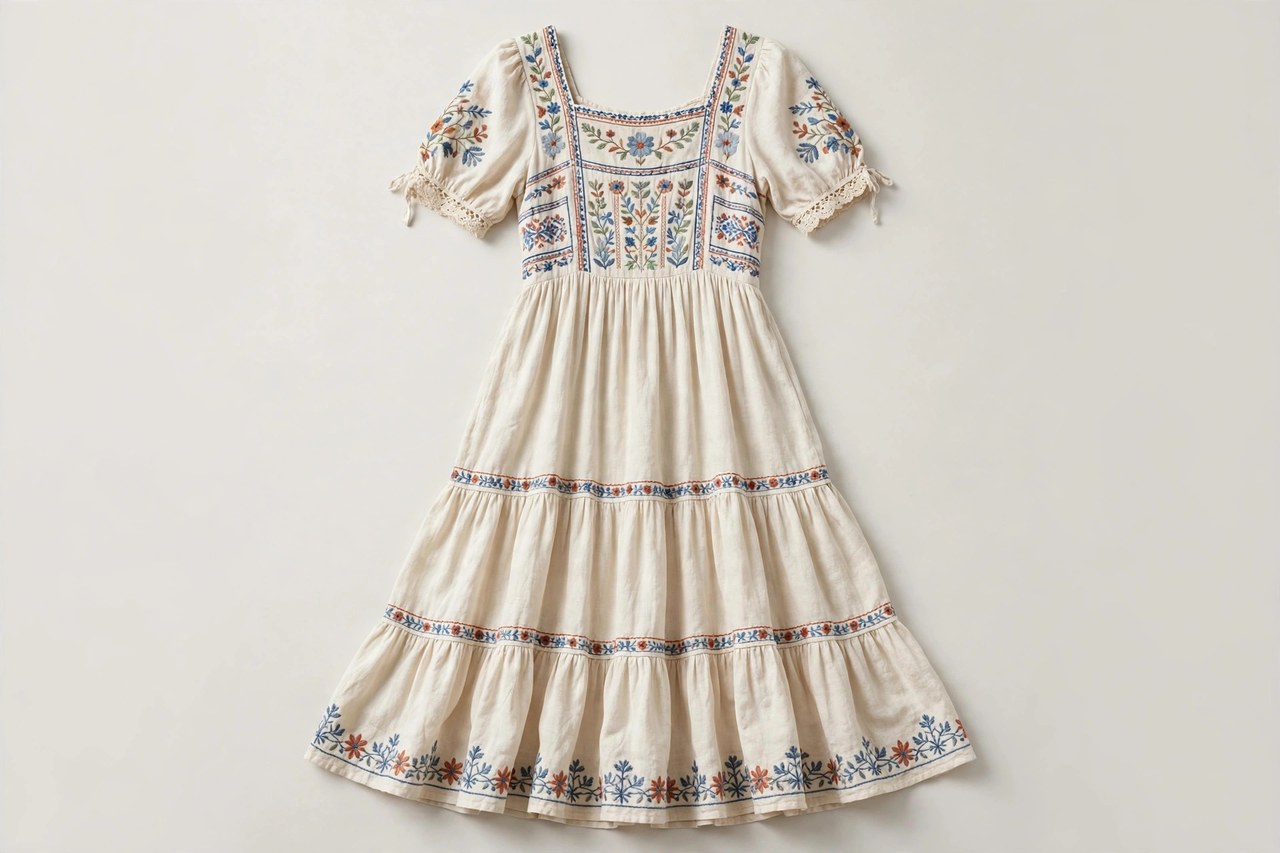
The peasant dress is a loose, gathered dress modeled on the traditional folk clothing of rural Europe — the everyday dress of working women in farming communities, adapted by fashion into a romantic, comfortable style. Its hallmarks are consistent across centuries and across modern versions: a roomy, forgiving cut, a gathered or drawstring neckline that can sit on or off the shoulder, puffed sleeves, natural fabrics, and decoration drawn from folk art, especially embroidery in earthy floral patterns.
Fashion rediscovers the peasant dress every decade or so — in the 1940s, the 1970s and repeatedly since — because it solves a permanent problem: how to look dressed and feel completely unrestricted at the same time. This guide covers its folk origins, construction, fabrics and care.
Folk Origins and the Shape They Created
Traditional peasant dress across Central and Eastern Europe was built from rectangles and gathering, because gathered cloth fits any body without tailored cutting and can be let out or taken in across a lifetime. A chemise-style bodice gathered at the neck, full sleeves gathered into cuffs, a skirt gathered at the waist: the same architecture appears in Ukrainian, Hungarian, Romanian, Bavarian and Scandinavian folk dress, varied by local embroidery, color and trim. The embroidery was the wealth of the garment — hours of stitching in floral and geometric motifs, often in red, rust, ochre and green on natural linen or cotton.
The modern peasant dress is a spectrum. At one end are faithful folk-inspired pieces in linen with real embroidered yokes; at the other, versions that keep only the gathered neckline and puff sleeve. The roomy comfort is not a flaw in the fit but the entire point of the design.
Defining Details: Neckline, Peasant Sleeve and Embroidery
The neckline is wide and gathered, controlled by elastic, a drawstring or smocking, so it can be worn squared on the shoulder, scooped, or pulled off one or both shoulders. The signature sleeve is the peasant sleeve: a puffed sleeve gathered at both the top and the bottom — gathered into the armscye or a yoke at the shoulder, full through its length, and gathered again into an elastic or banded cuff at the elbow or wrist. That double gathering is what creates the soft balloon volume that distinguishes it from an ordinary short sleeve.
Decoration concentrates where folk dress put it: at the yoke, neckline, cuffs and hem. Earth-toned floral embroidery — stylized flowers, leaves and vines in rust, mustard, sage, cream and dusty blue — is the classic motif set, worked in thread, or imitated by print in simpler versions. Smocking, crochet lace edging, tassel ties and woven ribbon trim complete the vocabulary. On a good peasant dress these details are integrated, with embroidery placed to frame the neckline; on a poor one a printed panel is simply pasted on, which the eye registers immediately even if the wearer cannot say why.
Fabrics, Fit and Choosing
Natural, breathable fabrics are true to the style and best in wear: cotton and cotton voile for summer lightness, linen and linen blends for the authentic slightly crisp hand, rayon challis for the softest drape in long versions, and cotton gauze for beach-weight dresses. The fit is deliberately roomy and comfortable — the dress skims rather than clings, with shape supplied by a smocked or elastic waist, a self-belt, or the gathering itself. Size by the bust and shoulders, not the waist; the waist is designed to be flexible.
Choose length and volume for your proportions. Maxi peasant dresses in soft rayon are the festival and holiday staple; knee-length versions in cotton are everyday summer dresses; mini versions read youngest and suit the puff sleeve best. If you are petite, look for scaled-down gathering and shorter sleeve volume so the dress does not wear you. Check that elastic at neckline and cuffs is firm but not tight, that off-shoulder styling actually stays in place when you move, and that embroidered sections are backed so they do not scratch — comfort is this style's promise and it should keep it everywhere.
Styling and Care
Peasant dresses style themselves around a rustic, natural register: flat leather sandals, espadrilles, ankle boots, woven or straw bags, and simple jewelry in wood, brass or stone. A wide belt over the gathers gives the dress a more defined shape for town wear; left unbelted with sandals it is a holiday dress. In cooler weather, layer with a denim or suede jacket and boots rather than tailored pieces, which fight the dress's folk character. Keep hair and makeup easy to match the dress's register — the whole style is an argument for unforced prettiness.
Care protects the decoration. Wash embroidered dresses inside out, in cool water on a gentle cycle or by hand, to shield stitching and tassels; rayon and linen versions may prefer hand washing per the label. Dry flat or on a line out of harsh sun, which fades earthy dyes unevenly, and iron on the reverse of embroidery with a pressing cloth. Store folded or on padded hangers — the gathered neckline's elastic lasts longer un-stretched. Looked after this way, a cotton or linen peasant dress softens beautifully with age and can serve for many summers.
Related Women's Guides
Photos

More to Explore on Apparel Search
Looking for Women's Clothing Stores?
This guide helps you choose women's peasant dresses. To browse where to buy, visit our women's clothing store directory, where you can find retailers that carry them.