Women's Sarongs Guide
A sarong is a large tube or length of fabric wrapped around the waist — traditional dress across whole regions, and a beach cover-up everywhere else.
Shop Women's Sarongs Now
Shop Women's Sarongs on Amazon Shop Women's Sarongs on eBayThe Amazon and eBay links on this page are affiliate links. If you make a purchase through them, Apparel Search may earn a commission.
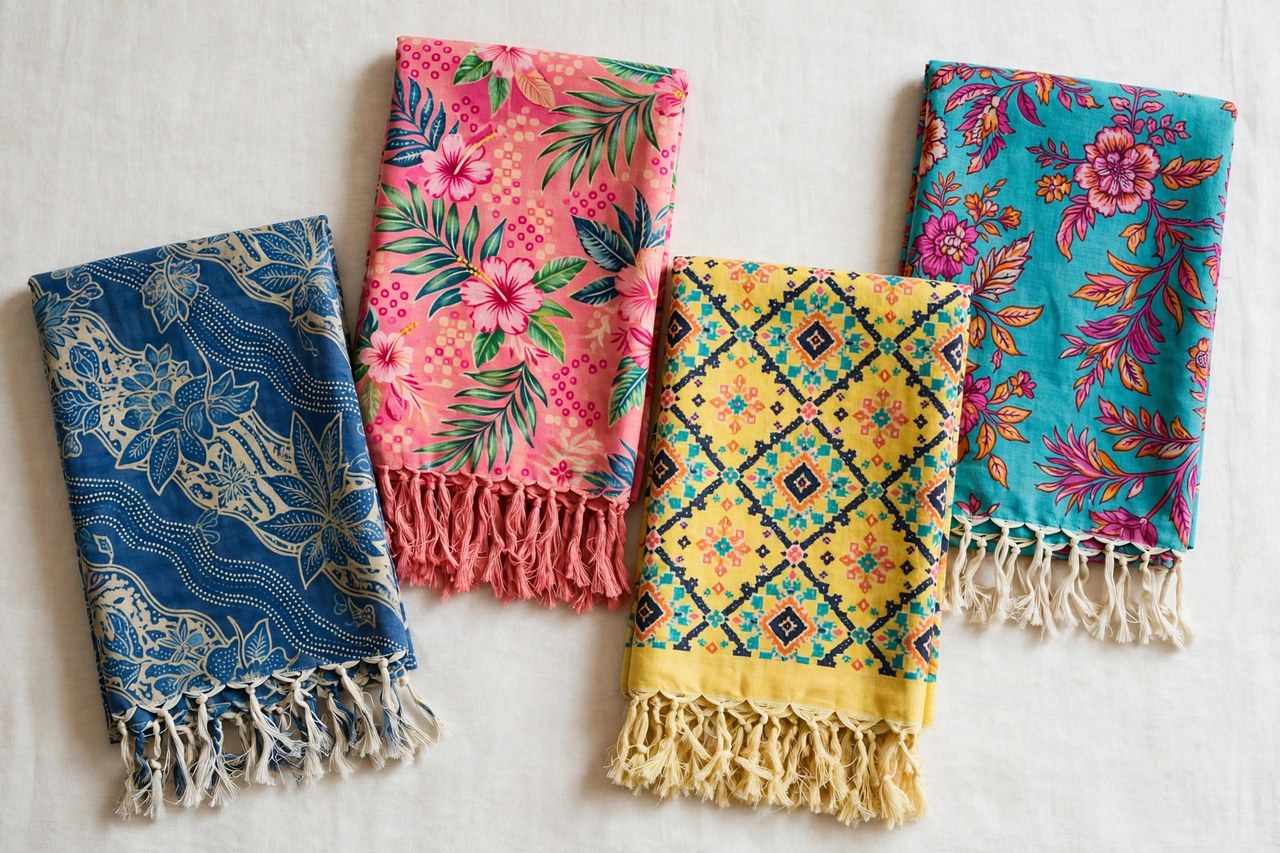
A sarong or sarung is a large tube or length of fabric, often wrapped around the waist, worn in Southeast Asia, Southern Asia, Western Asia, Northern and East and West Africa, and on many Pacific islands. Different types are worn in different places, and the word carries different meaning and importance depending on region, religion and culture. This guide separates the traditional garment from its beach descendant, because they share a name and a shape but not a job.
As beachwear, sarongs are a cover-up accessory worn around the pool, at the beach and at lakes, and swimsuit sarongs are an important part of many women's warm-weather wardrobes. As traditional dress, the sarong is everyday and formal clothing for women and men alike. Understanding the traditional construction — the tube, the panel, the rolling waist — makes both versions easier to buy and far easier to tie so they stay tied.
Traditional Construction: The Tube and the Kepala
The traditional sarung is a length of fabric about a yard (0.91 m) wide and two-and-a-half yards (2.3 m) long. Across the narrower width at the center sits a panel of contrasting color or pattern about a foot wide, woven or dyed into the fabric, known as the kepala, or 'head' of the sarong. The sheet is stitched at its narrower edges to form a tube, and that tube is the garment, complete before any tying begins.
To wear it, you step into the tube, bring the upper edge above the navel with the hem level with the ankles, position the kepala at the center of the back, fold the excess fabric from both sides to the front center where the folds overlap, and secure the sarong by rolling the upper hem down over itself. Malay men traditionally wear sarongs woven in a check pattern, while women wear sarongs dyed by the batik method; in Javanese culture batik sarongs are worn by all genders, including at formal occasions such as weddings.
Fabrics: Batik, Ikat, Plaid and Prints
Traditional sarong fabric often carries woven plaid or checkered patterns, or is brightly colored by batik or ikat dyeing. Many modern sarongs have printed designs, often depicting animals or plants. The distinction matters for care and for drape: woven patterns run through the cloth and age evenly, batik is dyed through and holds color well in sun and salt water, while surface prints on thin rayon are the lightest and cheapest but fade fastest at the fold lines.
For formal settings, women commonly wear the sarong with a kebaya blouse, a pairing in which fabric quality and finish carry the formality, not embellishment. Beach versions invert the priorities: quick drying, resistance to chlorine and salt, and enough opacity when wet. Rayon and viscose dominate beach sarongs because they drape softly and pack to nothing; cotton versions feel sturdier and more traditional but dry slowly and crease in a beach bag.
Beach Sarongs: Tying Styles That Stay Put
The beach sarong earns its keep through versatility. Tied at the waist it is a long or short skirt; hitched above the bust it becomes a simple dress; knotted at the neck it forms a halter cover-up; folded, it serves as a shawl, head covering or improvised beach mat. Full-length sarongs offer the most options, while half sarongs cover only the waist-to-thigh zone and pack smaller, suiting swimmers who want a café-ready layer rather than a full outfit change.
Security is the practical test. Tie at the side or front with a firm double knot, or use a sarong buckle or ring to thread the ends through, which holds soft rayon far better than a single knot. For a dress tie, cross the ends behind the neck rather than knotting at the bust alone. Choose a fabric with a little body if you plan to walk far; the thinnest gauze sarongs blow open in any breeze and work best poolside, close to your towel.
Sizing, Buying and Care
Sarongs are close to one-size, but dimensions still matter: check the length for the coverage you want and the width for comfortable overlap at your hip measurement, because a sarong that barely overlaps cannot be tied securely by any method. Traditional tube sarongs are bought by length and should reach the ankle when rolled at the waist. Bright batik and printed pieces should be washed separately at first, as loose dye is common in the first few washes.
Wash beach sarongs cool and gentle, rinse salt and chlorine out the same day, and dry in shade to protect color. Roll rather than fold for travel to avoid hard creases in rayon. Store traditional woven and batik sarongs folded flat, away from damp. A sarong asks very little — no sizing system, no fastenings, no alteration — and returns a garment that has served formal weddings and barefoot beach cafés with equal ease, which is why it has lasted so long in so many places.
Related Women's Guides
Photos

Looking for Women's Clothing Stores?
This guide helps you choose women's sarongs. To browse where to buy, visit our women's clothing store directory, where you can find retailers that carry them.