Women's Zebra Print Clothing Guide
Women's zebra print clothing carries the black-and-white stripes of an African equine onto dresses, tops, coats and accessories — a monochrome print with real biology behind it, explained and styled here.
Shop Women's Zebra Print Clothing Now
Shop Women's Zebra Print Clothing on Amazon Shop Women's Zebra Print Clothing on eBayThe Amazon and eBay links on this page are affiliate links. If you make a purchase through them, Apparel Search may earn a commission.
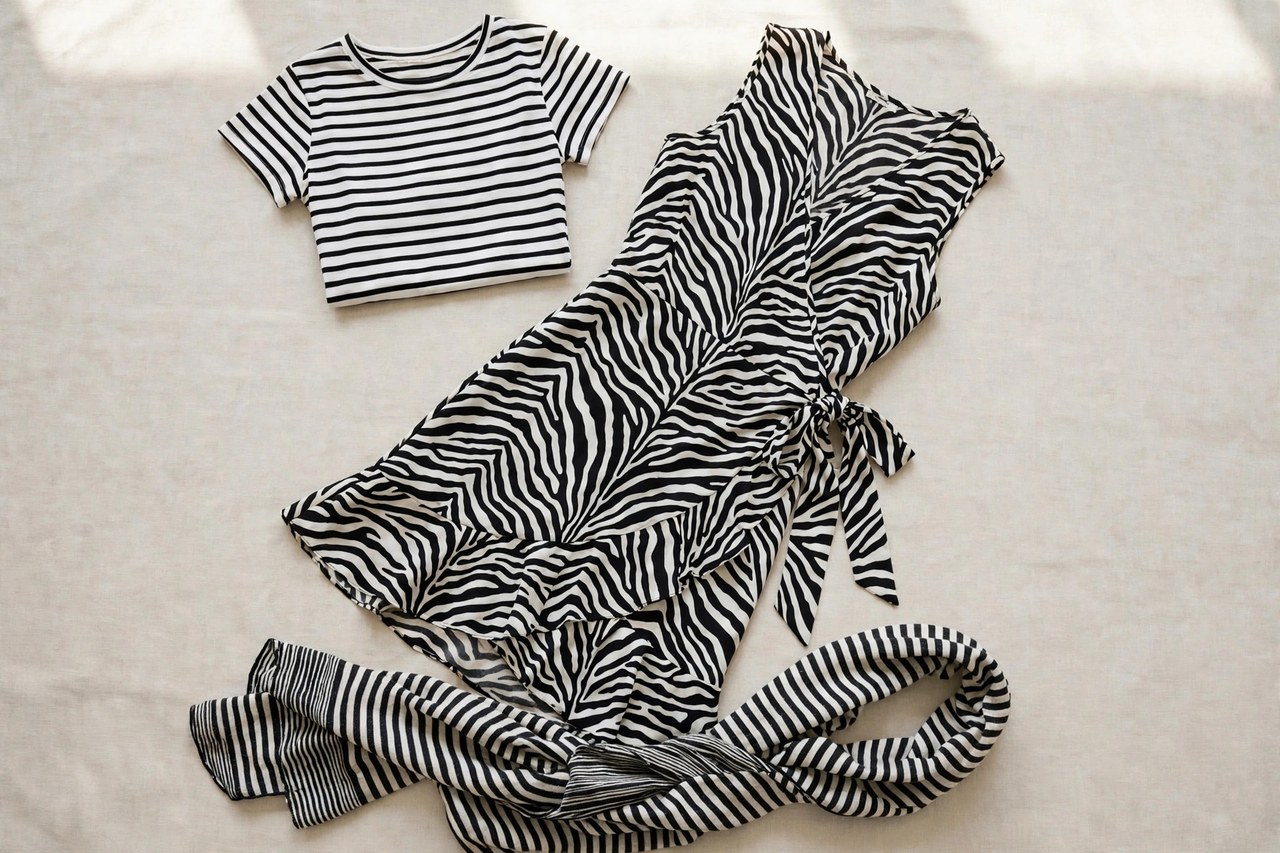
Women's zebra print clothing is any garment, shoe or accessory printed with the appearance of zebra stripes: irregular black-and-white bands borrowed from zebras, African equines with distinctive black-and-white striped coats. Just in case you were curious, an equine is a member of the genus Equus, in the family Equidae, which includes horses, donkeys and zebras — and of the three, only the zebra arrives wearing a graphic print.
Zebras' dazzling stripes make them among the most recognizable mammals on earth, and the print borrows that recognizability wholesale. This guide covers the animal science behind the stripes — because the theories behind them are genuinely interesting — and then the practical fashion questions: scale, garment choice, and how much zebra one outfit can carry.
Why Do Zebras Have Stripes?
Zebra stripes come in different patterns, unique to each individual — no two zebras are striped alike. Several theories have been proposed for the function of these stripes, with most evidence supporting them as a form of protection from biting flies. The theories repay a quick tour, because each one doubles as a way of seeing the print.
The confusion hypothesis states that the stripes confuse predators: making it harder to distinguish individuals in a group and to determine the number of zebras in it, making it difficult to determine an individual's outline when the group flees, and reducing a predator's ability to follow a target during a chase. The social function hypothesis states that stripes serve a role in intraspecific or individual recognition, social bonding, mutual grooming facilitation, or a signal of fitness — the unique pattern as a name tag. And the fly protection hypothesis holds that stripes deter biting flies, which matters because horse flies in particular spread diseases lethal to equines, such as African horse sickness, equine influenza, equine infectious anemia and trypanosomiasis.
The Fly Evidence
The fly theory has the oldest experiment behind it. It was found that flies were less likely to land on black-and-white striped surfaces than on uniformly colored ones in 1930, by biologist R. Harris. A 2012 study concurred, and concluded that the stripes reflect contrasting light patterns rather than the uniform patterns these insects use to locate food and water — the polarized light off a dark, uniform coat reads to a horse fly like a surface worth landing on, and a striped coat breaks that signal up.
None of this will keep flies off a zebra print dress, and it does not need to. Its value to a wearer is different: the print you are wearing carries a real evolutionary argument in its pattern, which makes zebra one of the few fashion prints with a documented function in nature. Why do women wear zebra stripes? Good question — maybe they simply like the print. Black and white in perfect unity needs no further excuse.
Choosing Scale and Garment
Printed zebra is a design translation, and its variables are scale, spacing and contrast. A fine, close stripe reads almost as texture from a distance and suits tops, knitwear and work-appropriate pieces; a wide, high-contrast stripe is the bold, unmistakable version, best on coats, dresses and statement pieces where the garment is meant to be the outfit. Irregular spacing looks natural; perfectly even, mechanical stripes look printed in the cheaper sense, so judge a piece up close.
Garment by garment: dresses and coats carry the print at full length and full effect. Tops and shirts are the entry dose, worn with plain bottoms. Trousers and leggings in zebra are a strong look that pairs with black or white above. Shoes, bags and scarves are the accent dose — one striped accessory lifts a black outfit without committing to it. Zebra is one member of the wider animal print family, linked below, alongside leopard, snake and cow prints, each with its own coloring logic; zebra is the only monochrome one, which is precisely its styling advantage.
Styling a Monochrome Print
Because zebra print is black and white, it pairs with every color — and argues with every other print. The reliable outfits treat zebra as the single pattern and build solids around it: black tailored pieces make it sharp, white makes it summery, denim makes it casual, and one saturated color — red, cobalt, kelly green — makes it fashion. Mixing zebra with a second animal print can work when scales differ greatly, but it is the advanced move, not the default.
Fit matters more in a print this graphic: stripes distort visibly over strained seams and pulling fabric, which reads as poor fit faster than it would in a solid. A zebra garment should skim rather than cling unless it is cut as a deliberate body-conscious piece in a fabric with real recovery. Whatever pattern of animal print clothing you are wearing, it is in fashion when the fit is right and the dose is deliberate.
Care for Printed Fabrics
Zebra prints are usually printed onto the fabric surface, so care follows print rules: wash inside out, cold, with like colors — a black-and-white print can grey itself if the black bleeds into the white in hot water with harsh detergent. Avoid bleach entirely, dry away from direct sun, and iron on the reverse where the fabric allows it.
On coated accessories and shoes, wipe rather than wash, and store bags stuffed and upright so the printed surface does not crease against itself. A zebra print kept crisp keeps its graphic punch; a faded one loses the contrast that is the entire point of the pattern.
Common Questions
Why do zebras have stripes, according to scientists?
Three main theories are proposed. The confusion hypothesis says stripes make it harder for predators to single out and follow individuals in a fleeing group. The social function hypothesis says the unique pattern aids individual recognition, social bonding and grooming. The fly protection hypothesis - with the most evidence - holds that stripes deter biting flies: experiments in 1930 by R. Harris and a 2012 study found flies land less on striped surfaces, because contrasting light patterns break up the uniform signal the insects use to find food and water.
Is every zebra's stripe pattern really different?
Yes. Zebra stripes come in different patterns unique to each individual, which is part of the basis for the social function hypothesis - the pattern can serve as a visual name tag within the herd. Printed clothing standardizes the pattern for manufacture, but better prints keep the irregular spacing that makes natural zebra look natural rather than mechanical.
How much zebra print should one outfit include?
One printed piece is the reliable rule: a zebra dress or coat as the outfit, a zebra top with plain bottoms, or a single striped accessory - shoes, bag or scarf - with a solid outfit. Zebra is monochrome, so it pairs with any solid color; what it argues with is a second print, which needs a deliberate difference in scale to work.
More in Women's Clothes Guide Z
Why Zebras Have Stripes
Start with the animal before the print: zebras are African equines with distinctive black-and-white striped coats, each individual’s pattern unique — an equus, a genus of mammals in the family Equidae, which includes horses, donkeys and zebras. Three leading theories explain the stripes. The confusion hypothesis holds that stripes confuse predators — by making it harder to distinguish individuals in a group, harder to determine an individual’s outline when the group flees, and harder to follow a target during a chase. The social function hypothesis says stripes serve a role in intraspecific or individual recognition, social bonding, mutual grooming facilitation, or a signal of fitness. The fly protection hypothesis holds that the stripes deter biting flies: horse flies spread diseases lethal to equines, such as African horse sickness, equine influenza, equine infectious anemia and trypanosomiasis, and it was found as early as 1930 by biologist R. Harris — confirmed by a 2012 study — that flies were less likely to land on black-and-white striped surfaces than uniformly colored ones, because the stripes reflect contrasting light patterns rather than the uniform patterns these insects use to locate food and water. In short, zebras’ dazzling stripes make them among the most recognizable mammals, and if you wear printed garments with the appearance of this majestic animal, possibly you can be dazzling as well.
Photos


More to Explore on Apparel Search
Looking for Women's Clothing Stores?
This guide explains women's zebra print clothing and how to wear it. To browse where to buy, visit our women's clothing store directory, where you can find retailers that carry it.