Milan, Italy Fashion Shopping Streets
The Quadrilatero della Moda, a nineteenth-century glass arcade, and Milan's alternative shopping streets
Welcome to the Milan, Italy fashion destination guide. Milan is Italy's fashion and design capital, and its shopping divides into clear territories: the Quadrilatero della Moda for the great designer houses, the Galleria and Piazza del Duomo at the city's ceremonial center, Corso Buenos Aires for hundreds of ready-to-wear shops, and the Ticinese district for vintage, streetwear and young Milanese style. This guide covers the fashion streets, designer boutiques and other important shopping destinations for consumers interested in clothing and fashion accessories.
Unlike Florence and Rome, where luxury shopping sits inside ancient centers, Milan's fashion quarter is a business district that happens to be beautiful - this is the city where the Italian ready-to-wear industry shows, sells and celebrates itself. Even travelers who buy nothing should walk the Quadrilatero once: the concentration of flagship boutiques in so few streets exists nowhere else in quite the same way.
The Quadrilatero della Moda
The quadrilatero della moda - the fashion quadrilateral - is formed by Via Montenapoleone, Via della Spiga, Via Sant'Andrea, Via Manzoni and Corso Venezia. Via Montenapoleone, also spelled Via Monte Napoleone, is Milan's most fashionable shopping street: an elegant and expensive street famous for its ready-to-wear fashion and jewelry shops, considered by many the most important street of the Milan Fashion District, where well-known fashion designers keep their high-end boutiques and the most exclusive Italian shoemakers maintain stores. Via Sant'Andrea, forming part of the quadrilateral along with Montenapoleone, della Spiga, Manzoni and Corso Venezia, is a luxury shopping street in the same register.
Stores found in Milan include Missoni, Trussardi, Kenzo, Giorgio Armani, Chanel, Moschino, Versace, Gianfranco Ferri, Hermes and Prada, and more. Between the quadrilateral and the Duomo, Piazza del Duomo - Cathedral Square - is the main piazza of Milan, named after and dominated by the Milan Cathedral. Rectangular, at about 17,000 square meters, it includes some of the most important buildings in Italy and some of its most prestigious commercial activities, and it is by far the foremost tourist attraction of the city - the natural starting point of any Milan shopping walk.
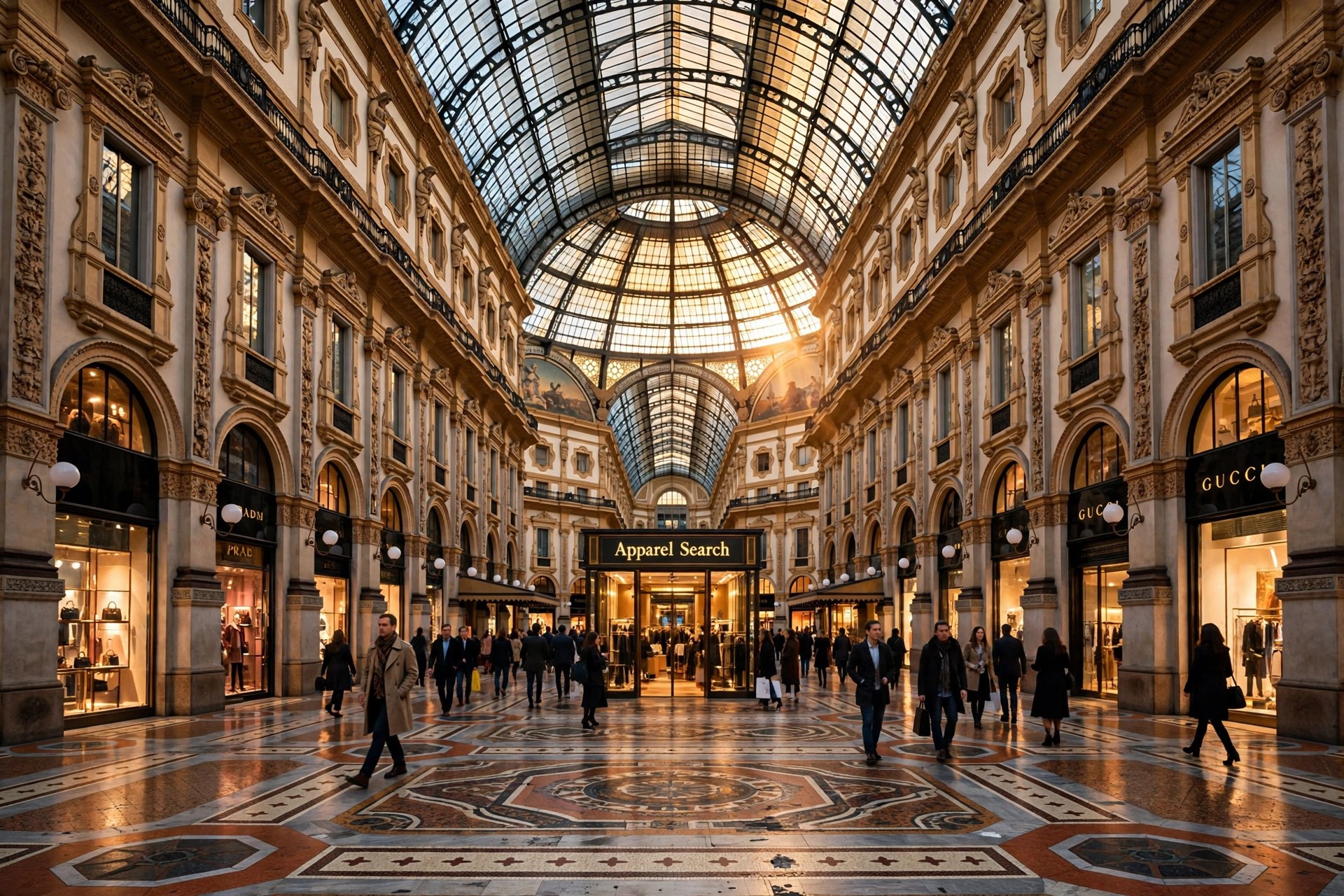
The Galleria Vittorio Emanuele II
The Galleria Vittorio Emanuele II is one of the world's oldest shopping malls: a four-story double arcade in central Milan, designed in 1861 and built by Giuseppe Mengoni, and named after Vittorio Emanuele II, the first king of the Kingdom of Italy. The Galleria is often nicknamed il salotto di Milano - Milan's drawing room - for its numerous shops and its importance as a Milanese meeting and dining place.
The arcade principally contains luxury retailers selling haute couture, jewelry, books and paintings, alongside restaurants, cafes and bars, and it is famous for being home to some of the oldest shops and restaurants in Milan. Shopping here is as much about the building as the boutiques: come for the flagship windows, stay for a coffee under the glass dome, and spin on the mosaic bull for luck like everyone else.
Beyond the Center: Ticinese, Torino and Buenos Aires
Corso di Porta Ticinese runs from the Colonne di San Lorenzo to Piazza XXIV Maggio, and it is a favorite shopping destination of Apparel Search because it is full of cute vintage shops where you can find many unique items. It is a fairly alternative area: jeans stores such as Diesel, 55DSL, Gas, Carhartt and Armani Jeans sit alongside skate shops, piercing and tattoo parlors and vintage clothing boutiques. Look for Tokidoki, the Japanese-inspired store by Italian designer Simone Legno, for original streetwear, toys and designer skates, and for Serendeepity as well. Via Torino, long one of Milan's main shopping streets, connects Piazza del Duomo with the Ticinese district and has developed as a shoe mall geared mainly to the young and stylish - everything from all-terrain boots to dainty sandals, at inexpensive, mid-range and high prices.
Corso Buenos Aires, in north-eastern Milan, is the city's great popular shopping street: with over 350 shops and outlets it qualifies as the most important shopping street of Milan and features the highest concentration of clothing stores in Europe. Its architecture is mostly late-19th and 20th century, with neo-classical and art nouveau buildings, and the street is at its busiest during the Christmas holidays. Where Montenapoleone specializes in high fashion and haute couture, Corso Buenos Aires is oriented toward mass products such as ready-to-wear - the Milanese high street. For shopping away from the center, Corso Vercelli near Parco Sempione offers branches of better central shops and good department stores, and short Via Belfiore is particularly shoe-oriented, with stores for every taste and budget.
Common Questions
What is the Quadrilatero della Moda in Milan?
The Quadrilatero della Moda is Milan's fashion quadrilateral, the district formed by Via Montenapoleone, Via della Spiga, Via Sant'Andrea, Via Manzoni and Corso Venezia. It concentrates the flagship boutiques of the major Italian and international fashion houses into a few walkable luxury streets.
What is the Galleria Vittorio Emanuele II?
One of the world's oldest shopping malls, a four-story double arcade in central Milan designed in 1861 and built by Giuseppe Mengoni, named after the first king of Italy. Nicknamed Milan's drawing room, it holds luxury retailers, historic cafes and restaurants beneath a glass dome beside the Duomo.
Where is the affordable shopping in Milan?
Corso Buenos Aires is Milan's ready-to-wear high street, with over 350 shops and the highest concentration of clothing stores in Europe. Via Torino is a young, shoe-focused street at mixed prices, and Corso di Porta Ticinese is the district for vintage shops, jeans stores and streetwear.