Apparel Search»Cricket Kits»Cricket Kit Design & Manufacturers
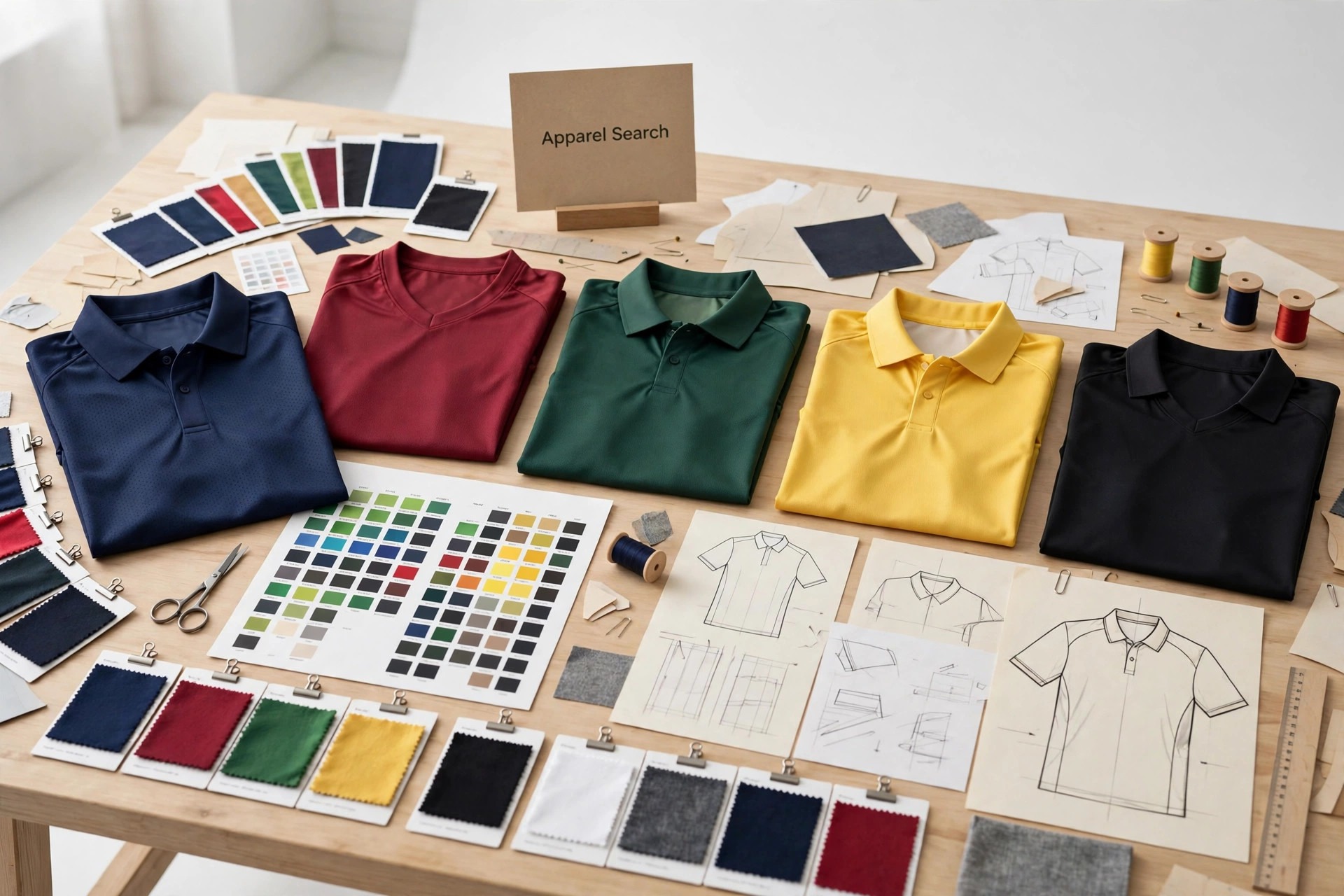
Illustrative image created for this guide by Apparel Search designers — sample jerseys are shown without team logos, sponsor logos or manufacturer marks.
Cricket Kit Design & Manufacturers
Cricket kit design has the strangest brief in sport: one wardrobe must not change for a hundred years, and the other must change every season. The white clothing of Test cricket is a protected tradition, altered only in fabric technology. The coloured jersey of one-day, T20 and franchise cricket is a fashion product — designed two years ahead, launched with a campaign, and judged by supporters like a collection. This guide explains how the coloured kit arrived, who designs and manufactures the modern jerseys, and the rules that shape what a cricket shirt can look like.
From Whites to Pyjamas: How Colour Arrived
For its first century and a half, cricket had no kit design in the modern sense. Players wore whites; distinction came from a cap, a blazer, a sweater's braid. The revolution was commercial and televisual: in 1977 the Australian media owner Kerry Packer, shut out of broadcast rights, launched World Series Cricket with the world's best players — playing day-night matches, with a white ball, in coloured clothing. The WSC teams wore pastel pink, yellow, blue and green kits that traditionalists derided as 'pyjamas'.
The mockery did not survive the ratings. Coloured clothing made teams instantly distinguishable on television, made shirts saleable to supporters, and made the limited-overs game a distinct product. Through the 1980s the colours spread through one-day cricket, and at the 1992 World Cup in Australia and New Zealand the transformation completed itself: every team in a designed coloured kit, player names and squad numbers on the backs for the first time, under floodlights. Every cricket jersey since — every IPL launch, every World Cup shirt — descends from that tournament.
The Modern Design Cycle
A modern cricket jersey begins life 18 to 24 months before it is worn. The maker's designers work from the team's identity assets — the established colours, which are almost never negotiable, the board or franchise marks, and the sponsor inventory — and develop a design language for the season: a pattern drawn from the city or the country's textiles, a gradient, a sash, a retro reference. Samples are produced for the board or franchise, adjusted for broadcast (colours are tested under floodlights and on screen), and signed off long before supporters see a thread of it.
The cycles then diverge. IPL franchises treat the kit as an annual collection: a launch event, a reveal video, a new design each season, with special one-off jerseys for causes — Royal Challengers Bengaluru's green jersey for sustainability awareness and Rajasthan Royals' all-pink kit are the famous examples. National teams move more slowly: a coloured kit typically serves a two-year cycle anchored to an ICC tournament, and a World Cup shirt is expected to become a keepsake, which pushes designers toward the classic end of each team's identity.
Who Makes the Kits
Cricket's maker landscape is more varied than football's. The global giants hold flagship contracts: adidas makes India's kits under a deal running from 2023, ASICS has dressed Australia for well over a decade, Castore took over England's kits in 2022, and Nike, New Balance and Puma have all held major national contracts in the modern era — Nike's long tenure with India (2006-2020) defined the sky-blue shirt for a generation of supporters.
Below that tier, regional and local makers are a structural part of cricket clothing: Sri Lanka's kits are made by the Sri Lankan company Moose Clothing; South Africa moved from Lotto to Macron in 2025; Pakistan and Bangladesh have frequently been supplied by domestic manufacturers working under licence from their boards; the West Indies has worked with Macron. In the IPL, the ten franchises sign individual apparel deals, and the cast rotates — global brands and Indian sportswear companies alike, changing as contracts expire. Our team guides in this section name each side's current maker with its season label, and say so plainly where a deal is reported rather than announced.
Sponsors, Numbers and the Rules of the Shirt
A cricket shirt carries more commercial furniture than it once did, and where it sits is regulated. In bilateral internationals, the front of the shirt belongs to the team's lead sponsor, the sleeves carry secondary sponsors, and the maker's mark sits on the chest or sleeve. At ICC tournaments the rules tighten: the event's own branding takes set positions, the front sponsor changes or shrinks, and the same team can look noticeably different at a World Cup from the series either side of it — one reason tournament shirts are collected separately.
Names and numbers, universal since 1992 in coloured cricket, reached Test cricket only in 2019, when the World Test Championship added names and numbers to the back of white shirts — a change debated like a constitutional amendment, and now simply part of the game. Numbers in franchise cricket are the player's own, kept across seasons, which is why an IPL jersey with a star's name and number is the default supporter purchase.
Fabric and Function
Under the design, the modern jersey is a technical garment: lightweight polyester or polyester-elastane with moisture-wicking finishes, mesh ventilation panels mapped to the body's heat zones, and prints applied by sublimation — the design is dyed into the fabric, which is why coloured cricket shirts can carry all-over patterns that whites never could. Player versions are cut slim and weigh very little; the priority is a full day's fielding in heat, in the IPL's April-May furnace or a Caribbean afternoon.
The whites moved the other way: the cut and colour stayed traditional while the cloth modernised — today's Test shirt is a technical polo in off-white, the sweater a lighter knit than its cable-knit ancestor, trousers a tailored performance fabric rather than flannel. It is the sport's design philosophy in one contrast: in the coloured game, technology shows; in the white game, it hides.
Shopping for a Cricket Jersey?
Replica jerseys and team training wear for most of the teams in this section are sold through Amazon. The Apparel Search Amazon guide keeps the shopping links in one place.
Shop on Amazon via the Apparel Search GuideThis link opens the Apparel Search shopping guide for Amazon, where the product links are kept in one place.
Common Questions
When did cricket teams start wearing coloured kits?
Coloured clothing arrived with Kerry Packer's World Series Cricket in 1977-79, spread through one-day cricket in the 1980s, and became universal at the 1992 World Cup — the first played entirely in colour, with names and numbers on the shirts.
Who makes the Indian cricket team's kit?
Adidas has made India's kits since 2023, succeeding Nike's long tenure (2006-2020) and a short interim period. The sky-blue limited-overs jersey and the white Test kit both come under the same deal.
Why do tournament jerseys look different from series jerseys?
ICC tournament regulations reserve set positions on the shirt for the event's own branding and restrict the size and placement of team sponsors, so the same team's World Cup shirt carries a different sponsor layout from its bilateral-series shirt.
Related Reading
Search Apparel Search