Tent stitch is a small, diagonal embroidery stitch that crosses over the intersection of one horizontal (weft) and one vertical (warp) thread of needlepoint canvas, forming a slanted stitch at a 45-degree angle. It is also known as needlepoint stitch and is one of the most basic and versatile stitches used in needlepoint and other canvas work embroidery. When worked on fine weave canvas over a single warp and weft thread it is known as petit point. Tent stitch has three variants, basketweave, Continental and half cross, all producing the same appearance on the front of the canvas.
|
Tent stitch is a small, diagonal embroidery stitch
that crosses over the intersection of one horizontal (weft) and one vertical
(warp) thread of needlepoint canvas forming a slanted stitch at a 45-degree
angle. It is also known as Needlepoint stitch and is one of the most basic
and versatile stitches used in Needlepoint and other Canvas work embroidery.
When worked on fine weave canvas over a single warp and weft thread it is
known as Petit point in contrast to stitches, such as Gobelin, worked over
multiple warp and/or weft threads. "Petit point" comes from the French language,
meaning "small point".
Tent stitch variants
Basketweave tent stitch Continental tent stitch
Half cross tent stitch There are three types of tent stitch, all producing
the same appearance on the front of the canvas but each worked in a slightly
different way and having particular characteristics, uses, benefits and
drawbacks. These variants of tent stitch are known as basketweave, continental
and half cross tent stitches:[
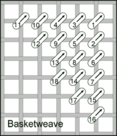
- Basketweave tent stitch
The basketweave form of tent stitch is worked in diagonal
rows up and down the canvas. The yarn on the back of the
canvas has a typical basketweave appearance, with alternating
horizontal and vertical stitches. Basketweave is the best
stitch to use for covering large areas of canvas as it does
not distort the canvas as the other two forms of tent stitch
do.
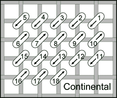
- Continental tent stitch
Continental stitch is worked horizontally or vertically
across the canvas. On the back of the work, the stitches
appear diagonally across two threads. This method uses more
yarn than half cross stitch tent stitch but is more hardwearing.
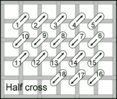
- Half cross tent stitch
Half cross stitch is worked horizontally or vertically across
the canvas. On the back of the work, the stitch appears
vertical or horizontal, not diagonal, and crosses only one
thread. This method uses less yarn than other stitches but
is not very durable as coverage on the back of the canvas
is a little thin.
References: Fasset, Kaffe Glorious Needlepoint 1987
London,Century Hutchinson ISBN 0-7126-3041-4
|
The Default Stitch of Needlepoint
If needlepoint has a default setting, it is tent stitch. One diagonal stitch over one canvas intersection sounds too small to build a craft on, but multiplied across a canvas it produces a dense, even, durable fabric of thread that can render a painted design almost stitch for stitch, each tent stitch acting as one pixel of the picture. Its 45-degree slant matches the diagonal of the canvas mesh, so the stitch sits naturally in the grid, and because every stitch is identical, the stitcher's whole attention can go to colour changes and counting, which is why tent stitch is the stitch in which printed and painted canvases are usually designed to be worked.
The three variants differ behind the work. Basketweave tent stitch is worked in diagonal rows up and down the canvas, and the yarn on the back forms a woven basketweave pattern of alternating horizontal and vertical stitches. It is the best stitch for covering large areas of canvas because it does not distort the canvas as the other two forms do; the alternating directions balance the pull that a field of identical diagonal stitches otherwise exerts, skewing the canvas into a parallelogram that must later be blocked back to square. Continental tent stitch is worked horizontally or vertically across the canvas; on the back the stitches appear diagonally across two threads, it uses more yarn than half cross but is more hardwearing, and its consistent diagonal back makes it strong for outlines and single lines. Half cross tent stitch is also worked in rows, but on the back the stitch appears vertical or horizontal, crossing only one thread; it uses the least yarn, but coverage on the back is thin and the stitch is not very durable, so it suits areas under little stress or threads that must be stretched economically.
Choosing and Using the Variants
Experienced needlepointers combine the variants within one piece without the front of the work showing any join: basketweave for backgrounds and large shapes, Continental for details, lettering and areas needing strength, half cross where yarn is short or a lighter coverage is acceptable. All three demand the same discipline of tension: stitches snug enough to cover the canvas intersection completely, never so tight that the canvas mesh is dragged out of true. Worked on fine weave canvas over a single thread, tent stitch becomes petit point, the miniature needlepoint of purses, jewellery and dollhouse textiles, where hundreds of stitches per square inch resolve into shaded, painting-like detail.
Tent stitch's modesty is its strength. Decorative needlepoint stitches such as brick stitch and Parisian stitch supply texture and pattern, but tent stitch supplies coverage, precision and a neutral ground against which those textures read. A needlepoint design can be worked entirely in tent stitch and lose nothing essential, while no other single stitch can make that claim, which is why it is fairly called one of the most basic and versatile stitches in canvas work.
Common QuestionsWhat is tent stitch?Tent stitch is a small, diagonal embroidery stitch crossing over the intersection of one horizontal and one vertical thread of needlepoint canvas, forming a slanted stitch at a 45-degree angle. It is one of the most basic and versatile needlepoint stitches. What are the three variants of tent stitch?The variants are basketweave, Continental and half cross tent stitch. All produce the same appearance on the front of the canvas but are worked differently, with different yarn use, durability and effects on the canvas. What is petit point?Petit point, from the French for small point, is tent stitch worked on fine weave canvas over a single warp and weft thread, producing very fine needlepoint, in contrast to stitches worked over multiple threads such as Gobelin. |