Knit Fabric
Knit fabric is built from interlocking loops of yarn, and that one idea produces everything from a T-shirt to a lace. This guide explains weft and warp knitting and introduces the main knit families and their uses.
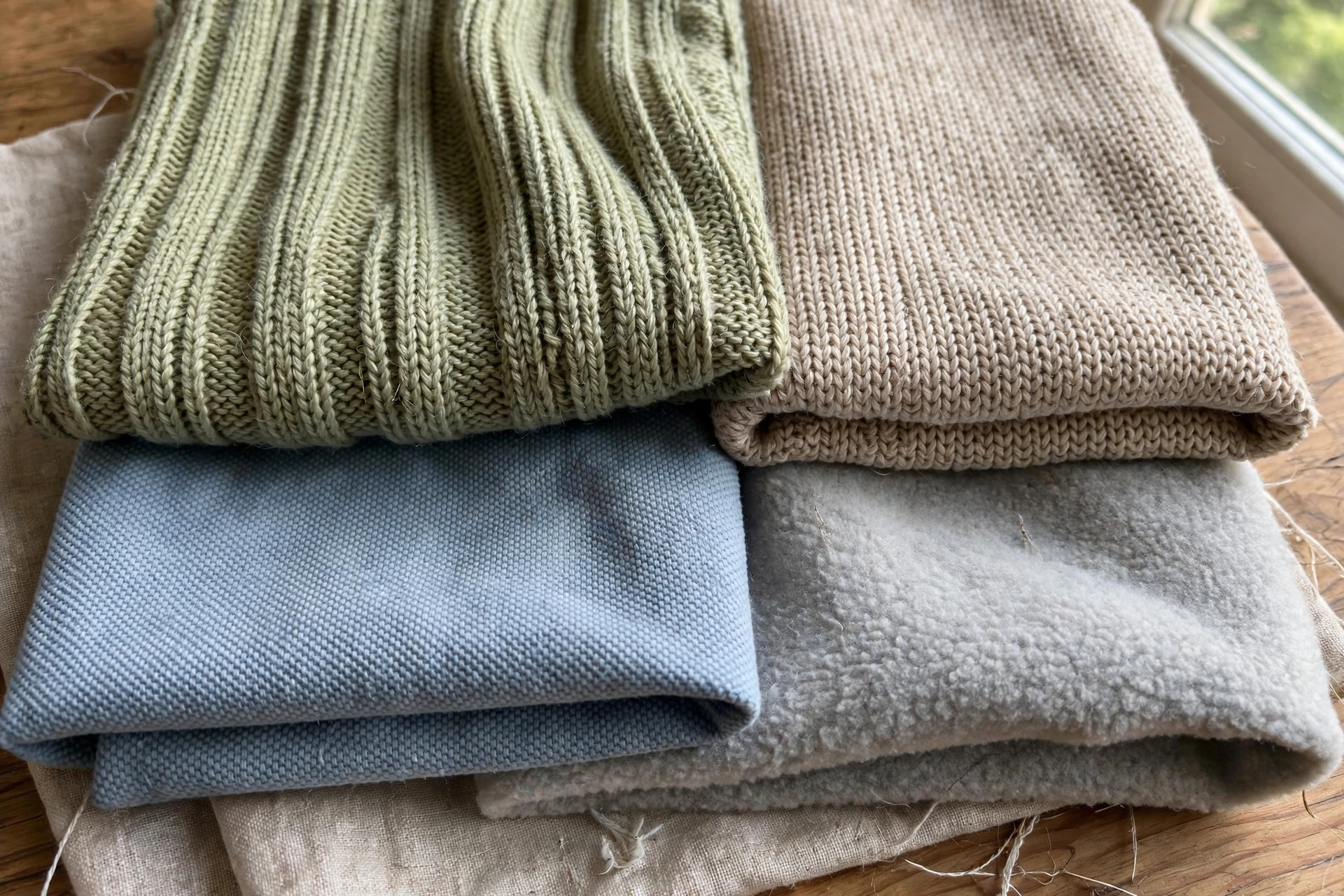
How Loops Become Cloth
Knitting creates fabric by forming yarn into loops and pulling new loops through old ones, row upon interlocking row. The vertical columns of loops are called wales and the horizontal rows are called courses, and together they give knitted cloth its defining behavior: it stretches, recovers, drapes softly, resists wrinkling and feels comfortable against skin because the loops themselves can change shape. A woven fabric, built from two sets of straight yarns crossing at right angles, simply cannot move the way a loop structure moves.
That loop structure also explains the cautions that travel with knits. A broken yarn can let a column of loops ladder downward, edges can curl where the loop tension is unbalanced, and a garment can grow in length under its own weight if the yarn and construction are too yielding. None of this makes knits inferior; it makes construction choice important. For more depth, see the Apparel Search knitting definition and its knitting history, both worth reading alongside this overview.
Weft Knitting and Warp Knitting
Weft knitting builds the fabric one course at a time from yarn running across the width, the same principle as hand knitting, mechanized on circular and flat machines. It produces the apparel staples: single jersey for tees, rib for cuffs and neckbands, interlock for smooth double-faced garments, pique for polo shirts, and brushed fleece for sweatshirts. Weft knits generally offer the most stretch and the softest drape in the knit world, and circular machines make them quickly and economically in tubular or open-width form.
Warp knitting works differently: many yarns, each on its own guide, form loops simultaneously along the length of the fabric. The results, tricot and raschel being the best-known families, are more dimensionally stable, resist laddering, and hold their width, which is why warp knits dominate lingerie, swimwear linings, athletic mesh, lace, nets and technical textiles. Raschel machines can also build elaborate lace and power-net structures. When a fabric must stretch but not grow, or must stay open and airy without falling apart, warp knitting is usually the answer the industry reaches for.
The Main Knit Families at a Glance
Single jersey is the lightest common apparel knit, different on its two faces and happy to curl, covered in depth in the jersey section of this guide. Rib knits alternate raised columns on both faces, giving strong crosswise stretch and recovery for bands, cuffs and whole fitted garments. Interlock is a double knit that looks similar on both sides, lies flat, and gives a smoother, more substantial hand than jersey at the same fiber. Pique builds a textured, waffle-like surface that breathes well, which is why polo shirts adopted it generations ago.
Beyond those four, fleece knits add a brushed or looped back for warmth, from sweatshirt French terry to deep-pile polar fleece. Ponte, or double-faced roma knits, give structured dresses and pants a firm, low-curl body. Tricot brings a fine, smooth warp knit to linings and lingerie, while mesh and net knits open the structure for sportswear and veiling. Sweater knits, made on flat machines in gauges from chunky to fine, cover cardigans, pullovers and knitted dresses, where the garment is often shaped during knitting itself rather than cut from flat cloth.
Choosing a Knit for a Job
Choose by behavior first and name second. Decide how much stretch the garment needs and in which direction, whether it must recover sharply at cuffs and waistbands, how much drape the design assumes, and what the surface should look like. Then match the family: jersey or interlock for soft tees and tops, rib where grip matters, pique for breathable collared shirts, fleece where warmth is the point, tricot where a stable, smooth layer must not ladder, and a ponte where a knit needs to behave almost like a woven in a tailored silhouette.
Knitting sits inside a full production chain, as the Malaysian Knitting Manufacturers Association shows: founded in 1975, it represents spinners, knitters, printers, dyers, finishers and garment makers in one national body. Cotton industry material on knit manufacturing likewise follows cotton from field to fabric. Whether you buy through the mills, wholesalers or stores gathered in this section, start from the construction your garment needs, then find the supplier whose machines and fibers deliver exactly that construction well.
More to Explore
References & Further Reading
Looking for Fabric Mills and Suppliers?
Continue into the wider Apparel Search fabric section for woven and specialty cloth, or use the Fabric Search hub to move to another fabric family and its suppliers.