Knit Fabric Mills
Knit mills build fabric loop by loop, and their machine parks decide which cloths they make well. This guide explains mill specialisms, from circular jersey to warp knits and pile fabrics, and how to match one to your program.
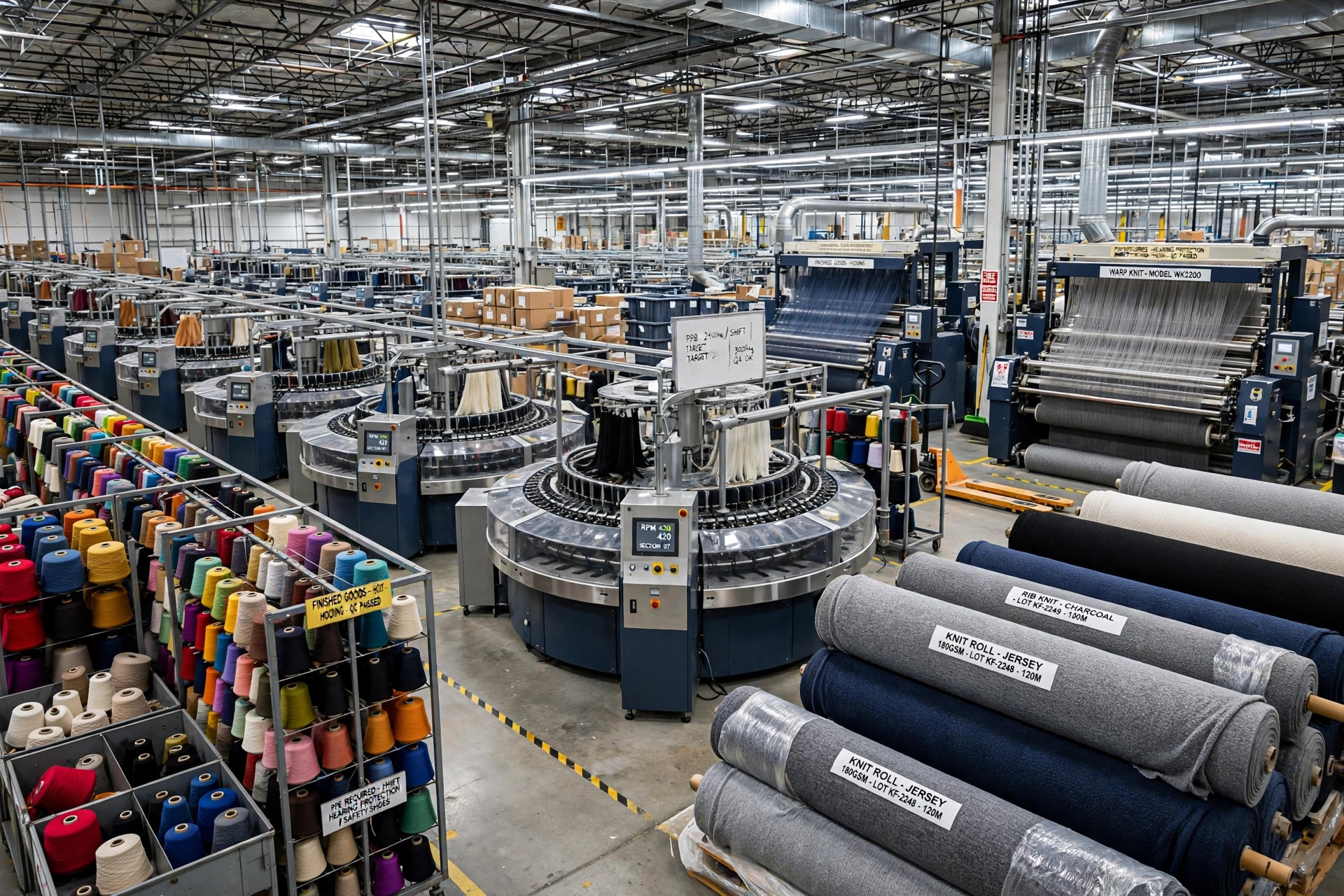
A Mill Is Its Machine Park
Knitting forms fabric by intermeshing loops of yarn, and the machinery sets the boundaries of what a mill can offer. Circular machines produce tubular or open-width weft knits such as jersey, rib, interlock, pique and fleece at high speed. Flat and warp knitting equipment produces tricot, raschel lace and mesh, and technical structures that circular machines cannot. When a mill lists its machinery honestly, by maker and type, it is handing you a map of its real capabilities, and the listings below reward that kind of reading.
Two examples make the point. Ganapathi Chettiar's knitting division is equipped with German Terrot and Mayer and Cie machines and Japanese Fukuhara machines to produce high-class knitted fabrics, alongside a yarn supply business dating to 1948. Gehring Textiles, founded in 1946, built its name the other way, as a manufacturer of warp knit fabrics for apparel, home goods, sporting goods, medicine and industrial uses, vertically integrated with its own dyeing and knitting mills. Same industry, different machine parks, different orders each should win.
Specialisms Hidden in the Listings
Read across the listings and distinct trades emerge. Artex Knitting Mills, a family business knitting in the United States since 1926, represents the long-lived domestic knitter. Ahill Fabric Center in Tirupur, established in 1973, offered finished knitted fabrics in any design, construction, color and finish from one place, serving garment exporters and innerwear makers. JMV Textiles, formed in 1971, grew from a first circular knitting machine into a fiber-to-finished-garments operation. Shaoxing Tianyuan Knitting specialized in polyester weft knits such as polar fleece, pique, interlock and ponte roma, supported by its own polyester yarn machines.
Other mills stake out material or product niches. China Bambro Textile built its business on bamboo fiber, yarn and knitted fabric as a biodegradable, natural material. Monterey Mills became a premier supplier of knitted pile fabric, serving paint roller, apparel, toy and many other end uses, a reminder that knits include raised pile surfaces as well as flat garment cloth. Jong Stit Knitting makes synthetic knitted fabrics at a capacity of 1,500 tons a month on hundreds of jacquard and modern machines, with spinning, knitting, dyeing and finishing integrated. Each description tells you which enquiries belong there and which do not.
Working With a Knit Mill
A productive mill enquiry names the construction, fiber, yarn count if you know it, finished weight, width, color quantity and end use. Mills think in kilograms and production runs, and they will ask about your garment market because a knit for childrens sleepwear carries flame and hand requirements that a knit for adult fashion tops does not. Expect lab dips for color approval, a strike-off for prints, and a bulk sample for final confirmation, and respect the sequence: approving bulk against anything less than a production-representative sample is how shade and shrinkage disputes are born.
Also ask how the mill handles the known weaknesses of knits. Spirality control, shrinkage limits after washing, pilling performance and colorfastness to washing, water and rubbing are standard quality conversations, and a professional mill answers with test methods and tolerances rather than adjectives. If your order will ship internationally, confirm packing form, roll length consistency and documentation early. Readers looking for domestic production can turn to the United States fabric mills section of Apparel Search, and keeping a domestic option priced alongside import quotes remains sound practice.
Choosing Between Good Mills
When several mills can knit your fabric, the decision turns on fit rather than superlatives. Consider communication speed and clarity, willingness to develop a small first order, the stability of their yarn sourcing, and whether their other customers make products like yours. A mill whose floor is set for fleece will run your fleece efficiently and your fine-gauge interlock reluctantly; the reverse is equally true. Place the trial where the machinery, fiber experience and end-use record all point the same way, and the trial usually confirms the choice.
Keep records as you would for any production partner: approved standards, test reports, delivery performance and claim handling, season by season. Knit supply is a relationship business because the fabric itself is variable, a living loop structure that responds to yarn lots, machine settings and finishing in ways woven cloth does not. The mills listed here, from a 1926 American family mill to high-volume Asian exporters, span that whole world. Your task is not to find a perfect mill, but to find the mill whose strengths line up with the cloth you actually need to ship.
Knit Fabric Mills in This Directory
The listings below present knit mills from long-established American and Indian mills to high-volume exporters, each with a short description of what it knits. A related India fashion resource appears in the references.
Ahill Fabric Center
Tirupur knitted fabric manufacturer, supplier and exporter established in 1973, offering finished knitted fabrics in any design, construction, color and finish from one place.
Artex Knitting Mills
Family-owned United States knitting mill operating since 1926, continuing a long tradition of American-made knitted products including headwear.
Attiva India
Mumbai company founded in 1970 and later a manufacturer and supplier of warp knit fabric, gym wear and sportswear, with roots as agents for yarn, fiber and silk suppliers.
China Bambro Textile Co., Ltd.
Large-scale supplier established in 2000 focused on bamboo fiber, yarn and textiles, specializing in research, development and application of eco-focused bamboo material.
Bamboo Knit Fabric
The bamboo knit fabric page of China Bambro Textile, covering its bamboo fiber knitted fabrics within its wider bamboo fiber, yarn, top and filament range.
Ganapathi Chettiar
Business conceptualized in 1948 as yarn suppliers and depot holders for well-known mills, with a knitting division using Terrot, Mayer and Cie and Fukuhara machinery for high-class knitted fabrics.
Gehring Textiles, Inc
Founded as a family business in 1946, a vertically integrated manufacturer of warp knit fabrics for apparel, home goods, sporting goods, medical, industrial and military applications.
JMV Textiles
Formed in 1971 to manufacture circular knitted fabric, growing from its first circular knitting machine in 1972 into a fiber-to-finished-garments operation.
Jong Stit Knitting Co., Ltd
Manufacturer of synthetic knitted fabrics with over 300 jacquard and knitting machines, 1,500 tons monthly capacity, and integrated spinning, knitting, dyeing and finishing.
Long Song Knitting Co.,Ltd
Taiwan knitting company established in 1982, later part of an integrated textile group spanning nylon chip and filament yarn production through to knitting.
Monterey Mills
Premier supplier of knitted pile fabric to the paint roller industry, with product lines spanning apparel, toys, saddle pads, slipper and boot fabrics, hospital pads and pet beds.
Pasupa Textiles
Indian knitted fabric manufacturer and exporter with integrated knitting and garmenting operations, emphasizing range, quality, competitive rates and prompt delivery.
Shaoxing Tianyuan Knitting
Shaoxing knitted fabric manufacturer and exporter started in 2002, specializing in polyester weft knits including polar fleece, pique, interlock, ponte roma, single jersey and rib.
Common Questions
What is the difference between a weft knit mill and a warp knit mill?
Weft knit mills form loops course by course, producing jersey, rib, interlock and fleece on circular or flat machines. Warp knit mills form loops from many yarns at once, producing tricot, raschel, mesh and many technical fabrics that resist runs and hold width well.
Why do knit mills quote in kilograms?
Knitted fabric varies in width and stretches as it is handled, so weight is a more reliable measure of how much yarn and fabric change hands than length alone. Always confirm the finished weight and width together so your yield calculation is real.
How should I trial a new knit mill?
Send a precise specification and your quality standards, approve lab dips and a bulk sample, wash-test the sample, then place a small production order and inspect it fully before scaling up. Machinery claims in a listing are a starting point, not a substitute for that sequence.
More to Explore
References & Further Reading
Looking for Fabric Mills and Suppliers?
Explore mills for every construction in the Apparel Search fabric directory, or return to the Fabric Search hub to compare fabric families side by side.