Jean Paul Gaultier at the Brooklyn Museum
The Fashion World of Jean Paul Gaultier: From the Sidewalk to the Catwalk, Brooklyn Museum, 2013–2014.
Jean Paul Gaultier at the Brooklyn Museum: this page introduces The Fashion World of Jean Paul Gaultier: From the Sidewalk to the Catwalk, the exhibition that brought the work of Paris's enfant terrible to Brooklyn in the winter of 2013–2014. The Fashion World of Jean Paul Gaultier: From the Sidewalk to the Catwalk ran at the Brooklyn Museum from October 25, 2013 to February 23, 2014. It was the first international exhibition devoted to the French couturier, organized by the Montreal Museum of Fine Arts in collaboration with Maison Jean Paul Gaultier, Paris, curated by Thierry-Maxime Loriot of the MMFA, with the Brooklyn presentation coordinated by Lisa Small, the museum's Curator of Exhibitions. Approximately 140 haute couture and prêt-à-porter ensembles — from Gaultier's earliest collections to his most recent — were shown on custom mannequins, many with interactive faces created by high-definition audiovisual projections, alongside accessories, sketches, stage costumes, film excerpts, and documentation of runway shows, concerts and dance performances.
The photo pages in this set — linked in the exhibition navigation on this page — record the visit gallery by gallery, and the museum and exhibition links in the references lead to the Brooklyn Museum's own presentation of the show. Jean Paul Gaultier, born in Arcueil, France, on April 24, 1952, presented his first collection in 1976 and became known as the enfant terrible of Paris fashion: Breton sailor stripes, corsets worn as outerwear, skirts for men, and the cone bra he designed for Madonna's 1990 Blond Ambition tour are his enduring signatures. He was creative director of Hermès from 2003 to 2010, retired from ready-to-wear in 2014, and closed his couture house with a final show in 2020.
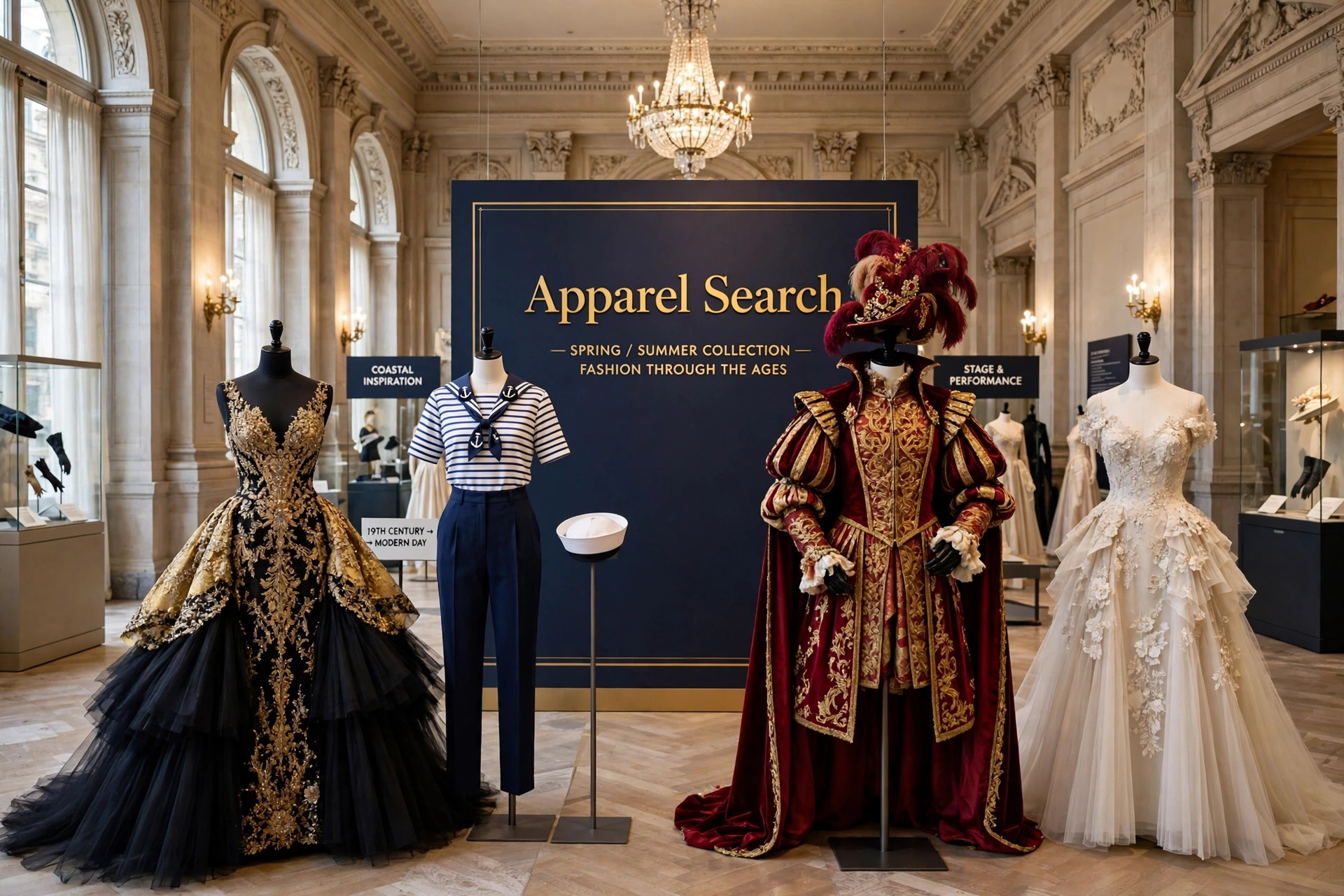
Illustrative image created for this guide — an artistic impression, not this designer's own garments.
Seven Themes, From the Sidewalk to the Catwalk
The exhibition was organized around seven themes tracing the influences on Gaultier's development — from the streets of Paris to the cinema — since he emerged as a designer in the 1970s. That structure is the exhibition's argument: the sailor stripes come from the street and the French navy alike; the corsetry comes from his grandmother's closet by way of the boudoir and the stage; the tailoring comes from London and Paris at once. Walking the themes in order is walking the influences in the order the designer absorbed them.
Alongside the ensembles, the galleries carried the evidence around the clothes: accessories, sketches, stage costumes, excerpts from films, and documentation of runway shows, concerts and dance performances, as well as photographs by fashion photographers and contemporary artists who stepped into Gaultier's world. The avant-garde designs challenge societal, gender and aesthetic codes in unexpected ways — in the museum's calm galleries, with the clothes standing still, that challenge reads more clearly than it ever could at runway speed.
The Talking Mannequins
The exhibition's signature device was its mannequins. Many of the approximately 140 ensembles were displayed on custom mannequins with interactive faces created by high-definition audiovisual projections: the figures appeared to speak, sing, smile and address the visitor directly. The effect turned a retrospective into a performance — appropriate for a designer whose clothes were always half costume — and it is the detail visitors remembered longest.
The photo pages that follow this introduction were taken at the museum during the Brooklyn run. They follow the galleries page by page: use the exhibition navigation to move through the set in order, or go straight to any page from the links on this page. The designer's main guide pages — collections, runway, profiles and the rest of his series in this guide — are linked in the references.
Photos

Common Questions
What was the Jean Paul Gaultier exhibition at the Brooklyn Museum?
The Fashion World of Jean Paul Gaultier: From the Sidewalk to the Catwalk, shown from October 25, 2013 to February 23, 2014 — the first international exhibition devoted to Gaultier, with approximately 140 haute couture and prêt-à-porter ensembles.
Who organized the Gaultier exhibition?
It was organized by the Montreal Museum of Fine Arts in collaboration with Maison Jean Paul Gaultier, Paris, curated by Thierry-Maxime Loriot of the MMFA; the Brooklyn presentation was coordinated by Lisa Small, Curator of Exhibitions at the Brooklyn Museum.
What made the exhibition's mannequins unusual?
Many ensembles were displayed on custom mannequins with interactive faces created by high-definition audiovisual projections — the mannequins appeared to speak, sing and address the visitor, a first for a fashion exhibition of this scale.