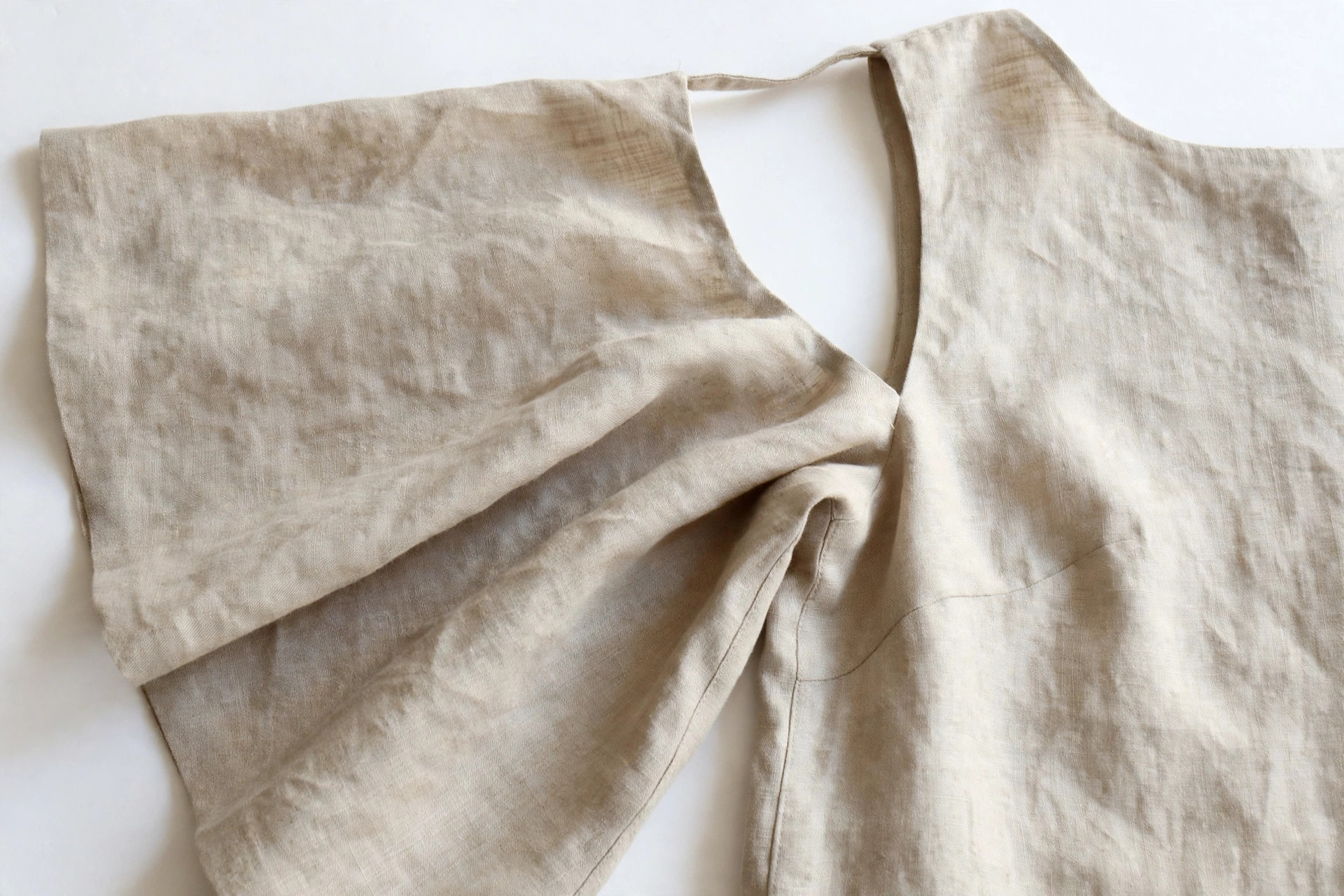
A dolman sleeve is a sleeve cut in one piece with the front and back of the garment — there is no separate sleeve piece and no armhole seam. The sleeve is very wide and deep at the armhole, with a great deal of fabric under the arm, and it narrows toward the wrist. The name comes from the dolman, a Turkish robe and later a military jacket, whose loose construction the sleeve copies.
No Armhole Seam — the Whole Point
In a dolman construction the pattern pieces extend from the centre of the garment straight out to the wrist cuff. The deep underarm fullness forms a soft drape or 'wing' when the arm is lowered and stretches out when the arm is raised. The closely related batwing sleeve exaggerates the same idea with an even deeper, drapier underarm that hangs like a bat's wing. Dolman sleeves suit soft, fluid fabrics and knitwear, where the excess folds fall gracefully; in stiff fabrics the underarm bulk can overwhelm the wearer.
The cut uses fabric generously across the width of the cloth, and the underarm is often reinforced with a small gusset or strengthened seam because the one-piece construction puts the strain there.
Wearing Dolman Sleeves
- The silhouette is wide through the body and sleeves and narrow at the wrist and hem — balance it with slim trousers or a skirt.
- Dolmans are a staple of relaxed knitwear, batwing tops, and caftan-style dresses.
- Raising the arms lifts the whole garment hem — a known dolman trait worth checking when trying one on.
FAQs
- What is the difference between a dolman sleeve and a batwing sleeve?
- They are the same family and the terms overlap. A batwing is the more extreme version — deeper and drapier under the arm; dolman is the general construction name.
- Why does a dolman sleeve have no armhole seam?
- Because the sleeve and bodice are cut as one piece of fabric. The absence of the seam is what creates the deep, draped underarm.
- Are dolman sleeves flattering?
- They give an easy, draped upper body and suit soft fabrics; the volume is at the underarm and shoulder, so fitted bottoms balance the look.
Detailed Guides: see Dolman Sleeve in the glossary A–Z listing of the Apparel Search fashion glossary for related terms.