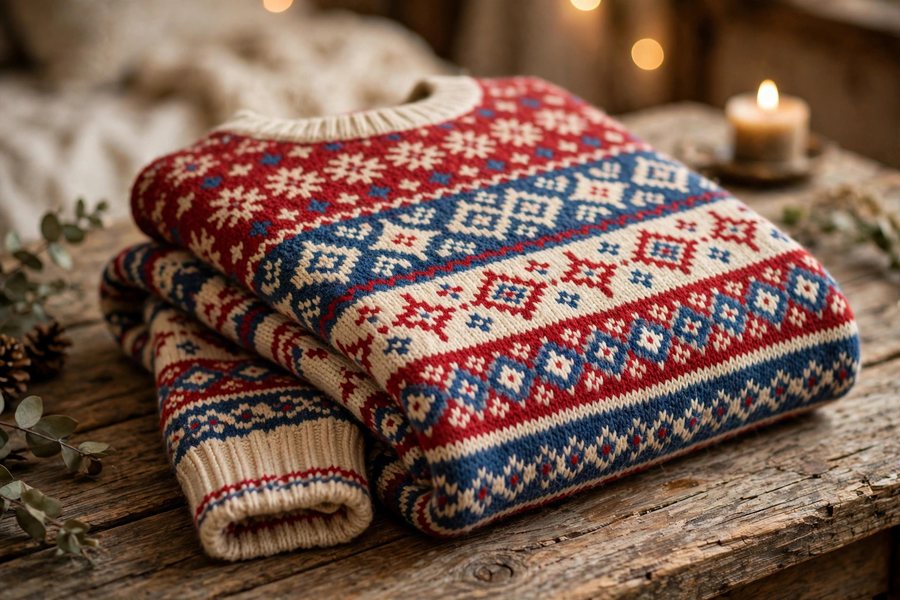
Fair Isle is a traditional stranded colorwork knitting technique originating in Fair Isle, a tiny island in the Shetlands of Scotland. Worked with two colors per row, it creates distinctive bands of geometric motifs — diamonds, crosses, and the famous oxo patterns — in a kaleidoscope of colors. Today the term covers both the technique and any knitwear decorated in its unmistakable style.
The Origins of Fair Isle Knitting
Fair Isle knitting developed on the remote Shetland island of Fair Isle, where knitters used the technique to create warm, durable garments from local wool. The style likely absorbed influences from Baltic and Scandinavian traders whose ships passed through Shetland waters. By the early 20th century, Fair Isle sweaters had caught the eye of British royalty — the Prince of Wales wore one publicly in 1921, launching the pattern into mainstream fashion.
Traditional Fair Isle uses only two colors in any single row, carried as floats across the back of the work. This constraint is the secret of its harmony: complex-looking patterns emerge from simple two-color rows stacked in careful sequences.
Recognizing True Fair Isle Pattern
Authentic Fair Isle is built from small repeating geometric motifs arranged in horizontal bands. Look for the signature oxo (x-and-o) rows, peerie patterns of tiny dots and diamonds, and larger star or tree motifs separated by narrow patterned borders. The palette traditionally drew from natural dyes — madder reds, indigo blues, undyed browns and creams — though modern versions use every color imaginable.
Many mass-market sweaters borrow the look without the technique, printing Fair Isle-style patterns onto jersey. True stranded knitting has visible floats on the inside and a double-thick, extra-warm fabric.
Wearing Fair Isle Today
Fair Isle shines in autumn and winter, when its cozy associations feel most at home. A classic crew-neck Fair Isle sweater pairs with dark denim or cords for an easy weekend look; a Fair Isle vest layers neatly over an oxford shirt. Keep the rest of the outfit simple — the pattern is the statement.
Care matters: hand-wash wool Fair Isle in cool water and dry flat to keep the colorwork crisp. For a festive twist, see our guide to the ugly Christmas sweater, Fair Isle's bolder holiday cousin.
FAQs
- What is the difference between Fair Isle and intarsia?
- Fair Isle carries both yarns across the entire row, creating floats on the wrong side; intarsia uses separate yarn supplies for each color block, leaving no floats. Fair Isle suits small repeating motifs, intarsia suits large single pictures.
- Is Fair Isle always made of wool?
- Traditionally yes — Shetland wool gives the classic look and warmth. Modern Fair Isle-style knits also come in cotton, acrylic, and cashmere blends, which are softer but less authentic in texture.
- Why is it called Fair Isle if similar knitting exists elsewhere?
- The technique resembles Scandinavian and Baltic stranded knitting, but the distinctive banded geometric style became associated with the island of Fair Isle after its sweaters gained fame in the 1920s.
Detailed Guides: see Fair Isle Knitwear in the F section of the Apparel Search fashion glossary for related terms.